Showing posts with label Xinjiang. Show all posts

Monday, October 25, 2021

Mongolia | Life & Death of the Ja Lama #18

Who was Dambijantsan?

A Buddhist monk; a freedom fighter for Mongolian independence; the descendant of Amursanaa (1723–1757), the Western Mongol who led the last great uprising against the Qing Dynasty of China; the incarnation of Mahakala, the Buddhist god of war; bandit, torturer, murderer, or evil incarnate? During his lifetime no one was sure who he really was, and even today the controversy about his life continues.

Born in what is now the Republic of Kalmykia, part of the Russian Federation, Dambijantsen traveled throughout Tibet, India, and China before arriving in Mongolia in 1890 where he tossed gold coins to bystanders and announced to one and all that he had come to free Mongolia from the yoke of the Qing Dynasty of China. After disappearing almost twenty years he returned to lead the attack on Khovd City, the last Chinese outpost in Mongolia. Honored by the Eighth Bogd Gegeen, the theocratic leader of Mongolia, for his efforts in achieving Mongolian independence, he went on to establish his own mini-state in western Mongolia, which he hoped to use as a base for establishing a Mongol-led Buddhist khanate in Inner Asia. His dictatorial nature and unbridled sadism soon came to the fore and he was finally arrested and imprisoned in Russia. After the Russian Revolution he returned to Mongolia, gathered new followers around him, and established a stronghold at the nexus of old caravan routes in Gansu Province, China. He robbed caravans, grew opium, and once again dreamed of creating a new Mongolian khanate in Inner Asia. Finally the new Bolshevik government in Mongolia, fearful of his rising power, issued orders for his assassination. Dambijantsan died in 1922, but in Mongolia legends persist to this day that his spirit still rides on the wind of the Gobi and continues to haunt his former lairs.
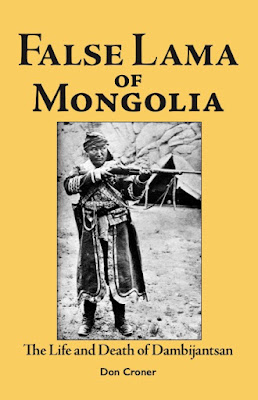

For more on Dambijantsan see False Lama of Mongolia: The Life and Death of Dambijantsan


Wednesday, January 20, 2010

Mongolia | Dönön Ükhiin Ever Khöldöne | Killer Winter

The Fourth of the Nine-Nines, known as Dönön Ükhiin Ever Khöldöne—Time When Four Year-Old Cows’ Horns Freeze—began on Monday, January 18. This is supposed to be the coldest of the Nine-Nines, periods of nine days each, each period marked by some description of winter weather. On Monday, however, it was an incredibly balmy 14ºF / Minus 10ºC at three in the afternoon, probably the highest temperature of 2010. This morning things are back to normal:  Minus 33°F / -36 °C at 6:00 a.m.

This is turning out to be a Killer Winter. The UB Post:
Official figures indicate that approximately 90 percent of the country is suffering from zud  conditions, with snowfall reaching between 20-120 centimeters. The average temperature in northern Mongolia has dropped to -35 degrees Celsius, with temperatures in the rest of country ranging between-17 to -22 degrees Celsius. So far, the coldest temperature of -47 degrees was recorded in Uvs Province. As of 16 January 2010, a total of 198 sums in 19 provinces are suffering from severe weather.

According to estimates by the Emergency Management Agency (NEMA), a total of 786,639 heads of livestock have perished, 89 percent of which belong to the ten worst affected provinces. The total loss of livestock is approximately 17 per cent of the estimated 43.6 million heads of livestock in the country. Some five people died during a recent snowstorm.
Xinjiang Province of China, just south of western Mongolia, has also been hammered, According to the NYT:
Closed roads and delayed flights left thousands of travelers stranded Tuesday following blizzards and extreme cold that killed four people and affected 1.6 million others in northwestern China, a government spokesman said. Snowstorms delayed 122 flights in Urumqi, capital of Xinjiang region, on Monday, leaving more than 4,000 passengers stranded, and blocked roads from nine avalanches stranded more than 1,000 passengers in the region, according to a Urumqi government spokesman surnamed Wang. Like many Chinese officials he declined to give his full name. Four people had died because of the bad weather, Wang said Tuesday. He did not give details.Rescue workers were evacuating thousands of rural residents to safer ground at lower altitudes because of the latest storm front, expected to last through Wednesday and plunge temperatures to minus 45 degrees (minus 43 Celsius), Wang said.

In neighboring Mongolia, an official appealed for help from the international community as his country battles the most severe winter it has seen in three decades.
I have several friends in Urumqi but I have not heard from any of them for months, since internet access Remains Cut Off to Xinjiang following the Upheavals there last July. The last I heard all internet cafes were closed and all common email services like hotmail.com were blocked.

Tuesday, July 7, 2009

China | Xinjiang | Urumqi

Update: Death Toll Rises to 156 in Ethnic Clashes in Western China. The riots have now spread to Khotan. Update #2: Internet service has now been cut to Xinjiang: China Locks Down Restive Region After Deadly Clashes.

My favorite city in China, Urumqi, is experiencing serious problems. See Riots Erupt in Western China Amid Ethnic Tension. Haven’t heard from any of my friends there yet. They are usually very hesitant to communicate by email, which they are convinced is monitored by the government. Urumqi is the capital of Xinjiang, which I used to visit quite frequently. Given the difficulty of acquiring Chinese visas here in the Big Buuz I doubt if I will be going back any time soon.

Downtown Urumqi

Uighur Market District in Urumqi

Uighur Carpet dealer in downtown Urumqi

Pomegranates in the Uighur Market

Thursday, December 25, 2008

Mongolia | Life & Death of the False Lama #14

Who was Dambijantsan?

A Buddhist monk; a freedom fighter for Mongolian independence; the descendant of Amursanaa (1723–1757), the Western Mongol who led the last great uprising against the Qing Dynasty of China; the incarnation of Mahakala, the Buddhist god of war; bandit, torturer, murderer, or evil incarnate? During his lifetime no one was sure who he really was, and even today the controversy about his life continues.

Born in what is now the Republic of Kalmykia, part of the Russian Federation, Dambijantsen traveled throughout Tibet, India, and China before arriving in Mongolia in 1890 where he tossed gold coins to bystanders and announced to one and all that he had come to free Mongolia from the yoke of the Qing Dynasty of China. After disappearing almost twenty years he returned to lead the attack on Khovd City, the last Chinese outpost in Mongolia. Honored by the Eighth Bogd Gegeen, the theocratic leader of Mongolia, for his efforts in achieving Mongolian independence, he went on to establish his own mini-state in western Mongolia, which he hoped to use as a base for establishing a Mongol-led Buddhist khanate in Inner Asia. His dictatorial nature and unbridled sadism soon came to the fore and he was finally arrested and imprisoned in Russia. After the Russian Revolution he returned to Mongolia, gathered new followers around him, and established a stronghold at the nexus of old caravan routes in Gansu Province, China. He robbed caravans, grew opium, and once again dreamed of creating a new Mongolian khanate in Inner Asia. Finally the new Bolshevik government in Mongolia, fearful of his rising power, issued orders for his assassination. Dambijantsan died in 1922, but in Mongolia legends persist to this day that his spirit still rides on the wind of the Gobi and continues to haunt his former lairs.


For more on Dambijantsan see False Lama of Mongolia: The Life and Death of Dambijantsan


Tuesday, December 23, 2008

Mongolia | Life & Death of Dambijantsan, the False Lama

Who was Dambijantsan?

A Buddhist monk; a freedom fighter for Mongolian independence; the descendant of Amursanaa (1723–1757), the Western Mongol who led the last great uprising against the Qing Dynasty of China; the incarnation of Mahakala, the Buddhist god of war; bandit, torturer, murderer, or evil incarnate? During his lifetime no one was sure who he really was, and even today the controversy about his life continues.

Born in what is now the Republic of Kalmykia, part of the Russian Federation, Dambijantsen traveled throughout Tibet, India, and China before arriving in Mongolia in 1890 where he tossed gold coins to bystanders and announced to one and all that he had come to free Mongolia from the yoke of the Qing Dynasty of China. After disappearing almost twenty years he returned to lead the attack on Khovd City, the last Chinese outpost in Mongolia. Honored by the Eighth Bogd Gegeen, the theocratic leader of Mongolia, for his efforts in achieving Mongolian independence, he went on to establish his own mini-state in western Mongolia, which he hoped to use as a base for establishing a Mongol-led Buddhist khanate in Inner Asia. His dictatorial nature and unbridled sadism soon came to the fore and he was finally arrested and imprisoned in Russia. After the Russian Revolution he returned to Mongolia, gathered new followers around him, and established a stronghold at the nexus of old caravan routes in Gansu Province, China. He robbed caravans, grew opium, and once again dreamed of creating a new Mongolian khanate in Inner Asia. Finally the new Bolshevik government in Mongolia, fearful of his rising power, issued orders for his assassination. Dambijantsan died in 1922, but in Mongolia legends persist to this day that his spirit still rides on the wind of the Gobi and continues to haunt his former lairs.


For more on Dambijantsan see False Lama of Mongolia: The Life and Death of Dambijantsan


Saturday, December 13, 2008

China | Xinjiang | Yuezhi Potheads

Earlier I wrote about the Yuezhi Who lived in the Ili Basin in western Xinjiang and the Turpan Basin. While in Turpan I visited the ruins of the ancient city of Jiaohe and the nearby Yueshi graves dating to over 2000 years ago.
Yuezhi Graves

Yuezhi Graves

Yuezhi Graves

Yuezhi Graves

Now comes word that the Yuezhi (or Gushi as they are sometimes called) of Turpan were Proto-Hippy Potheads. According to CNN:
An ancient race that lived 2,700 years ago in the Gobi Desert may have been among the first to use cannabis for medical or religious purposes. Researchers believe an ancient Gushi [Yueshi] shaman may have consumed or burned pot for medical or religious purposes. Nearly two pounds of the plant was found stashed in the tomb of a Gushi shaman. It was high in the chemical compounds that provide its psychoactive properties.  
"It had evidence of the chemical attributes of cannabis used as a drug," said Dr. Ethan Russo, an author of a study published in the Journal of Experimental Botany. "It could have been for pain control. It could have been for other medicinal properties. It could have been used as an aid to divination." 
The Gushi people were a Caucasian race with light hair and blue eyes who likely migrated thousands of years ago from the steppes of Russia to what is now China. A nomadic people, they were accomplished horsemen and archers. Chinese archaeologists excavating a network of 2,500 tombs near the town of Turpan in the Xinjiang-Uighur Autonomous Region unearthed the shaman's grave, which contained the cannabis, along with a trove of artifacts such as bridles, archery equipment and a rare harp.
Since archery equipment and pot were found together these people may have been the distant ancestors of Ted Nugent. The harp was no doubt a precursor of the electric guitar.

Friday, December 12, 2008

Mongolia | The Life & Death of the False Lama #11

Who was Dambijantsan?

A Buddhist monk; a freedom fighter for Mongolian independence; the descendant of Amursanaa (1723–1757), the Western Mongol who led the last great uprising against the Qing Dynasty of China; the incarnation of Mahakala, the Buddhist god of war; bandit, torturer, murderer, or evil incarnate? During his lifetime no one was sure who he really was, and even today the controversy about his life continues.

Born in what is now the Republic of Kalmykia, part of the Russian Federation, Dambijantsen traveled throughout Tibet, India, and China before arriving in Mongolia in 1890 where he tossed gold coins to bystanders and announced to one and all that he had come to free Mongolia from the yoke of the Qing Dynasty of China. After disappearing almost twenty years he returned to lead the attack on Khovd City, the last Chinese outpost in Mongolia. Honored by the Eighth Bogd Gegeen, the theocratic leader of Mongolia, for his efforts in achieving Mongolian independence, he went on to establish his own mini-state in western Mongolia, which he hoped to use as a base for establishing a Mongol-led Buddhist khanate in Inner Asia. His dictatorial nature and unbridled sadism soon came to the fore and he was finally arrested and imprisoned in Russia. After the Russian Revolution he returned to Mongolia, gathered new followers around him, and established a stronghold at the nexus of old caravan routes in Gansu Province, China. He robbed caravans, grew opium, and once again dreamed of creating a new Mongolian khanate in Inner Asia. Finally the new Bolshevik government in Mongolia, fearful of his rising power, issued orders for his assassination. Dambijantsan died in 1922, but in Mongolia legends persist to this day that his spirit still rides on the wind of the Gobi and continues to haunt his former lairs.


For more on Dambijantsan see False Lama of Mongolia: The Life and Death of Dambijantsan


Sunday, November 30, 2008

Mongolia | Life & Death of the False Lama #9

Who was Dambijantsan?

A Buddhist monk; a freedom fighter for Mongolian independence; the descendant of Amursanaa (1723–1757), the Western Mongol who led the last great uprising against the Qing Dynasty of China; the incarnation of Mahakala, the Buddhist god of war; bandit, torturer, murderer, or evil incarnate? During his lifetime no one was sure who he really was, and even today the controversy about his life continues.

Born in what is now the Republic of Kalmykia, part of the Russian Federation, Dambijantsen traveled throughout Tibet, India, and China before arriving in Mongolia in 1890 where he tossed gold coins to bystanders and announced to one and all that he had come to free Mongolia from the yoke of the Qing Dynasty of China. After disappearing almost twenty years he returned to lead the attack on Khovd City, the last Chinese outpost in Mongolia. Honored by the Eighth Bogd Gegeen, the theocratic leader of Mongolia, for his efforts in achieving Mongolian independence, he went on to establish his own mini-state in western Mongolia, which he hoped to use as a base for establishing a Mongol-led Buddhist khanate in Inner Asia. His dictatorial nature and unbridled sadism soon came to the fore and he was finally arrested and imprisoned in Russia. After the Russian Revolution he returned to Mongolia, gathered new followers around him, and established a stronghold at the nexus of old caravan routes in Gansu Province, China. He robbed caravans, grew opium, and once again dreamed of creating a new Mongolian khanate in Inner Asia. Finally the new Bolshevik government in Mongolia, fearful of his rising power, issued orders for his assassination. Dambijantsan died in 1922, but in Mongolia legends persist to this day that his spirit still rides on the wind of the Gobi and continues to haunt his former lairs.


For more on Dambijantsan see False Lama of Mongolia: The Life and Death of Dambijantsan


Friday, August 8, 2008

China | Xinjiang Province | Urumqi

Urumqi, in Xinjiang Province, China, has long been one of my favorite cities. Thus it is sad to read this news on the first day of Olympics in Beijing:
Xinjiang's capital, Urumqi, appeared to be on high alert today. Security guards were checking bags at the entrances of hotels, department stores and discos in the busy city, where office towers and apartments buildings have been shooting up in recent years. Guards with red arm bands rode on most public buses, watchful for attackers. Small groups of police patrolled the sidewalks of the bustling Muslim quarter, where merchants cooked lamb kebabs and sliced up watermelons at fruit stands.
Downtown Urumqi

Hong Shan (Red Mountain) in downtown Urumqi

Uighur Quarter in Urumqi

The famous Erdaoqiao Market in the Uighur Quarter

Uighur Restaurant

Performers in Uighur Restaurant

Uighur Carpet Store

Sample carpets

Pomegranates

Saturday, January 6, 2007

China | Xinjiang Province | Turpan | Jiaohe

Back in Turpan after my Berlin interlude I wandered six miles west of the city to the ruins of the ancient city Jiaohe.

Tuesday, December 26, 2006

China | Xinjiang | Turpan | Toyuq

About another twenty miles east of Bezeklik is the small oasis of Toyuq, located right on the edge of the Taklamakan Desert. The hills around here are riddled with caves which once served as Buddhist hermitages and monastic complexes. Unfortunately these caves are now closed to the public. Since the late fourteenth century the area has been Islamic and is now a favorite pilgrimage site for Moslems from all over Central Asia. Toyuk is known as “Little Mecca,” and a pilgrimage here is considered “half as sacred” as a pilgrimage to Mecca itself. Pilgrims who come here can count themselves as “half-hadji” (pilgrim to Mecca). The oasis is also famous for its elongated white grapes, known as Mare’s Nipple Grapes, which are highly valued as far away as Beijing.
Oasis of Toyuq on the northern edge of the Flaming Mountains
Incredibly lush oasis land surrounded by bleak desert
The Emerald-domed Mosque is the center of “Little Mecca.”
Main Mosque in Toyuq

China | Xinjiang | Turpan | Bezeklik

From Gaochang I mosied up to the nearby Bezeklik Grottos, located in the gorge of the Murtuk River, which flows through the Flaming Mountains. Here there are seventy-some caves dating from the fourth to thirteen centuries. At one time the caves were filled with one of the most staggering collections of Buddhist wall paintings in Central Asia and perhaps the world. Moslem iconoclasts, who arrived in the area in the late fourteen-century, damaged some of the paintings; Western archeologists, including Aurel Stein and Von Le Coq, removed many of the remaining paintings at the beginning of the twentieth century; and what was left was almost completely destroyed by the Mao’s Little Generals, the Red Guards, during the Cultural Revolution in the late 1960s and early 1970s. Although a dozen or so of the caves are now open to the public almost no of the original artwork, with the exception of some barely visible 1000 Buddhas motifs on the ceiling of one or two of the caves, has survived in situ. Many examples of the wall paintings, “stolen” by Western archeologists such as “the thief Stein” and others—as information signs at the complex are now quick to point out, can however be seen in museums in London, Berlin, and St. Petersburg. See Foreign Devils on the Silk Road: The Search for the Lost Cities and Treasures of Chinese Central Asia for the sordid details on Stein, Le Coq, et. al.

Given the fact that nearby Gaochang is often posited as a possible location of the history Shambhala, it is interesting to speculate the Kalachakra Tantra was composed here or at the many Buddhist monastic complexes tucked away in the adjacent mountains. However, the art work produced here was entirely lacking in any Vajrayana influences, leading one to believe that tantric Buddhism was not practised in this area.
The gorge of the Murtuk River, flowing through the Flaming Mountains. The cave complex is just above here.
The caves were dug into cliffs along the bank of the Murtuk River.
More views of Bezeklik:
Uighur women at Bezeklik
Near where the Murtuk River debouches onto the desert floor is another cave complex known as Shenjinkou, just visible above the curve of the river. This area is now closed to the public.

Monday, December 25, 2006

China | Xinjiang Province | Gaochang | Shambhala

From Turpan I proceeded about 20 miles east to the ruins of the city of Gaochang, the southern capital of the ancient kingdom of Khocho. Shambhalists have long considered Khocho one of the main candidates for the historical kingdom of Shambhala where the Kalachakra was first composed and taught. Scholar of Indic religions Sir Charles Eliot opined as early as 1921 that, “This country [Shambhala] is seen only through a haze of myth: it may have been in India or it may have been somewhere in Central Asia, where Buddhism mingled with Turkish ideas.” In 1949 Tibetologist-Shambhalist Giuseppe Tucci (Tibetan Painted Scrolls) noted:
It is evidently a pious tale, without the least historical foundation, that the Kalacakra “the wheel of time”, was revealed by the Buddha twelve months after his enlightenment in the mc’od rten at Dhanyakataka, which for the occasion, became dilated until it assumed the proportions of the universe, symbolized by every stupa. The scholar who is said to have given a literary form of this revelation was Zla ba bzan po [Suchandra, First King of Shambhala], an incarnation of P'yag na rdo rje, who put the Buddha's words into writing, and having gone back to his country, Sambhala, and built there a stupa in honour of the Kalacakra, taught his people its secrets. But everything leads us to think that there is much truth in the rest of the narrative; according to it in Sambhala, placed by tradition near the river Sita, (viz. Tarim) many generations of kings succeeded one another and ruled wisely, handing down the secret teaching of the Kalacakra, until their power was weakened by a raid of the Kla klo, coming from Me k'a (Mecca), i.e. the Moslem invasion.
The eminent Shambhalist John Newman also weights in on this issue:
The primary texts of the Kalachakra system came into around the beginning of the 11th century . . . so Shambhala must have existed at that time. The Vimalaprabha (See Ornament of Stainless Light: An Exposition of the Kalachakra Tantra and Kalacakratantra: The Chapter On The Individual Together With The Vimalaprabha) tells us that Shambhala is on a latitude north of Tibet, Khotan, and China, Furthermore, the Vimalaprabha says again and again that Shambhala is north of Sita River. The descriptions of the Chinese traveler, Hsuan tsang [Xuanzang] (7th century) and the Tibetan traveler, Man lungs Guru (13th century), both clearly identify the Sita as the Tarim River in Eastern Turkestan. Thus, “Sambhala” [sic] must be a special name for the Uighur kingdom centered at Khocho that flourished circa 850-1250.
The Uighurs of course originated in Mongolia, where they had their capital at Khar Balgas, in what is now Övörkhangai Aimag. When they migrated en masse to Xinjiang circa 840 a.d. they set up a northern capital at Beshbaliq, on the northern side of the Tian Shan Mountains, and a southern capital on the southern side at Gaochang.

Ur-Shambhalist Edwin Bernbaum (1980) elaborates:
. . . by these criteria, the Uighur Kingdom of Khocho in the Turfan [sic] Depression beneath the Tien Shan Mountains stands out as one most likely places to have been Shambhala. In accordance with the Tibetan guidebooks to Shambhala, Turfan lies north of the Sita, which most Western scholars have identified as the Tarim River. Established by the Uighurs, a Turkish people, around A.D. 850, the kingdom of Khocho flourished for four hundred years as a remarkable oasis of culture and learning. A predominately Buddhist country with numerous monasteries, it also had active centers of Manicheism and Nestorian Christianity—two of the three religions with the greatest influence on the Kalachakra. Although few Muslims lived in the Kingdom itself, Islam was certainly familiar as a new and aggressive religion that was supplanting Buddhism elsewhere in Central Asia.

At the time the Kalachakra appeared in India, the kingdom of Khocho probably possessed the most advanced civilization and the highest standard of living of any country in Central Asia. Well-irrigated fields and orchards produced enough surplus food to allow the Uighurs to run welfare programs for the poor. Living together in peaceful harmony, people of different races, religions and languages stimulated each other”s thoughts and culture. Paintings found in the ruins of Turfan show houses built in the Chinese style, men and women dressed in embroidered silk, and a chamber emsemble complete with harps, guitar, and flutes. Even the Chinese, the most fastidious connoisseurs of culture, were impressed the grace of Uighur society. In Turfan we [see] how a number of religions coexisted in an enlightened kingdom that survived for several hundred years; perhaps a group of dedicated mystics founded a similar, but smaller, community where they went on to extract the underlying wisdom of these religious traditions.
In his 2001 edition of The Way to Shambhala: A Search for the Mythical Kingdom Beyond the Himalayas Bernbaum writes that he finally visited Khocho in 1984: “. . . I managed to travel to the heart of Central Asia, to the region most likely to have inspired the myth of Shambhala. There, in the Turfan Depression of western China, at the foot of the Tien Shan mountains, I visited the ruins of the ancient kingdom of Khocho or Gaochang, the most likely prototype for the hidden city itself. Gazing at the extensive walls spreading around me toward the distant mountains, I felt as thought I had come to a place of particular significance on my own journey exploring the many facets of the myth of Shambhala.”

The Indefatigably Peripatetic Pilgrim Xuanzang visited pre-Uighur Gaochang in 629 or 630, at the beginning of his sixteen-year sojourn from China to India and back, when the city was ruled by the half-Chinese king Qu Wentai. The powerful potentate and the pious pilgrim fast became bosom buddies, so much so that Qu Wentai eventually insisted that Xuanzang give up his wandering ways and remain in Gaochang. After Xuanzang staged a three-day hunger strike he was finally allowed to continue on to India, where among other places he visited Bodhgaya and Nalanda.
The Inner City Wall at GaochangMain Temple at Gaochang. Zuanzang gave teachings in the courtyard in front of this temple.
Xuanzang also reportedly gave teachings in this hall.
Ruins of building where Xuanzang supposedly lived while at Gaochang
The famous Flaming Mountains just north of Gaochang, mentioned in the Journey to the West, a fictionalized account of Xuanzang’s life.


See More Photos of Gaochang