Showing posts with label Silk Road. Show all posts

Sunday, October 25, 2009

Turkey | Istanbul | Silk Road

Over the years I have wandered to many of the more famous stops on the eastern stretch of the old Silk Road, including its eastern terminus Xian, in Shaanxi Province, China. Continuing westward on the Silk Road I drifted through Lanzhou on the Yellow River, Jiayuguan, the western limit of China during the Ming Dynasty and the end of the Great Wall, and made an obligatory stop at the famous 1000 Buddha Caves at Dunhuang. On the Northern Silk Road, south of the Tian Shan but north of the Taklamakan Desert, I visited the now-tiny oasis town of Toyuk, the famous grape-growing town of Turpan, the nearby Buddhist Caves of Bezeklik and the now-ruined cities of Jiaohe and Gaochang, also known as Khocho), both of which were destroyed during the internecine wars at the beginning of the Mongol Yuan Dynasty, and the old Uighur capital of Beshbaliq, on the north side of the Tian Shan. On the Southern Silk Road, south of the Taklamakan Desert, I swung by Khotan, the ancient Buddhist stronghold, nominal location of the historical Shambhala, and center of the Silk, Carpet, and Jade trades, and also Kashgar, in eastern Xinjiang, at the confluence of the Northern and Southern Silk Roads. I also spent a night at the Tash Rabat Caravanserai in Kyrgyzstan, on the old Silk Road from Kashgar to the Fergana Valley, and much later checked into a Russian caravanserai in the ancient trading port of Astrakhan, a Silk Road terminus on the Volga River at the northern end of the Caspian Sea.

Having visited much of the eastern Silk Road, I naturally wanted to visit Istanbul, arguably the most illustrious of the Silk Road’s western termini. Over the years I had received several invitations to visit Istanbul, the latest from our very own Girl from the Golden Horn, the internationally renowned adventuress, temptress, and provocateur-auteur Gunj, with whom I once did a horse trip to Khargiin Khar Nuur in Mongolia. I had received several dispatches from Gunj over the summer in which Bukhara, Samarkhand, Cholpan Ata, Osh, and several other Central Asia cities and towns were mentioned as recent ports of call. Then came one email that mentioned she was going on some ill-defined mission into the Pamir Mountains. I accused her of searching for the notorious Sarmoung Monastery, which she adamantly denied. She did allow that George Gurdieff’s hangouts in Istanbul still existed, however.

In addition to the city’s status as a Silk Road terminous, I was also intrigued by the suggestion I have heard from several lamas in Ulaan Baatar, including Lama Gombo, that a portal to Shambhala can be found in Istanbul. These current-day assertions may be echos of certain enigmatic passages in The Crystal Mirror, a nineteenth century text by the ethnically Mongolian but Tibetan-named lama Nyima Chokyi Thuken. As you know, Khamariin Khiid in Mongolia is also reputed to be a Portal to Shambhala. (A recently surfaced rumor that yet another Portal to Shambhala can be found in the basement of the Rubin Museum in New York City should be discounted due to the dubious source of the information.)

Then came word that Gunj would be back in Istanbul for the last two weeks of October before returning to her pied á terre in Manhattan, not far from the Strand Book Store. If I wanted to visited Istanbul, I should do so while she was there.

So I booked a flight Ulaan Baatar–Beijing–Hong Kong–Dubai–Istanbul and return. Normally I would have stopped in Beijing and stocked up on Puerh Tea from my favorite tea dealer, the estimable Ms. Na, but now the peckerwoods in the Chinese Embassy here in UB have made it so difficult to get Chinese visas that I no longer bother; I just winged straight on through to Hong Kong. Since I had to transfer to Dragon Air for the flight down to Hong Kong I did get to see for the first time Beijing’s spectacular Terminal #3, opened for the Beijing Olympics in 2008. Mongolian Airlines still flies to old Terminal #2, so I had to take a shuttle bus to Terminal #3. To paraphrase Richard Nixon standing in front of the Great Wall, the “the terminal is really, really great.” Or at least really, really huge. A terminal of a city which has every intention to be the world leader by the middle of this century. And yes, there are Starbucks. More importantly there are “charging stations” for topping off laptops, cell phones, and Kindles, and small free wi-fi islands around at least some of the charging stations, although there does not seem to be free wi-fi terminal wide.

I had an eight-hour layover in Hong Kong, so I took the train to Kowloon, thinking I would spend a few hours just strolling around the city with one eye open for any Puerh Tea buying possibilities. Unfortunately my body had already accustomed itself to late-fall temperatures in Ulaan Baatar—we had had a nice little blizzard a couple of days before I left and there was still a few inches of snow on the ground on the morning of my departure—and I was totally unacclimated to Kowloon’s near tropical temperatures. Within ten minutes of walking I was drenched in sweat. Then a slow drizzle turned into a near deluge. So I caught the subway over to Hong Kong Island and spent a few hours in my favorite bookstore right near the Center Metro Station. Although I had already downloaded fifteen or twenty books onto my Kindle for reading on this trip I could not resist buying hard copies of Butcher and Bolt: Two Hundred Years of Foreign Entanglement in Afghanistan, a rip-roaring account of how Afghanistan has become known as The Graveyard of Empires. The English Empire suffered if not its greatest defeat in Afghanistan then certainly its most ignominious; the Soviet Empire likewise got its butt kicked, and now it is the turn of the USA. And I could not resist picking up a copy of The Blue Manuscript by Sabiha Al Kemir. I am a sucker for books about manuscripts.

Thus fortified with reading material I took the train back out to the airport and caught the 0:35 AM Red-Eye Special to Dubai. I was flying on Emirates Airlines, which has wonderfully new and clean planes with fairly roomy, plushly appointed seats, and exuberantly friendly flight attendants. They announced that among the attendants there were speakers of Arabic, English, Turkish, French, Spanish, Portuguese, and Russian. When they turn out the regular cabin lights there are tiny little light bulbs embedded in the roof which twinkle like stars, so you can imagine you are sleeping out in the desert, in the “Big Tent,” as they say in Mongolia.

Arrived in Dubai’s mammoth but then deserted airport at four in the morning local time. The only place I could find open was a Burger King, so I sat and drank lamentable coffee while reading Lars Brownworth’s Lost to the West: The Forgotten Byzantine Empire on my Kindle. As soon as the sun came up I took a cab down to the Old Town, where I hoped to stock up on Arabian scents in the Perfume Souk. The souks do not open until 9:00 am, but the covered walkways of the Gold Souk were open so I took a bench and sat for two hours watching the passersby. There were no tourists or travelers at this time of the morning. All the people were locals who work in the souks—mostly Pakistanis—and an assortment of local loiterers. I was struck by the number of Chinese who appear to be working here. Are they colonizing Dubai now?

As soon as my favorite scent store opened I bought frankincense and an assortment of essential oils, including musk, rose, jasmine, araic, nooria, amber, and a smattering of others, plus several kinds of aromatic woods which can be burned as incense and some Iranian saffron for culinary purposes. Then I went back to the airport and sipped immense lattes—the cauldron-like cups have handles on either side so you can pick them up with both hands—until my 2:30 PM departure for Istanbul, also on Emirates Airlines.

Planes were stacked up over Istanbul so I was an hour late in arriving. By eight in the evening I was ensconced in a hotel within fifteen minutes walk of the Hagia Sofia, arguably the center of old Istanbul. At nine at the next morning I entered the precincts of the old Church/Mosque.
Hagia Sofia
As you know, Hagia Sofia was built between 532 and 537 A.D. on the orders of the Byzantine Emperor Justinian. For almost a thousand years, until the the completion of the cathedral in Seville, Spain, in 1520, it was the largest church in the world.
Hagia Sofia
In late June, 1203, members of the 4th Crusade, ostensibly bound for the Holy Land, where they hoped to retake Jerusalem from the Moslems, decided to swing by Istanbul—then known as Constantinople—for a little free-lance looting and plunder, this despite the fact that Constantinople was at the time a Christian city, albeit Orthodox and not Catholic, like the western European Crusaders. According to the historian Speros Vryonis:
The Latin soldiery subjected the greatest city in Europe to an indescribable sack. For three days they murdered, raped, looted and destroyed on a scale which even the ancient Vandals and Goths would have found unbelievable. Constantinople had become a veritable museum of ancient and Byzantine art, an emporium of such incredible wealth that the Latins were astounded at the riches they found. Though the Venetians had an appreciation for the art which they discovered (they were themselves semi-Byzantines) and saved much of it, the French and others destroyed indiscriminately, halting to refresh themselves with wine, violation of nuns, and murder of Orthodox clerics. The Crusaders vented their hatred for the Greeks most spectacularly in the desecration of the greatest Church in Christendom. They smashed the silver iconostasis, the icons and the holy books of Hagia Sofia, and seated upon the patriarchal throne a whore who sang coarse songs as they drank wine from the Church's holy vessels. The estrangement of East and West, which had proceeded over the centuries, culminated in the horrible massacre that accompanied the conquest of Constantinople. The Greeks were convinced that even the Turks, had they taken the city, would not have been as cruel as the Latin Christians. The defeat of Byzantium, already in a state of decline, accelerated political degeneration so that the Byzantines eventually became an easy prey to the Turks. The Crusading movement thus resulted, ultimately, in the victory of Islam, a result which was of course the exact opposite of its original intention.
Hagia Sofia
In 1453 the Ottoman Turks, after a lengthy siege described in intriguing detail in the book 1453: The Holy War for Constantinople and the Clash of Islam and the West, captured Constantinople. On Tuesday, May 29, 1453 Sultan Mehmet II entered the city and carrying the sword of the Prophet Mohammed rode his mule straight into Hafia Sofia. Dismounting, he kneeled on the floor and after sprinkling a handful of dust on his head as a sign of humility, announced the victory of Islam over the city and declared that henceforth Hagai Sofia would serve as a mosque. In 1935 Hagia Sofia was turned into a museum and is now visited by thousands, if not tens of thousands, of people a day.
Second Floor Hallway in the Hagia SofiaInterior of the Hagia Sofia
Interior of the Hagia Sofia

Thursday, October 15, 2009

China | Shaanxi | Xian City Wall

While in town to see the Nestorian Stele, I thought I might as well check out the rest of Xian, which as you no doubt know was the eastern terminus of the Silk Road and during the Tang Dynasty probably the largest and most developed city in the world. It is still now probably the last large walled city in the world. The wall surrounding the inner city is a total of 7.3 miles long, forty-nine feet high, and fifty-nine feet wide at the top.
The immense Southern Gate to the city
Just inside the Southern Gate
Stairs lead up to the top of the City Wall
The southern side of the City Wall
The top of the City Wall
The 7.3 mile-long top of the wall provides a nice walking and biking path. Notice the bicycle-built-for-two.
Biker on top of the Wall
Belly button of Biker on top of the Wall
Inside of the east side of the City Wall
Outside of the east side of the City Wall
A green strip and hiking path extends all around the outside of the wall

Path along the outside of the wallOuter rampart of the City Wall

Green strip and park along the outside of the City WallRestored Qing Dynasty houses just inside the City Wall

China | Shaanxi | Xian | Nestorian Stele

I have a big stack of books I have been dipping into, but when my mind wearies and I need a little light reading I turn to The Lost History of Christianity: The Thousand-Year Golden Age of the Church in the Middle East, Africa, and Asia--and How It Died (also Kindle Edition). Although not a Christian myself, I do find the advance of Nestorian Christianity into Asia via the Silk Road fascinating from an historical point of view. A few years ago I wandered down to Xian, the Eastern Terminous of the Silk Road, specifically to see the famous Nestorian Stele on display in the city’s Belian Museum.

Grounds of the Belian Museum
Erected in 781 AD, the stele gives a brief description of the introduction of Nestorian Christianity into China in the 8th Century.

At the top of stele is a Nestorian Cross; beneath the cross is the heading “Memorial of the Propagation in China of the Luminous Religion from Daqin”. Beneath the heading—not really visible in the photo—is The History Itself in 1,756 Chinese characters plus a few lines in the Syriac language.


Christianity, along with Islam, was one of the many imports that trodded eastward on the Silk Road. For more on this see the wonderfully informative Religions of the Silk Road. Also see The Great Mosque in Xian.

Of course there is much else in the Belian Museum, including many swoon-inducing Buddhist art works. Here are just two samples:

A Tang Dynasty Buddha

A Tang Dynasty rendering of Avalokitesvara, the Bodhisattva of Compassion, unearthed in Xian in 1952.

Wednesday, October 14, 2009

Kyrgyzstan | Tash Rabat Caravanserai

Woke up this morning thinking about the Tash Rabat Carvanserai which I had visited seven or eight years ago. I had been dreaming of Lady Ga Ga throughout most of the night, and I guess the inevitable Connection Between Lady Ga Ga and Caravanserais triggered my memories of Tash Rabat. Located in Kyrgyzstan, between the small city of Naryn, on the upper reaches of the Naryn River, one of the sources of the fabled Syr Darya River (the ancient Jaxartes), and Kashgar, in Xinjiang, this is one of best preserved caravan hostels on the entire eastern section of the Silk Road. I stopped overnight here while traveling from Bishkek, the current capital of Kyrgyzstan, to Kashgar. Of course you can no longer stay in the caravanserai itself, but the local Kyrgyz maintain a small wooden guesthouse nearby and there are also several gers available for rent. I stayed in a ger.

Tash Rabat Caravanserai
Although it is a standard sight-seeing stop for most travelers from Bishkek to Kashgar via the Torugart Pass, with many of them staying overnight, very little is known about the history of the caravanseria itself. The local Kyrgyz claim to know nothing, except that it was a standard stop on the old Silk Road. Other sources maintain that the caravanseria was originally a Nestorian Christian monastery or church dating back to the 10th century. The interior layout is indeed in the form of a cross, with a large doomed room at the intersection of the arms and the vertical column. Since there was a Nestorian Bishopric in Kashgar in the 12th century it is not outside the realm of possibility that the Nestorian Christians established an outpost here. (Incidentally, see The Lost History of Christianity: The Thousand-Year Golden Age of the Church in the Middle East, Africa, and Asia--and How It Died (also Kindle Edition) for an utterly fascinating account of Christianity in Asia during the first Millennium. Many people forget that for its first one thousand years Christianity was essentially an Asian religion. Only later did it become identified with the “West”. )

Still other sources maintain that the building was once a Buddhist temple or monastery. Others dismiss both these assertions and claim that the caravanserai was purpose-built in the 14th century. Anyhow, the building measures roughly about 110 feet deep by 100 feet wide, with a wall 18 feet high at the entrance and tapering down to four or five feet at the back. Off the main corridor are numerous rooms, some measuring only 8 by 8 feet, which were apparently used by the more humble travelers. This corridor leads to a large room which served as the lobby, kitchen, and dining room combined. This room is capped by a dome which extends sixty or more feet above the floor. It looks as if there may have been frescos or paintings around the top edge of the dome, but these are now largely obliterated. It was eerily silent here under the dome even during the day when there was a lot of ruckus outside—drunken Kyrgyz brawling with each other, dog fights, etc. Off to the side of this central area were several large bedrooms apparently meant for more affluent travelers.

At one point while I was there full-sized bus arrived with at least forty veiled women on board. I did not see any men except for the two drivers. They went together into the main room under the dome and after all other visitors, including myself, were shooed out, they apparently engaged in prayers or a ceremony of some sort. After or hour or so they came out of the building and immediately boarded the bus and left. The local Kyrgyzs allowed that they were Sufis, but other than that would say nothing about what they were doing there.

A elderly Russian man who claimed he lived about twenty miles down road from the caravanserai and just happened to be passing by could shed no more light on the Sufis, but he did say there was a local legend which maintained that the caravanserai was built over the entrance to a cave which extended for dozen of miles south, with an opening on the other side of the Chinese border. He claimed that in the nineteenth century daring smugglers used the caves to smuggle gold and other compact items into China. Whether there is any truth to this legend I cannot say.

Looking up the valley from Tash Rabat. The old Silk Road went up this valley.

Nowadays the road heads west and then swings around some spurs of the Tian Shan Mountains before reaching the Torugart Pass to the south. In the old days the caravan route went straight up the valley from the caravanserai and over the Tash Rabat Pass through the Tian Shan. This was the last pass before the 12,310-foot Torugart Pass leading to Kashgar and Xinjiang. I hired a horse from the local Kyrgyz and rode up the valley to the 13,018-foot Tash Rabat Pass for a look around. The north side of the pass is quite steep and would have been a trial for heavily-laden horses or camels. I really wanted to ride on to the Torugart Pass, but this of course was impossible. The next day I continued on by jeep to the Chinese border at Torugart Pass and on to the storied Silk Road City of Kashgar.

View south from 13,018-foot Tash Rabat Pass

Sunday, November 30, 2008

Mongolia | Life & Death of the False Lama #9

Who was Dambijantsan?

A Buddhist monk; a freedom fighter for Mongolian independence; the descendant of Amursanaa (1723–1757), the Western Mongol who led the last great uprising against the Qing Dynasty of China; the incarnation of Mahakala, the Buddhist god of war; bandit, torturer, murderer, or evil incarnate? During his lifetime no one was sure who he really was, and even today the controversy about his life continues.

Born in what is now the Republic of Kalmykia, part of the Russian Federation, Dambijantsen traveled throughout Tibet, India, and China before arriving in Mongolia in 1890 where he tossed gold coins to bystanders and announced to one and all that he had come to free Mongolia from the yoke of the Qing Dynasty of China. After disappearing almost twenty years he returned to lead the attack on Khovd City, the last Chinese outpost in Mongolia. Honored by the Eighth Bogd Gegeen, the theocratic leader of Mongolia, for his efforts in achieving Mongolian independence, he went on to establish his own mini-state in western Mongolia, which he hoped to use as a base for establishing a Mongol-led Buddhist khanate in Inner Asia. His dictatorial nature and unbridled sadism soon came to the fore and he was finally arrested and imprisoned in Russia. After the Russian Revolution he returned to Mongolia, gathered new followers around him, and established a stronghold at the nexus of old caravan routes in Gansu Province, China. He robbed caravans, grew opium, and once again dreamed of creating a new Mongolian khanate in Inner Asia. Finally the new Bolshevik government in Mongolia, fearful of his rising power, issued orders for his assassination. Dambijantsan died in 1922, but in Mongolia legends persist to this day that his spirit still rides on the wind of the Gobi and continues to haunt his former lairs.


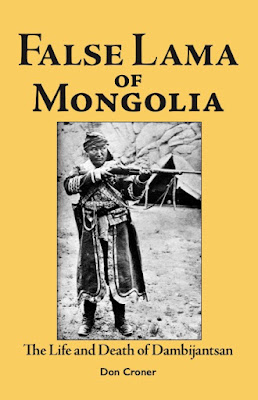
For more on Dambijantsan see False Lama of Mongolia: The Life and Death of Dambijantsan


Monday, January 28, 2008

Mongolia | Ulaan Baatar | Scriptorium

Welcome to the Scriptorium!
One corner of my hovel in the howling wilderness of Zaisan Tolgoi is devoted to my Scriptorium. New Additions to the Scriptorium are made on a monthly and sometimes weekly basis.
One section of my Scriptorium
Just this week there have been four new additions, three fiction and one non-fiction. The first fiction title is Michael Chabon's Gentleman of the Road. I had read Chabon’s first novel The Mysteries of Pittsburgh, which was interesting only because I myself had once lived in Pittsburgh, in the Shadyside District where much of the action takes place, but I had not read anything by him since. But Gentlemen of the Road takes place in 10th-century Khazaria, the Jewish kingdom which then existed on the Steppes Along the Volga River north of the Caspian Sea, and who could resist a setting like that? Later, in the seventeenth century, several tribes of the Oirat, or Western Mongols, including the Torguts and Dörböts, would migrate to this same area north of the Caspian Sea and become known as the Kalymks. The infamous Ja Lama was a Dörbot Kalmyk from this area. The main characters in Chabon’s book are two swindlers and con men, a Jew from Regensburg, in what is now Germany, and a gigantic black Abyssinian from Africa—the title’s Gentlemen of the Road—who get caught up in a scheme to place a Khazar prince on the Khazarian throne. But then it turns out that the Khazar prince is actually a princess! The Gentlemen of the Road should have been tipped off to this when the prince/princess refused to urinate in their presence. Like many con men they could not believe they were being conned. Who could resist a story like this?


Ever since reading The Miniaturist, a tale about a miniature painter in the Indian court of Jalaluddin Muhammad Akbar (جلال الدین محمد اکبر), also known as Akbar the Great (1542 –1605), a distant descendant of Chingis Khan, I have been a big fan of Kunal Basu.

Thus I could hardly resist his book The Opium Clerk, a tale about a Indian clerk working for the East India Company in the late 1800s. Lots of interesting details about the production of opium in India, and some of the action takes place in Canton, where the East India Company unloaded a lot of their opium. On a contemporary note some might say it’s payback time for the Opium Wars, which opened up China to foreign opium, resulting in the addiction of tens of millions of Chinese. Like, who now owns a sizable chunk of Merrill, Lynch and Citibank?

I am also a big fan of Yasmina Khadra, already having read his The Swallows of Kabul, plus The Attack and The Sirens of Baghdad. Yes, I said “his” books, since despite his female pen name the author is a man. Yasmina Khadra (Arabic:ياسمينة خضراء) is the pen name of the Algerian author Mohammed Moulessehoul (born January 10, 1955). Moulessehoul, who was an officer in the Algerian army when he first starting writing, adopted a woman's pseudonym to avoid military censorship. He revealed his true identity in 2001 and now lives in exile in France. So I sprung for one more of his books, In the Name of God, a story about how villagers in Algeria got caught up in fanatical Islamic fundamentalism. Just reading this one—review to follow.

The one non-fiction title added to the Scriptorium this week was The Turks in World History. I stopped by the Silk Road Restaurant the other day and was paging through this book while I had a cup of coffee. On page 12 was an illustration entitled “Nomadic Camp Scene.” The original was done in the fifteenth or sixteenth century somewhere between Herat and Tabriz in what is now Iran. Glancing up from the book I was startled to see a copy of this exact same painting on the wall in front of me. This is just one of the numerous Silk Road-themed reproductions on display at the Silk Road Restaurant. There are also reproductions of the Uighur Princes and Uighur Princesses from the Bezeklik Caves, near Turpan in Xinjiang, China. By the way, the originals of these paintings are now in the Indian Art Museum in Dalhem, on the outskirts of Berlin, Germany. Then on page 42 there is a photo of the Tonyukuk Monuments near Nalaikh, not far from Ulaan Baatar. All and all, this looks to be quite an interesting book. There does seem to be one glaring omission: there is no mention of the Turk Gunj.

Sunday, May 27, 2007

China | Gansu | Dunhuang | Mogao Caves

Wandered out to Dunhuang, in western Gansu Province, for a peek at the Mogao Caves.
An enormous Maitreya Statute takes up the entire inside of this temple. The no-cameras-in-the-caves policy is very strictly enforced here hence no photos.
There are seven or eight hundred caves here—some sources say more than a thousand—but unfortunately only about a dozen are routinely open to the public, and these can only be seen by joining a guided tour—you are not allowed to wander around by yourself. More Information.
These caves downstream from the main complex are not open to the publicUndeveloped cave complex

Sunday, April 22, 2007

China | Gansu Province | Jiayuguan | Lanzhou

Unable to arrange a trip to the Mazong Mountains I booked a berth on the 8:40 pm sleeper train back to Lanzhou. That gave me a free afternoon so I decided to head back to the fort for a more leisurely look around. Arriving at the fort I immediately encountered Ms. Chan in the parking lot. She came bounding over, seemingly overjoyed to see me. Via sign language I indicated that I was going into the fort and would not need a car. She just nodded and smiled.
Ms. Chan
On my earlier trip there had been several hundred visitors to the fort but this was a weekday and the place was nearly deserted. I spend three hours slowly circumnavigating the top of the fortress wall, pausing here and there to daydream about the events which must have taken place here over the last seven centuries.
Inside of fort on a quiet day
When I emerged from the fort in the late afternoon there was Ms. Chan right by the entrance gate. I was going to go back to the hotel, but since she was apparently waiting for me I mentioned in Chinese the name of the so-called Beacon Tower overlooking the Taolai River a couple of miles away. This is one of the standard sights in the area but one I was going to forgo; since Ms. Chan seemed eager however I decided to go have a look. On the way Ms. Chan stopped at a store roadside store and came out with a liter bottle of mineral water for me. When I tried to pay for it she just waved me off.
From the fort the unrestored, pounded earth wall runs due south to the Taolai River
There are several beacon towers in this section, including one right on the cliff overlooking the river.
Taolai River
The day up till now had been warm with a solid dome of cobalt-blue sky overhead. No sooner did we arrive at the river than it very suddenly clouded over and a ferocious wind starting howling out of the north. Then it started snowing, huge snowflakes the size of half dollars driven almost horizontally by the wind. Soon visibility was down to about thirty feet. Ms. Chan laughed uproariously, as if this blizzard in the middle of what had been a warm spring day was the funniest thing she had ever seen in her life. As soon as the snow slowed down a bit we headed back to my hotel. I grabbed my bag and then had Ms. Chan take me to the train station. Despite my protestations she insisted on carrying my bag into the train station and then waited with me until I boarded the train. When the train pulled away she was still on the platform waving. It was a bit of a mystery to me why she was being so solicitous. I am almost tempted to think that she was an emanation of White Tara, the Protectress of Travelers. I even felt a a pang of guilt about not giving her a tip, but I reasoned that Tara would not expect one.

Wednesday, April 18, 2007

China | Gansu Province | Jiayuguan | Great Wall

From Beijing I took one of the morning planes to Lanzhou, on the Yellow River in eastern Gansu, 704 miles to the west, and then caught the afternoon puddle-jumper on to Jiayuguan, 369 miles still farther west.
Lanzhou, on the Yellow River
In Jiayuguan I wanted to check out the possibility of making a trip to the Mazong (Horse’s Mane) Mountains to the north and Gobi Desert beyond.

The bus from the airport was not running—there were only about thirty people on the small plane and most of them seemed to be locals who were met at the airport by acquaintances. I had to take a cab for the six-mile trip into town. The cab driver was a woman in her mid-twenties. She delivered me to the Jiayuguan Hotel on the main city square and insisted on carrying my bag inside. I had read that the Jiayuguan Hotel was a dump and was going to stay there only because it was conveniently located. The accounts must have been written before a recent upgrade. The place now is quite up-scale and all the receptionists and even some of the waitresses in the restaurant speak English. The listed price reflected the upgrade—400 yuan for a standard room; more than the venerable Yong An, where I stay in Beijing—but this price was quickly lowered to 200 yuan when I showed signs of heading for the door. Mid-April is the off-season in Jiayuguan. All the while the cab driver was hovering by my elbow. Speaking through one of the receptionists she then offered to take me the next morning to the two most famous local sights—the westernmost extension of the Great Wall of China and the Jiayuguan Fort, on the western edge of town. A price was arrived at and we agreed to meet at nine the next morning.

There was some kind of settlement here in this wide corridor between the Qilian Mountains to the north and the Mazong Mountains to the north since at least Han times some two thousand years ago. More than a thousand tombs dating from the Wei (220-265) and Western Jin ((265-316) dynasties are scattered around the surrounding desert. During the Ming Dynasty the fort here marked the western limits of the Chinese Empire. The Great Wall, starting far to the east at Shanhaiguan on the Bohai Gulf, ended here, and in 1372 a fort was built to guard the border. The nearby town become knowns as “Jiayuguan,” which means “Barrier of the Pleasant Valley.” The city now has a population of some 115,000. Cement and fertilizer factories dominate the town, and iron ore and coking coal are mined in the nearby mountains. Although nowhere near as famous a tourist attraction as Dunhuang, some five hours by bus to the south, a fair amount of tourists stop by to see the Great Wall, the fort, and a smattering of other local sights. All serous Silk Roadies make an obligatory stop here because of its importance as a way-station on the Silk Road.

The day I arrived it had been very overcast and I was not able to be see much of the surrounding area either on the plane’s approach or on the drive into town. The next morning I was a bit startled when I drew back the curtains and beheld the glacier-capped 18,000 foot-plus Qilian Mountains dominating the entire southern horizon.
Qilian Mountains from Downtown Jaiyuguan
The town itself is at an elevation of 5385 feet. In the foreground to the south were in the much lower buckskin colored Wenshu Mountains. It was these mountains to the south and the Heishan to the immediate north and the Mazong beyond that funneled many of the various caravan routes of the Silk Road through this area. That is why during the Ming Dynasty this place was called “The Greatest Pass Under Heaven.”

The driver was right on time the next morning. Her name is Chan. She is in her late twenties I would say, very thin, with a finely chiseled face. I quickly discovered she did not speak a single word of English. For someone who works with the public she seemed intensely shy—or maybe she was just shy around foreigners. She would glance at me out of the corner of her eyes for a microsecond and than intently stare straight ahead, as if she had seen something she really shouldn't have. Our first stop is the so-called Overhanging Wall section of the Great Wall, 6.2 miles from the hotel on the city square. From the fort, 4.2 miles away, the Wall runs across flat desert and ends at the top of a high hill.
The Overhanging Wall
Beyond here the rugged ridges of the Heishan form a natural barrier. A wall was built here probably as early as the Han Dynasty some 2000 years ago but the current version dates from the Ming Dynasty.
The Overhanging Wall
After the fall of Mongolian Yuan Dynasty in 1368 a Ming army led by General Feng Sheng drove the last of the Mongol armies from the region. The existing wall was upgraded and new sections built in an attempt to prevent any further Mongol incursions. The pounded earth wall from the fort to the Overhanging Wall appears to be more-or-less the original version, but the brick section climbing up the spine of the mountain appears to have undergone extensive restoration.
The Overhanging Wall
Nearby is a newly installed suite of granite statues depicting various travelers, pilgrims, and generals who have filed through Jiayuguan over the ages.
Among the more notable is Lao Tzu, the founder of Taoism, who some sources claim made the first recorded trip through Jiayuguan in the fifth century BC. Lao Tzu was of course the author of record of the Dao De Qing, the seminal text of Taoism. Discouraged that so few people were willing to follow his teachings of The Way he mounted his black buffalo and rode westward. Here at Jiayuguan he left China proper and disappeared into the wilderness beyond and hence into legend. That he was supposedly between 160 and 200 years old when he made the trip brings the historicity of this whole account into question.
Lao Tzu
There is no doubt about the historicity of Xuanzang, the peripatetic pilgrim who passed this way around 630 on his way from Xian in Shaanxi Province to India. I have visited numerous places in Xuanzang’s itinerary, including Lanzhou in eastern Gansu Province; Turpan and Khotan in Xinjiang, Bodhgaya, site of the Buddha’s Enlightenment, nearby Vulture's Peak, where the Buddha taught, and the great Buddhist university of Nalanda, all in India; the Big Goose Pagoda in Xian where the Buddhist texts he brought back from India were stored, and his tomb at Xingjiao Temple near Xian.
Peripatetic Pilgrim Xuanzang with his panier of sutras brought back from India
Near the statue complex is Jiayuguan’s only Buddhist temple, which has recently been restored.
Temple
Nearby is another section of wall which is being restored and is not open to the public. When I expressed a desire to see it Ms. Chan took a dirt road to the base of the mountain and then led me up an extremely steep narrow foot path which ended at an opening in the wall where the workmen gained access. I had to admire her pluckiness. She was wearing street shoes and had to climb several of the steep sections of the trail on her hands and knees.
View of the Overhanging Wall, with Buddhist Temple at bottom left
We climbed onto the top of the wall, where several workmen were repairing the brick steps, and proceeded upwards. Ms. Chan really seemed to be enjoying herself. She whooped and hollered as we climbed higher and new vistas were presented to us.
The charming Ms. Chan taking a breather
I got the impression that she had been on the lower part of the wall where the workman were but had never before climbed to the top.
Climbing to the to Beacon Tower
From the tower we were presented with a sweeping view of the mountains to the north and south and the corridor between them which made this place so strategically important.
The Greatest Pass Under Heaven