Showing posts with label Zanabazar. Show all posts

Tuesday, January 26, 2010

Mongolia | Life of Zanabazar | Second Trip to Tibet

Most traditional accounts do not mention Zanabazar’s trip to Inner Mongolia to met the Dalai Lama in early 1655. Skipping over this episode, they relate instead  that in the summer of 1655 Zanabazar decided to make another trip to Tibet: “. . . I should like to accomplish my pious desire of again making obeisance to the Dalai Lama,” Zanabazar announced, “and especially to the Holy Panchen Vajradhara Lama [Panchen Lama] and hear the initiations and empowerments and so on which I meditated on before.” In preparation for the journey he decided to go into meditation for several months at his newly established retreat of Tövkhon near Erdene Zuu. In the autumn of 1655 he left for Tibet. See Zanabazar’s Second Trip to Tibet.

Also see:


See also Kindle Version


Saturday, January 23, 2010

Mongolia | Ja Lama

Who was Dambijantsan?

A Buddhist monk; a freedom fighter for Mongolian independence; the descendant of Amursanaa (1723–1757), the Western Mongol who led the last great uprising against the Qing Dynasty of China; the incarnation of Mahakala, the Buddhist god of war; bandit, torturer, murderer, or evil incarnate? During his lifetime no one was sure who he really was, and even today the controversy about his life continues.

Born in what is now the Republic of Kalmykia, part of the Russian Federation, Dambijantsen traveled throughout Tibet, India, and China before arriving in Mongolia in 1890 where he tossed gold coins to bystanders and announced to one and all that he had come to free Mongolia from the yoke of the Qing Dynasty of China. After disappearing almost twenty years he returned to lead the attack on Khovd City, the last Chinese outpost in Mongolia. Honored by the Eighth Bogd Gegeen, the theocratic leader of Mongolia, for his efforts in achieving Mongolian independence, he went on to establish his own mini-state in western Mongolia, which he hoped to use as a base for establishing a Mongol-led Buddhist khanate in Inner Asia. His dictatorial nature and unbridled sadism soon came to the fore and he was finally arrested and imprisoned in Russia. After the Russian Revolution he returned to Mongolia, gathered new followers around him, and established a stronghold at the nexus of old caravan routes in Gansu Province, China. He robbed caravans, grew opium, and once again dreamed of creating a new Mongolian khanate in Inner Asia. Finally the new Bolshevik government in Mongolia, fearful of his rising power, issued orders for his assassination. Dambijantsan died in 1922, but in Mongolia legends persist to this day that his spirit still rides on the wind of the Gobi and continues to haunt his former lairs.


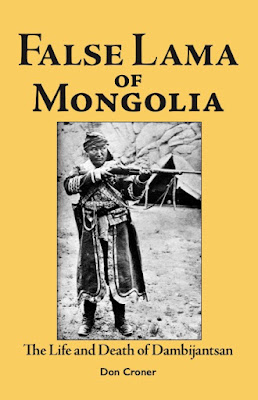
For more on Dambijantsan see False Lama of Mongolia: The Life and Death of Dambijantsan


Thursday, January 21, 2010

Mongolia | Life of Dambijantsan

Who was Dambijantsan?

A Buddhist monk; a freedom fighter for Mongolian independence; the descendant of Amursanaa (1723–1757), the Western Mongol who led the last great uprising against the Qing Dynasty of China; the incarnation of Mahakala, the Buddhist god of war; bandit, torturer, murderer, or evil incarnate? During his lifetime no one was sure who he really was, and even today the controversy about his life continues.

Born in what is now the Republic of Kalmykia, part of the Russian Federation, Dambijantsen traveled throughout Tibet, India, and China before arriving in Mongolia in 1890 where he tossed gold coins to bystanders and announced to one and all that he had come to free Mongolia from the yoke of the Qing Dynasty of China. After disappearing almost twenty years he returned to lead the attack on Khovd City, the last Chinese outpost in Mongolia. Honored by the Eighth Bogd Gegeen, the theocratic leader of Mongolia, for his efforts in achieving Mongolian independence, he went on to establish his own mini-state in western Mongolia, which he hoped to use as a base for establishing a Mongol-led Buddhist khanate in Inner Asia. His dictatorial nature and unbridled sadism soon came to the fore and he was finally arrested and imprisoned in Russia. After the Russian Revolution he returned to Mongolia, gathered new followers around him, and established a stronghold at the nexus of old caravan routes in Gansu Province, China. He robbed caravans, grew opium, and once again dreamed of creating a new Mongolian khanate in Inner Asia. Finally the new Bolshevik government in Mongolia, fearful of his rising power, issued orders for his assassination. Dambijantsan died in 1922, but in Mongolia legends persist to this day that his spirit still rides on the wind of the Gobi and continues to haunt his former lairs.


For more on Dambijantsan see False Lama of Mongolia: The Life and Death of Dambijantsan


Monday, August 17, 2009

Mongolia | Gandan | Dhanyakataka Stupa

Tashchoimphel Temple at Gandan
Wandered by Gandan Monastery and took a peek at the Dhanyakataka Stupa Thangka in the Tashchoimphel Temple. Although Taranatha, Zanabazar’s previous Incarnation (See Incarnations of Javzandamba), wrote extensively about the Kalachakra and translated one of the most famous guidebooks to Shambhala from Sanskrit into Tibetan, Zanabazar Himself, the First Bogd Gegen, apparently showed little if any interest in the teachings. It was the Fourth Bogd Gegeen who first introduced the Duinkhor, or Kalachakra Teachings, into Mongolia in 1801. In 1803 he made a trip to Lhasa and brought back with him a large collection statues and books, including material connected with the Kalachakra. According to ethnologist A. M. Pozdneev, “In 1806 he set up a special datsang for the school of Duinkor [Kalachakra]” and services were performed here in 1807. "In the same year 1807, the Gegen ordered a yum written in gold from Tibet . . . Moreover, being devoted to the task of developing Duinkor, the Gegen decorated the temple of Dachin-kalbain-Sume, gilding its roof, and in its courtyard he established his personal residence.”

He also reportedly commissioned a thangka showing the Dhanyakataka Stupa in southern India where by tradition Shakyamuni Buddha first taught the Kalachakra Tantra to the first King of Shambhala. This is the thangka which can now be seen in the Tashchoimphel Temple.
Thangka of the Dhanyakataka Stupa
Close-up of the thangka showing Buddha emanating as the Kalachakra Deity inside the stupa. It was in this form that he taught the Kalachakra Tantra to Suchandra, the First King of Shambhala.

By tradition the Dhanyakataka Stupa is located at Amaravati, in south India, where the Dalai Lama gave a Kalachakra Initiation in January of 2006.
Ninety-two year-old Lama Gombo (left) was kind enough to point out the Dhanyakataka Thangka to me.

Thursday, July 16, 2009

Mongolia | Natural and Historical Monuments | Saridgiin Khiid

See a new, revised account of Saridgiin Khiid, the monastery founded by Zanabazar and intended to be the center of Buddhism in Mongolia. It was later destroyed by Zanabazar’s arch nemesis Galdan Bolshigt.
Ruins of Saridgiin Khiid

Thursday, May 14, 2009

Russia | Kalmykia | Elista | Telo Tulku Rinpoche

The next morning I have breakfast in the hotel restaurant, which is plush with carpets and still more blonde-wooded furniture. The house breakfast is frugal however; an small omelet, some paper-thin slices of cold cuts and cheese and bread, plus an expresso cup of instant coffee. At the table next to me are four Russian businessman in suits. They order a liter and a half bottle of vodka and consume it with their breakfast. Some things in Mother Russia never change.

The night before Andzha had given me a Russian SIMMs Card for my cell phone and now he calls me. Telo Rinpoche had been in India but he had just arrived yesterday with his teacher, the head of Drepung Gomang Monastery in southern India. At noon there will be a greeting ceremony for the Drepung Tripa, the official title of the lama from India, at the big Altan Süm (Golden Temple), the Rinpoche’ headquarters here in Elista, and the Rinpoche will have a few minutes to speak to me in his office beforehand. Also the monastery’s guest apartment is now ready to be occupied and Andzha will take me there before we go to the Golden Temple.

The apartment is in Microrayon #2, about a mile from the Golden Temple. The building is a Khrushchev-era construction exactly like apartment buildings in Ulaan Baatar from the same era. The builders could have used the same blueprints. Even the doors are the same. I have lived in several of these kinds of apartment buildings in UB so I immediately feel right at home. There’s no furniture but there are a a couple of mattresses propped against one wall. I put one of these on the floor and cover it with a carpet, not a handmade silk carpet like the one I sleep on in Ulaan Baatar but a machine-made woolen carpet from Turkey, but, hey, one can’t have all the comforts of home while traveling. In a corner is a pile of blankets and pillows. The kitchen has a gas stove but there is no hot water.

From here we proceed directly to the Golden Temple. This imposing structure is the largest Buddhist temple in Europe. It was completed only in 2005.

Golden Temple

Andzha drives in the private entrance at the back of the monastery and after taking off our shoes in the first floor entry hall take an elevator to the fourth floor where the Telo Rinpoche has his residence and office. From the elevator we step into a large room which at first glance seems to contain an enormous Buddhist-oriented craps table. But no, it is in fact an immense conference table, seating twenty-four, with a mandala embedded in the middle of it.

Conference Table with Mandala in the middle

Closer view of Mandala. The bottom side of the Mandala is visible in the ceiling of the Main Hall of the Temple.
I have a sudden vision of the 25th King of Shambhala sitting here with his staff, including General Hanuman, the Final Incarnation of the Bogd Gegeen, directing the final battle against the barbarian unbelievers. Andzha adds that the main temple hall is directly below this room, and that the bottom side of the mandala, painted with the same design, can be seen in the ceiling of the hall. All the prayers offered in the main temple ascend through the mandala and concentrate themselves here in this conference room.

The Telo Tulku Rinpoche’s luxurious office, appointed like that of a now disgraced CEO of a Too-Big-to-Fail bank in the USA, is off to one side of this awe-inspiring conference room. The redolence odor of rancid butter, mutton fat, and juniper incense common to monasteries in Mongolia, some of which have not felt a broom since before the fall of the Qing Dynasty, is noticeably absent here.

Telo Tulku Rinpoche

The Telo Rinpoche, the latest in a line of incarnations going back to Mangala, one of the original disciples of the Buddha and including Tilopa, one the 84 Mahasiddis of India, and the last Diluv Khutagt of Mongolia, whose book I have mentioned, greets me warmly. He must meet the Drepung Tripa shortly but he says that afterward he will give me a guided tour of the temple. In the meantime what can he do for me? I tell him that I would like to talk to historians who might know something about Dambijantsan, who was born here in Kalmykia and whose life I am researching, and who like the Rinpoche himself is considered to be, in some circles at least, an incarnation of one the 84 Mahasiddis of India, in Dambijantsans case the mahasiddi known as Güwari. The Rinpoche summons his secretary and instructs her to call one of the local research instittutes and track down any scholars who can shed some light on the up until now shadowy existence of Dambijantsan here in Kalmykia.

Then we take the elevator down to the first floor of the temple and proceed out into the immense main hall. Telo Rinpoche goes out to front gate to meet the Drepung Tripa and I remain behind. A couple hundred people have assembled to greet Drepung Tripa, and many are buying khadags (prayer scarves) from a small shop out front to present to him. Finally a procession of monks lead by Telo Rinpoche proceeds from the front gate to the entrance of the main hall of the temple. The Drepung Tripa, who appears to be in his sixties, comes last, bestowing his blessings on all those who approach him.

Telo Tulku Rinpoche (left) leading the procession into the Temple

The Drepung Tripa blessing people outside the Temple

He is the head of Drepung Gomang Monastery in southern India, which was founded by Tibetans who fled Tibet after the Chinese invasion of 1959 and named after Drepung Monastery in Tibet. Gomang was one of the several colleges at Drepung in Lhasa and the one at which most Mongolians monks who studied in Lhasa attended. Zanabazar, the first Bogd Gegeen of Mongolia, stayed at Gomang during his visits to Mongolia.

Ruins of Gomang College at Drepung in Lhasa

Many other famous Mongolian lamas studied here, including Agvan Dorzhiev, the Buryat who eventually became a tutor to the 13th Dalai and who Accompanied the Dalai Lama to Mongolia in 1904 when the latter fled Tibet after the invasion of the Younghusband Expedition.

Agvan Dorzhiev

Dambijantsan also reportedly attended Gomang College at Drepung in Lhasa. It was here that he allegedly killed his monastic roommate after a quarrel, an act which of course ended his monastic career and put him on the path which would eventually lead him to Mongolia. As George Roerich, in his book Trails to Inmost Asia, notes, “It seems the murder was the crucial point of his life for from then on begins his life as an errant warrior monk, full of wonderful adventures, messianic prophecies, and cruel deeds.”

The Drepung Tripa

The Drepung Tripa mounts the throne in the main hall of the temple and a chanting ceremony begins. After he is served a ceremonial offering of tea and rice people line up to again receive his blessing, after which everyone receives a small portion of rice (Drepung, I might add here, means “Rice Heap”). This greeting ceremony concluded the Drepung Tripa proceeds to the Telo Rinpoche’s office on the fourth floor. The Rinpoche asks me to come with along. At this office he is greeted by a camera crew from a Russian television station. It seems they want an interview with him. “I wanted to give you a tour of the temple,” he said, “But now I must talk to these people. But the monks are going to give the Drepung Tripa a complete tour of the temple, so just tag along with them and you will see everything.” The Drepung Tripa and his group go up to the fifth floor and I follow. The public is normally not allowed above the fourth floor, since the fifth floor contains a huge suite reserved solely for the Dalai Lama should he ever visit Kalmykia again. He has not visited since the temple has been built but there are high hopes he will soon.

At the entrance to the Dalai Lama’s suite on the fifth floor a guard stops me, the only person not in monks’ robes, and says, “Sorry, the public is not allowed up here.” Like a groupie who says, ”I’m with the band,” I said, “I am with the Drepung Tripa.” The guard said, “Oh, excuse me, I am so sorry!” Putting his hand together he bowed and said, “Please, please, go in!”

Sitting Room of the Dalai Lama’s Suite

The suite is immense, with magnificent carpets and sumptuous sofas and chairs. Should the Dalai Lama feel homesick, on one wall there is a painting of the Potala, his former home in Lhasa. I have toured the Dalai Lama’s living quarters in the Potala several times and oddly enough they are preserved just the way he left them, although apparently not in anticipation of his return.

Painting of the Potala in the Dalai Lama’s Suite

On the facing wall is a painting of the Golden Temple. To one side of the sitting room is the Dalai Lama’s bedroom, complete with double bed. Instead of a chocolate, there is a prayer scarf on the pillow.

Dalai Lama’s bed: there’s no chocolate on pillow but there is a prayer scarf

Just off the bedroom is a small study and meditation niche with a mat on the floor and low table. Off to the other side of the sitting room are conference rooms and rooms for the Dalai Lama’s attendants.

Dalai Lama’s Meditation and Study Niche

The sixth floor, which is actually a walkway around the cupola at the top of the temple is also normally closed to the public but of course we get to go up for a look. From here we get a good view at the very modest city of Elista, which ends abruptly less than half a mile away, beyond which treeless steppe stretches off to the horizon. It is windy even here, and even bit cool, but the Drepung Tripa lingers, seeming to enjoy the view from all four sides of the cupola.

View of Elista from the cupola of the Temple

Another view from the cupola

The Drepung Tripa enjoying the view from the cupola

From here we descend back down to the first floor for a tour of the monastery’s Scriptorium, which in additional to a large collection of regular books and Tibetan-language sutras has high speed internet free for the public. The Drepung Tripa asks to see several Tibetan language sutras and lingers over them for awhile.

Drepung Tripa perusing tome in the Scriptorium

I cannot help noticing a display case contaiing a collection of books about the Oirat Zaya Pandita (1599–1622), whose path I keep crossing in the most unexpected places.

Namkhaijantsan (1599–1662), The Oirat Zaya Pandita

He is the inventor of the so-called Tod Bichig Script, a variation of the traditional vertical Mongolian script. While researching the dialects of western Mongolia he stayed at Tögrög Monastery in the small town of Mankhan, on the Dund Tsenger River in what is now Khovd Aimag. Dambijantsan’s camp, where in 1912 he assembled his troops for the assault on the Manchu Fortress in Khovd City, was located on the Dund Tsenger Gol not far from Mankhan. The Zaya Pandita also accompanying the little six-old prince Galdan to Lhasa in 1649 when the latter went there to become a monk. Galdan, who later renounced his vows as a monk and became the khan of the Zungarians, or Western Mongols, would launch a disastrous war against the Eastern Mongols, led by Zanabazar, the first Bogd Gegeen. Seeking protection from Galdan, Zanabazar in 1691 accepted the suzerainzy of the Qing Dynasty in China, making Mongolia a province of China and leading to the subjugation of the Eastern Mongols by the Manchus for 220 years. To free Mongolia from China became the overriding goal of the first part of Dambijantsan’s life.

From the Scriptorium we moved on to the very finely appointed museum of the monastery. Among the plethora of displays here, too numerous to detail, was another exhibit about the Zaya Pandita and also one about Agvan Dorzhiev, the enigmatic Buryat, mentioned before, who did much to revitalize Buddhism in Kalmykia at the beginning of the twentieth century. As mentioned, Dorzhiev reportedly studied with Dambijantsan at Drepung Monastery in Lhasa. Next to the Museum we peek into the lusciously appointed Conference and Film Viewing Hall.

Conference Hall

The Drepung Tripa then retired to his quarters. Andzha and I went to the monastery’s canteen for a late lunch of hearty beef and barley soup (Andzha, despite his years as a monk in India, is not a vegetarian). While we were eating he got a call from Telo Rinpoche, who said that a meeting had been set up for me tomorrow at the Kalmykian Institute of Humanistic Research. Apparently the panditas there know something about Dambijantsan.

Wednesday, January 7, 2009

Mongolia | Life & Death of the False Lama #17

Who was Dambijantsan?

A Buddhist monk; a freedom fighter for Mongolian independence; the descendant of Amursanaa (1723–1757), the Western Mongol who led the last great uprising against the Qing Dynasty of China; the incarnation of Mahakala, the Buddhist god of war; bandit, torturer, murderer, or evil incarnate? During his lifetime no one was sure who he really was, and even today the controversy about his life continues.

Born in what is now the Republic of Kalmykia, part of the Russian Federation, Dambijantsen traveled throughout Tibet, India, and China before arriving in Mongolia in 1890 where he tossed gold coins to bystanders and announced to one and all that he had come to free Mongolia from the yoke of the Qing Dynasty of China. After disappearing almost twenty years he returned to lead the attack on Khovd City, the last Chinese outpost in Mongolia. Honored by the Eighth Bogd Gegeen, the theocratic leader of Mongolia, for his efforts in achieving Mongolian independence, he went on to establish his own mini-state in western Mongolia, which he hoped to use as a base for establishing a Mongol-led Buddhist khanate in Inner Asia. His dictatorial nature and unbridled sadism soon came to the fore and he was finally arrested and imprisoned in Russia. After the Russian Revolution he returned to Mongolia, gathered new followers around him, and established a stronghold at the nexus of old caravan routes in Gansu Province, China. He robbed caravans, grew opium, and once again dreamed of creating a new Mongolian khanate in Inner Asia. Finally the new Bolshevik government in Mongolia, fearful of his rising power, issued orders for his assassination. Dambijantsan died in 1922, but in Mongolia legends persist to this day that his spirit still rides on the wind of the Gobi and continues to haunt his former lairs.


For more on Dambijantsan see False Lama of Mongolia: The Life and Death of Dambijantsan


Post settings Labels No matching suggestions Published on 10/15/21 6:07 AM Permalink Location Options Custom Robot Tags

Monday, December 22, 2008

Mongolia | Life & Death of the False Lama #12

Who was Dambijantsan?

A Buddhist monk; a freedom fighter for Mongolian independence; the descendant of Amursanaa (1723–1757), the Western Mongol who led the last great uprising against the Qing Dynasty of China; the incarnation of Mahakala, the Buddhist god of war; bandit, torturer, murderer, or evil incarnate? During his lifetime no one was sure who he really was, and even today the controversy about his life continues.

Born in what is now the Republic of Kalmykia, part of the Russian Federation, Dambijantsen traveled throughout Tibet, India, and China before arriving in Mongolia in 1890 where he tossed gold coins to bystanders and announced to one and all that he had come to free Mongolia from the yoke of the Qing Dynasty of China. After disappearing almost twenty years he returned to lead the attack on Khovd City, the last Chinese outpost in Mongolia. Honored by the Eighth Bogd Gegeen, the theocratic leader of Mongolia, for his efforts in achieving Mongolian independence, he went on to establish his own mini-state in western Mongolia, which he hoped to use as a base for establishing a Mongol-led Buddhist khanate in Inner Asia. His dictatorial nature and unbridled sadism soon came to the fore and he was finally arrested and imprisoned in Russia. After the Russian Revolution he returned to Mongolia, gathered new followers around him, and established a stronghold at the nexus of old caravan routes in Gansu Province, China. He robbed caravans, grew opium, and once again dreamed of creating a new Mongolian khanate in Inner Asia. Finally the new Bolshevik government in Mongolia, fearful of his rising power, issued orders for his assassination. Dambijantsan died in 1922, but in Mongolia legends persist to this day that his spirit still rides on the wind of the Gobi and continues to haunt his former lairs.


For more on Dambijantsan see False Lama of Mongolia: The Life and Death of Dambijantsan


Friday, December 12, 2008

Mongolia | The Life & Death of the False Lama #11

Who was Dambijantsan?

A Buddhist monk; a freedom fighter for Mongolian independence; the descendant of Amursanaa (1723–1757), the Western Mongol who led the last great uprising against the Qing Dynasty of China; the incarnation of Mahakala, the Buddhist god of war; bandit, torturer, murderer, or evil incarnate? During his lifetime no one was sure who he really was, and even today the controversy about his life continues.

Born in what is now the Republic of Kalmykia, part of the Russian Federation, Dambijantsen traveled throughout Tibet, India, and China before arriving in Mongolia in 1890 where he tossed gold coins to bystanders and announced to one and all that he had come to free Mongolia from the yoke of the Qing Dynasty of China. After disappearing almost twenty years he returned to lead the attack on Khovd City, the last Chinese outpost in Mongolia. Honored by the Eighth Bogd Gegeen, the theocratic leader of Mongolia, for his efforts in achieving Mongolian independence, he went on to establish his own mini-state in western Mongolia, which he hoped to use as a base for establishing a Mongol-led Buddhist khanate in Inner Asia. His dictatorial nature and unbridled sadism soon came to the fore and he was finally arrested and imprisoned in Russia. After the Russian Revolution he returned to Mongolia, gathered new followers around him, and established a stronghold at the nexus of old caravan routes in Gansu Province, China. He robbed caravans, grew opium, and once again dreamed of creating a new Mongolian khanate in Inner Asia. Finally the new Bolshevik government in Mongolia, fearful of his rising power, issued orders for his assassination. Dambijantsan died in 1922, but in Mongolia legends persist to this day that his spirit still rides on the wind of the Gobi and continues to haunt his former lairs.


For more on Dambijantsan see False Lama of Mongolia: The Life and Death of Dambijantsan


Friday, November 21, 2008

Mongolia | Life & Death of the False Lama #7

I wrote earlier about the circumstances leading up to Dambijantsan’s Enrollment in a Monastery in Dolonnuur.

The beginnings of Dambijantsan’s monastic career at Dolonnuur are unclear. He may have taken the preliminary vow known as Rabjun, which is given to young boys when they first enter a monastery. In addition to learning to read and write Mongolian, he probably began to study at least written Tibetan, since at that time most Buddhist texts were in the Tibetan language, and he would have received lessons in elementary Buddhism teachings, including the doctrines of the Gelug, or Yellow Hat, sect, one of the four main divisions of Tibetan Buddhism and the one to which the Dalai Lama belonged.

From his fellow Mongolian students, many of them from Khalkh Mongolia, the young boy who had been born in Russia may have imbibed the anti-Manchu sentiment then growing among a people ever-increasingly impoverished by their Qing masters. And perhaps he even got a sense that all was not well in the Qing Dynasty itself, then still reeling from the disastrous Second Opium War of 1856–60. In 1860, the year Dambijantsan was born, British and French forces had entered Bejing and sacked the Summer Palace, then forced on the Qing government to sign the so-called Peking Convention, which opened several Chinese ports to foreign trade, gave foreigners the right to travel in the interior of China, allowed Christian missionaries into the country, and, perhaps most importantly, legalized the importation of opium, the mainstay of British trade at the time. It was a blow from which the Qing Dynasty would never really recover. The emperor Xianfeng, totally mortified by China’s defeat in the Opium War and the onerous settlement forced on him by the foreign powers, died a broken man a year later at the age of twenty-nine. One of his concubines would lead a coup état and subsequently rule China for the next forty-seven years as the Empress Dowager Cixi, overseeing the slow but inexorable decline leading to the final extinguishment of the Qing Dynasty. When the Qing Dynasty finally did fall, in 1911–12, Dambijantsan would be in western Mongolian, leading the fight for Mongolian independence.

Maisky and George Roerich both allude to Dambijantsan’s youthful soujourn in Dolonuur but give no details. According to one of his Russian biographers he excelled in his studies and was soon marked out for advancement in the lamaistic community. Talented and ambitious young monks were inevitably drawn to Lhasa, the wellspring and lodestone of Tibetan Buddhism, so it is not surprising that Dambijantsan would have set his sights on the Tibetan capital. There was a problem, however. Although a Kalmyk, he was apparently a Russian citizen, and most foreigners, including even Buddhists from Russia, were not allowed into Tibet. The earlier fraternal ties the Kalmyks had enjoyed with Tibet had ended at least a hundred years ago. But as a Mongolian-speaking Kalmyk studying in Doloonuur he might well have been able to pass himself off as a Khalkh from Mongolia. As such he would have been allowed to travel to Tibet and enroll in a monastery there. As we shall see, he would not have been the only Russian citizen to attempt this ploy. Dambijantsan’s propensity for assumed false identities might well have begun at this point.

In any event, we soon find Dambijantsan in Lhasa, the capital of Tibet and home of the Dalai Lama, enrolled in the Drepung Monastery, one of the “Great Three” monasteries of Tibet, along with Sera and Gandan. Drepung (literally “rice heap”) Monastery had been founded in 1416 by Jamyang Chöje Tashi Pelden (“Dashi-baldan“ in Mongolian accounts), born in Tibet near Samye Monastery, and a close disciple of Tsongkhapa, the founder of the Gelug sect. He was believed to be the Eleventh Appearance of Javzanbamba, the line of incarnations of which Zanabazar, the First Bogd Gegeen of Mongolia, was the sixteenth. In addition to Drepung, he established more than one hundred other monasteries, retreat centers, and hermitages all over Tibet.

Drepung, located at the base of Gambo Utse Mountain about five miles west of the Potala, was once reputed to be the largest Buddhist monastery in the world, with as many as 8,000 monks in residence. The second, third and fourth Dalai Lamas lived at Drepung—this was before the completion of the Potala, later the residence of the Dalai Lamas—and their bodies were emtombed here. Zanabazar, the First Bogd Gegeen of Mongolia stayed at Drepung during his visits to Tibet in the years 1649–51 and 1655–56. Drepung was divided into colleges (dratsangs) which specialized in a particular teaching or hosted monks from some specific area in the Buddhist world. One college, for example, hosted monks from Kham, in eastern Tibet. Gomang College was famous for its Mongolian monks, and it was here that Dambijantsan gravitated.

Drepung in general was renowned as an institute of higher learning, with many monks studying for fifteen or twenty year to achieve the Buddhist equivalent of a doctorate degree. Any monk aspiring to reach the pinnacle of Buddhist teachings could fulfill his ambitions here. According to George Roerich, Dambijantsan spent “many years” at Drepung. Unfortunately we do not know who his teachers were, what specific teachings he specialized in, or what initiations he might have taken. His years at Gomang College were not wasted, however. “People who knew him well,” according to Roerich, “affirm that his knowledge of Buddhist metaphysics and secret Tantric teachings was unusually vast and it seems he enjoyed a high reputation among the high lamas of Mongolia.”

Later in life Dambijantsan would claim that the met the great Buryat-Mongol Lama Agvan Dorzhiev while in Tibet. He did not relate when and where they met, but they both would have been at Drepung Monastery at about the same time, and it is quite possible they crossed paths at Gomang College, the traditional haunt of Mongolian monks in Lhasa. If their paths did not cross they certainly moved in parallel directions. Both were of Mongols born in Russia; both would study in Tibet, both would enter the political realm—Dorzhieff in Tibet and Dambijantsan in Mongolia; both would dream of estabishing a Buddhist-oriented realm on Inner Asia; and both were men who assumed very public roles but whose lives were always surrounded in mystery.

Look behind the curtains of late nineteenth-early twentieth century Russo-Tibeto-Mongolian affairs and you are more than likely to find there, directing the hesitant actors, prompting the tongue-tied, and ready to stride on stage himself whenever necessary, the enigmatic figure of the always-present but paradoxically ever-elusive Dorzhiev, or Ngawang Losang, as he was known in Tibetan. Dorzhiev was born in the valley of the Uda River, which flows into the Selenga River at the city of Ulaan Ude (in Dorzhiev’s time, Verkhneudinsk) in the current autonomous republic of Buryatia in the Wood Tiger Year of the 14th sixty-year cycle of the Kalachakra calendar (1854 according to the Gregorian calendar). A precocious student with obvious linguistic talents he soon excelled in Russian—his native language was Buryat—and, oddly enough for the time and place, French. He showed an early interest in Buddhism and quickly added Tibetan, the language of most religious texts, to his resumé. At the age of thirteen he received an Amitayus Long-Life Empowerment from a local lama, who also advised him to go to Tibet for further studies.

Tibet, however, was far off; and Dorzhiev’s means were limited. Örgöö, in Mongolia, was much closer, and it was there that Dorzhiev went a year later, in 1868. He took the precepts of an upsaka, or religious layman, restraining himself from killing, stealing, lying, irresponsible sexual activity, and the use of intoxicants. Apparently at this point he was not totally convinced of his religious vocation and not yet ready to become a fully ordained monk. Instead he soon married a woman named Kholintsog and may have fathered a child—coitus in the married state not being considered irresponsible sexual activity. He quickly discovered that “the household life, both in this and future births, is like sinking into a swamp of misery.” After consulting with his teacher, the revered Mongolian lama Penchen Chomphel, he decided to advance a further step on the path of his religious vocation by taking the vows of a celibate layman, or ubashi. At this point wife and purported child disappear from his curriculum vitae, never to be heard from again.

Agvan Dorzhiev

For the really serious student of Buddhism there was only one ultimate destination—Lhasa, the lodestar of Inner Asian Buddhists. Dambijantsan himself had reached this conclusion. Dorzhiev was nothing if not ambitious and he soon trained his sights on the Tibetan capital, where he hoped to eventually acquire the degree of geshé, the Buddhist equivalent of a doctorate. But here we get the first whiff of intrigue that was to hover like a miasma around Dorzhiev for the rest of his life. Historian of Russian and Tibetan relations Alexandre Andreyev has speculated that even at this early date Dorzhiev may have working for Russian intelligences services. Documents in the archives of the Imperial Russian Geographical Society propose “sending one or more Buryat Buddhists to Lhasa . . . with a Mongolian mission which was to bring back to Urga a new incarnation of the recently deceased Khutukhtu.” The Buryats were to concern themselves with “intelligence gathering.”

According to one source Dorzhief and Penchen Chomphel left Mongolia for Lhasa in the winter of 1873. They may well have been accompanying the caravan sent to bring back the little Tibetan boy, a relative of the Dalai Lama, who had determined to be the 8th Bogd Gegeen. As mentioned, all Europeans and citizens of the Russia empire were still strictly barred from entering Tibet at this time, and Dorzhiev, although a Buryat and a Buddhist, was still a citizen of Russia. Thus he went along on the caravan disguised as a Khalkh Mongol attendant to Penchen Chomphel. This was quite a dangerous undertaking for the Buryat. If exposed he would have been subjected to severe punishments, perhaps even ending up in a Tibetan dungeon. Any Tibetan who aided him risked having his property confiscated, or might have even be sewed up in a leather bag and thrown into the Tsangpo River to drown, the fate of Lama Senchen, the Shigatse monk who in the early 1880s had befriended the Indian pundit Chandra Das, who was in the pay of the British.

In Lhasa Dorzhiev found temporary refuge at Gomang College in Drepung Monastery. Here he could blend in with Mongolian monks who would be unlikely to expose him even if they know his true status. We cannot say for sure if Dambijantsan was there at the time. If our chronology is correct he entered the monastery at Dolonnuur around 1867 but we do not know how long he studied there before moving on to Drepung in Tibet. If they were both at Drepung at they had one thing in common; as Russian citizens they were both in Tibet illegally. Dambijantsan, perhaps already at this time a master of assumed identities, did not seem to have a problem, but word seems to have leaked about Dorzhiev’s true origins. His position precarious and running low on funds, he decided to forgo for the moment his dream of pursuing Buddhist studies in Lhasa and instead return to Örgöö. Here the record is clearer; he and Penchen Chomphel did accompany the caravan bringing the little four-year-old 8th Bogd Gegeen to Mongolia.

The Tibetan monk Luvsanchoijinimadanzinbanchug (1870–1924) was the twenty-third incarnation of Javsandamba and eighth in the line of Bogd Gegeens of Mongolia established by Zanabazar. He would witness the fall of the Qing Dynasty and oversee the rise of an independent state of Mongolia; in additional to his role as head of Buddhism in Mongolia he would eventually be crowned king of Mongolia; and he would live to see his power usurped by the Bolshevik communists who had seized control of the country in 1922. As his life was inextricably intertwined with that of Dambijantsan’s we will have more to say about him later.

By the time Dorzhiev returned to Örgöö he had decided on his religious vocation. At the age of twenty-one he was given full ordination as a monk by Penchen Chomphel and began studies with a number of other venerable monks who initiated him into various tantric practices, including the sadhana of Vajrabhairava, which would become his life-long practice. He also studied at monasteries at Wutai Shan in Shanxi Province, China, a mountain (actually a cluster of five peaks) dedicated to Manjushri, the Bodhisattva of Wisdom. He had not given up his dreams of continuing his studies in Lhasa, however. Informed by knowledgeable lamas at Wutai Shan that the obstacles he had previously faced could be overcome by generous offerings to monasteries and officials in Lhasa, he returned to Buryatia and managed to solicit a considerable amount of alms from his fellow countrymen, duly impressed as they were by the energetic and charismatic monk who already seemed destined for greater things. Part of this booty was given to Dzasak Rinpoche, a high-ranking lama at Wutai Shan. This worthy, who apparently had good connections in Tibet, smooth the way for Dorzhiev’s trip back to Lhasa and even determined an auspicious time for him to leave on his journey.

The twenty-six year old Dorzhiev arrived back in the Tibetan capital in 1880. Upon his arrival he made generous offerings to the Big Three monasteries of Sera, and Gandan, and Drepung, with an extra and especially munificent donation to Gomang College at Drepung. “By this means,” relates his biographer, “which may not exactly have been bribery, but something very much like it, the earnest and energetic young Buryat was able ‘to create favourable conditions for my studies’”. The matter of his Russian citizenship was for the time being forgotten.

Dorzhiev’s subsequent career at Lhasa was nothing short of meteoric. He studied with some of the most distinguished lamas in Tibet and in 1888, just eight years after his arrival in Lhasa, he was awarded the Buddhist equivalent of a doctorate, passing the exams with the highest honors. Normally it took fifteen or twenty year to earn such a degee. “It is . . . a little puzzling how he managed to complete the course so quickly,” observes his biographer, “for there is usually a waiting list and ample funds are necessary to pass the final hurdles. Everything points to Dorzhiev having an influential patron and sponsor. Perhaps money was reaching him from Russia—and perhaps from high places in Russia. Naturally he is reticent about anything of this kind.” He immediately began instructing Mongolian and Buryat students in Buddhistic logic and metaphysic and soon became “a recognized member of the monastic elite.”

All this would pale in comparison to his next assignment. That same year, 1888, he was appointed as tutor of the-then twelve-year old Thirteenth Dalai Lama. For the next ten years he was the Dalai Lama’ ‘inseparable eattendant,” himself instructing the Dalai Lama on a near-daily basis and present when other lamas gave him initiations into the highest teachings of Vajrayana Buddhism. He would also eventually rank as the Dalai Lama’s closest political advisor. The fact that he was a Russian citizen had been forgiven but not forgotten. Some in the Dalai Lama’s entourage were appalled that a foreigner should have became the religious leader’s right hand man, and they intrigued to have him dismissed and thrown out of Tibet. But he had the support of the Dalai Lama himself and all their objections were in vain. The Buryat monk who had first slunk into Lhasa in disguise had become one of the most powerful men in the country.

Indeed, to this day Dorzhiev has not been forgotten at Drepung Monastery. When questioning monks there in 2001 about Zanabazar, the First Bogd Gegeen of Mongolia, I described him as “a famous Mongolian lama who had once studied at Drepung.” The monk I was talking to at first thought I was referring to “Ngawang Losang, the Mongolian monk from Russia.” This was of course Dorzhiev. (It turned out he also knew about Zanabazar, and was even aware that the Ninth Bogd Gegeen is now living in India.)

Much of Dorzhiev’s subsequent career lies outside the scope of our narrative. Suffice it to add here that he became the leader of the pro-Russian faction in the Tibetan court, and the British would use his Great Game intrigues with Russia, intended as they were to bring Tibet into the Russian sphere of influence, to justify their 1904 invasion of Tibet by the Younghusband Expedition. The Dalai Lama, accompanied by Dorzhiev, would flee Tibet in advance of the British invasion and eventually turn up in Örgöö, now Ulaan Baatar, the capital of Mongolia. And we will see that in addition to their probable encounter at Drepung, Dorzhiev is linked with Dambijantsan several more times, so we might well have to return to his story later on.

Given his apparent talents, Dambijantsan, like Dorzheiv, might have gone to beome a teacher himself at Drepung or some other monastery and eventually become a high-ranking lama in the Buddhist hierarchy. It was not to be. According to Roerich, “From his youth, he manifested an ambitous, impetuous, and cruel character.” This aspect of his character now came to the fore. “It is generally said,” continues Roerich, “that he killed his roommate in the monastery because of a dispute and had to flee Llhasa in order to escape from the stern monastic law. This fact is generally known in Tibet and Mongolia.”

Obviously any advancement in the monastic world was now impossible. A new stage of Dambijantsan’s life was about to begin. As Roerich notes, “It seems the murder was the crucial point of his life for from then on begins his life as an errant warrior monk, full of wonderful adventures, messianic prophecies, and cruel deeds.”

Saturday, November 15, 2008

Mongolia | Life and Death of the False Lama #6

Earlier I wrote about the Exodus of the Kalmyks and how Dambijantsan’s tribe, the Dörböts, had been left behind in Kalmykia . . .

At the time Dambijantsan was born, at the beginning of the 1860s, Tibetan Buddhism, despite the continued pressure to convert the Kalmyks to Russian Orthodoxy, was still prevalent in Kalmykia, the land of the Kalmyks. In all likelihood Dambijantsan was born into a family which adhered to Buddhism to one degree or another. The first news we hear of him is that at the age of seven he was supposedly enrolled as a novice in a Buddhist monastery in Dolonnuur, in what is now the Chinese province of Inner Mongolia. Maisky heard this story while in western Mongolia in 1919, when Dambijantsan was still alive. Dolonnuur was firmly in the orbit of the Eastern Mongols, the Chahar of Inner Mongolia and Khalkh of what was then considered Outer Mongolia, and at first glance it appears strange that a young Dörböt from the Volga River in Russia would have gravitated there. Kalmyks wishing to enter a monastery outside of Kalmykia, we would think, would have been more drawn to western China, including the modern-day provinces of Xinjiang, Qinghai, and Gansu, the traditional strongholds of the Torguts, Dörbots, and other Oirats, both those who not migrated westward in the early seventeenth century and those who had returned in the great exodus of 1771. Fred Adelman, in his introduction to Pozdneev’s Mongolia and Mongols makes precisely this objection, and John Gaunt in his doctoral thesis on Dambijantsan repeats it: “it would be unlikely to find a Volga Kalmuk at Doloon Nuur, as they were not oriented toward Inner Mongolia’s monastic net.”

The French scholar Isabelle Charleux, an expert on Inner Mongolian monasteries, offers a different interpretation: “There were many monks and students [at Dolonnuur] from all of the Mongol world, given the reputation of the Dolonnuur monasteries and their high reincarnated masters that attracted people from very far away . . . The Dolonnuur monasteries were not only connected with the Khalkh Mongols; but also with the Inner Mongolians of Alashan and Kholun Buir . . . Also the migrant population of the Chahar banners included many Oirat Mongols. If Dambijantsan’s parents were especially fond of the Dolonnuur monasteries—because they knew a lama there, because of the reputation of the monasteries, etc.—they would have sent their child there.”

A Russian researcher adds that Dambijantsan’s parents moved to Inner Mongolia “for all the usual reasons”—presumably they were traders—when he was a very small boy, which would explain how the seven-year old boy also ended up there. Therefore it is entirely possible that this entry into Dambijantsan’s curriculum vitae was not simply a later invention meant to burnish this reputation among the Khaklh Mongols but that he actually was enrolled as a monk at Dolonnuur at an early age. In any case, this is the last we hear of his parents.

Dolonnuur (doloon = seven, nuur = lake; Seven Lakes) is located in the grasslands (now suffering from increasing desertification) 210 miles north of Beijing, about fifty-two miles beyond the first major pass leading to the Mongolian Plateau.

Ovoo at the first pass on the Mongolian Plateau

Statue of Khubilai Khan at the first pass on the Mongolian Plateau

The area is much hallowed in Mongolian history. Fourteen miles from the current town of Dolonnuur is the site of Shangdu, originally established in 1256 as the headquarters of Chingis Khan’s grandson Khubilai. After Khubilai founded the Yüan Dynasty he made what is now Bejing the primary capital of his empire, but he retained Shangdu as his summer capital, where he and his court retired each year to escape the enervating heat of the North China Plain. Shangdu was destroyed in the so-called “Red Scarf Rebellion” of 1358, a precursor to the upheavals which led to the fall of the Yuan Dynasty in 1368 and the rise of the Ming Dynasty. Later the city became known to some as the Xiancheng, or Apparition City, since people claimed that at certain times the old city as it was in the days of Khubilai appeared suddenly before their eyes and then disappeared just as quickly, leaving only the ruins as we see them today. Shangdu is also remembered as the subject of Coleridge’s much celebrated poem "Xanadu”:
In Xanadu did Kubla Khan
A stately pleasure-dome decree:
Where Alph, the sacred river ran
Through caverns measureless to man
Down to a sunless sea . . .
Ruins of Khubilai’s Palace at Shangdu

The ruins are now a popular tourist attraction and the area still serves as a summer getaway, only now not for Mongol potentates but for Beijing’s middle classes. More important to our story, however, it was at nearby Dolonnuur that in 1691 a fateful meeting took place between the Kangxi emperor of China and Zanabazar, the First Bogd Gegeen of Mongolia and the nominal head of the Khalkh Mongols.

Tourist Camp near Shangdu

When we last left Khara Khula he was organizing the four tribes of the Oirat into the Oirat Confederation. He died in 1634 and his son Baatar-Hongtaiji assumed the throne. In 1635 the Dalai Lama officially recognized Baatar-Hongtaiji as the leader of the Oirats and gave him the title of Yerdyen. By 1640 Baatar-Hongtaiji’s realm become known as the Zungarian Khanate. The name derives from the Mongol zuun gar, “left hand“, or “eastern side;”; although the Oirats dwelt in the western end of the lands inhabited by Mongol peoples, the Choros tribe to which Khara Khula and Baatar-Hongtaiji belonged was the easternmost of the Oirat confederation and thus on the “left hand“ looking southward, as the Mongols always oriented themselves.

Following a long internecine struggle between Baatar-Hongtaiji’s offspring, replete with fratricide and rivers of blood, Galdan, probably the youngest of his eleven or so sons, seized the reins of the Zungarian Khanate. Under Galdan the Zungarian Khanate eventually encompassed a huge swath of Inner Asia, including the western edge of current-day Mongolia, the current-day Chinese province of Xinjiang, including the Silk Road cities of Hami, Turpan, and Kashgar, the legendary cities of Bukhara of Samarkand in what is now Uzbekistan, and the eastern part of current-day Kazakhstan. Although little remembered today, during Galdan’s reign the Zungarian Khanate was a formidable adversary of both Czarist Russia and Qing-Dynasty China.

Galdan would become one of the role models of Dambijantsan, and we will return for a more detailed examination of his career in good time. Suffice it to say here that in 1688 Galdan, hoping to add the territory of the Khalkh Mongols to the Zungarian Empire, invaded what is now the country of Mongolia. Meeting little opposition from the disorganized Khalkh, his army first trashed the great monastery of Erdene Zuu, built on site of the old Mongol capital of Kharkhorum, and the Monastery at Khögno Khan Uul (now known as Khögnö Taryn Khiid), just to the east. Advancing farther eastward, Galdan’s men then demolished Saridgiin Khiid, located in the Khentii Mountains north of Ulaan Baatar, the monastery which had been established by Zanabazar himself and intended to be the center of Buddhism in Mongolia. Zanabazar, his brother Chakhuundorj the Tüsheet khan, the leaders of the other Khalkh khanates, and, according to one source, at least 30,000 of their followers fled southeastward before the advance of Galdan’s troops, eventually reaching the edge of the Mongolian Plateau near Dolonnuur, land of the Chahar Mongols, who had already accepted the authority of the Qing Dynasty. Here the Khalkh Mongols, by now almost destitute, threw themselves at mercy of the Qing emperor Kangxi.

Dolonnuur
was at that time already an important monastic center, with no less then twelve incarnate lamas in residence. The town, strategically located at the edge of the Mongolian plateau, was also a busy Chinese-Mongolian entrepôt. Because of deposits of copper ore nearby it became a center of mining and smelting, and its factories were well-known for their weapons, and later its workshops became better known for the bronze Buddhist Artwork of the Dolonnuur School.

Dolonnuur School White Tara in the Bogd Khan Winter Palace Museum

The Kangxi emperor, apprized of the arrival of the Khalkh Mongols in his domains, decided to meet with their leaders and if possible bring them into the fold of the Qing Dynasty. He left Beijing on May 9, 1691 and made his leisurely way north, stopping to do a spot of hunting on the way. From May 29 to June 3 Kangxi finally meet with Zanabazar and the other Khalkh leaders in Dolonnuur. A great banquet was followed by a display of Qing might in the form of cannons, newly acquired from Jesuits in Bejing, the firing of which caused the Mongols “to tremble with fear and admiration,” at least according to Qing sources. The upshot of all this was that in exchange for protection from the forces of Galdan Bolshigt and a promise from Kangxi to restore to the Khalkh their lost lands in Mongolia, Zanabazar accepted the suzerainty of the Qing Dynasty, in effect making Mongolia a province of China. The country which Chingis Khan and his sons had conquered and his grandson Khubilai had once ruled as the first emperor of the Mongol Yüan Dynasty now dominated Mongolia. Mongolia would remain under Chinese control until 1911, when the Qing Dynasty fell. Those 220 years of subjugation by the Qing Empire are seen by some as a direct consequence of Zanabazar’s capitulation to Kangxi, and as a result many Mongolians resent him to this day. Dambijantsan himself would devote the greater part of his life to undoing what Zanabazar had done and restoring the independence of Mongolia.

But that was all in the future. In 1691, In honor of his meeting with Zanabazar and the capitulation of the Mongols, Kangxi ordered the construction of what would become the Khökh Süm, or Blue Temple. (One prominent Mongolian incarnation, the Kanjurwa Khutagt [1914–1980], maintains that on the contrary Mongol nobles built the temple in honor of Kangxi, a telling interpretation of events from a Mongol viewpoint)

Front of the Khökh Süm, which is currently being restored

The Khökh Süm was completed around 1700 and it eventually began the center of a sizable monastery. About a half mile away, the Shar Süm, or Yellow Temple, was built between 1729 and 1731 and it too became the foundation of a monastery.

Ruins of the Shar Süm

Ruins of the Shar Süm

Both monasteries were overseen by a line of incarnate lamas known as the Jangjya Khutagts. Sedendonub, the first Jangjya Khutagt, was instructed by Kangxi himself to “spend the chilly wintertime in Peking and in the summertime heat govern here and the direct the local clergy.” The Jangjya Khutagts maintained residences at both the Blue Temple and and the Yellow Temple.

The Jangjya Khutagt’s residence at the Khökh Süm

Side buildings at the Jangjya Khutagt’s residence at the Khökh Süm

The second Jangjya Khutagt, Rölpé Dorjé, was described by one scholar as “an intimate of the Qianlong emperor and thus perhaps the most powerful Tibetan hierarch in the Qing Empire.” Dolonnuur’s importance as a monastic center was underlined by the fact that the Third Panchen Lama visited here during his trip to China in 1780. The Panchen Lamas along with the Dalai Lamas were the highest ranking incarnate lamas in Tibet. The Panchen Lama arrived in Dolonnuur on the 20th day of the 6th month, and according to hagiographic Tibetan accounts was greeted by one million people, although this is almost certainly an exaggeration. In any case, while in Dolonnuur the Panchen Lama reportedly “performed a purification ritual that pacified the restless demons of Mongolia.” He also gave a Yamantaka initiation to the Jangjya Khutagt and read prayers dedicated to the sacred land of Shambhala, a realm about which he had already written a guidebook entitled Shambhala Lamyig.

From Dolonnuur the Panchen Lama proceeded to the Qing Summer Resort at Jehol where he was amazed to discover not only a Huge Replica of the Potala in Lhasa, already alluded to, but also a replica of his own Tashilhunpo Monastery in Shigatse. This complex of temples and facades, known as the Xumifoushou Miao (Happiness and Longevity Temple of Mt. Sumeru) was hurriedly constructed in 1779 and early 1780 by order of the Qianlong emperor. In front of it he had placed yet another stele declaring that the complex had been built to provide the Panchen Lama with “a restful place for meditation.” The Xumifoushou Miao too is now a major tourist attraction. Unfortunately, the Panchen Lama never returned to Tibet from this trip. From Jehol he proceeded Beijing to where he contracted small pox and died in late November of 1780.

The Russian ethnographer A. M. Podzneev visited Dolonuur in 1893. By then the monastic center seems to have lost some of its luster. The Yellow Temple had some 400 monks and the Khökh Temple some 500, not a lot compared to monasteries in Lhasa in Tibet and Örgöö (now Ulaan Baatar] in Mongolia. The fourth Jangjya Khutagt, who died in 1891, spent most of his life in Beijing and had not visited Dolonnuur in fifty years. Pozdneev was by that time a very seasoned traveler in Mongolia and China but even he was shocked by conditions in Dolonnuur: “It would be hard to imagine anything dirtier and in greater disarray than Doloon Nuur’s street and alleys. The street in all Chinese cities are normally narrow and dirty, but here they are even narrower and dirtier . . . In the rainy season these ditches used as thoroughfares are so full of water and mud that some of the streets become iiterally impassable.”

Presumably this is more-or-less the same Dolonnuur Dambijantsan would have experienced in the late 1860s when he arrived there at the age of seven and became a novice monk.

The streets of Dolonnuur are in better shape today

Thursday, November 6, 2008

Mongolia | Ulaan Baatar | Soyolma and Her Works

Wandered out to the artist Soyolma’s studio. The lovely, gracious, and charming Soyolma is a member of a whole family of renowned artists. Soyolma herself was declared Mongolia’s “Top Female Artist of the Year” in 2007.

Soyolma

One of Soyolma’s works

Another of Soyolma’s works

Detail

Still another of Soyolma’s works

Painting of Narkhajid

According to legend the wife of Hari, the Eighteenth Kalkin King of Shambhala (Khaan Sengeychagya in Mongolian) was an emanation of Narkhajid. Dorjinnaljirma, the consort of Zanabazar, the First Bogd Gegeen of Mongolia, was also believed to be an emanation of Narkhajid.

A different version of Narkhajid

Narkhajid drinking blood from a human skull. My kind of gal!

A White Tara by Soyolma

Some of Soyolma’s works are currently on display at the Union of Mongolian Artists’ Gallery located on the south side of Sükhbaatar Square, in the same building with the Jumbo TV Screen outside. (Just today the Jumbo TV was showing ads for Macbooks; how bizarre is that!) If you are in the neighborhood drop on by. And the Silk Road Restaurant is only a couple of minutes’ walk away! Stop in and chew the fat with Batbold!

Building with the Mongolian Artists’ Gallery