Showing posts with label George Gurdieff. Show all posts

Monday, October 25, 2021

Mongolia | Life & Death of the Ja Lama #18

Who was Dambijantsan?

A Buddhist monk; a freedom fighter for Mongolian independence; the descendant of Amursanaa (1723–1757), the Western Mongol who led the last great uprising against the Qing Dynasty of China; the incarnation of Mahakala, the Buddhist god of war; bandit, torturer, murderer, or evil incarnate? During his lifetime no one was sure who he really was, and even today the controversy about his life continues.

Born in what is now the Republic of Kalmykia, part of the Russian Federation, Dambijantsen traveled throughout Tibet, India, and China before arriving in Mongolia in 1890 where he tossed gold coins to bystanders and announced to one and all that he had come to free Mongolia from the yoke of the Qing Dynasty of China. After disappearing almost twenty years he returned to lead the attack on Khovd City, the last Chinese outpost in Mongolia. Honored by the Eighth Bogd Gegeen, the theocratic leader of Mongolia, for his efforts in achieving Mongolian independence, he went on to establish his own mini-state in western Mongolia, which he hoped to use as a base for establishing a Mongol-led Buddhist khanate in Inner Asia. His dictatorial nature and unbridled sadism soon came to the fore and he was finally arrested and imprisoned in Russia. After the Russian Revolution he returned to Mongolia, gathered new followers around him, and established a stronghold at the nexus of old caravan routes in Gansu Province, China. He robbed caravans, grew opium, and once again dreamed of creating a new Mongolian khanate in Inner Asia. Finally the new Bolshevik government in Mongolia, fearful of his rising power, issued orders for his assassination. Dambijantsan died in 1922, but in Mongolia legends persist to this day that his spirit still rides on the wind of the Gobi and continues to haunt his former lairs.


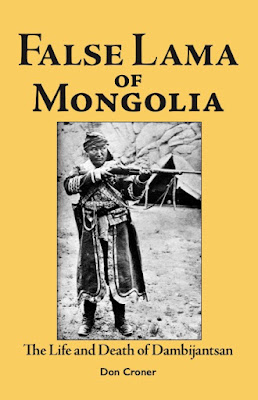
For more on Dambijantsan see False Lama of Mongolia: The Life and Death of Dambijantsan


Monday, November 30, 2009

Mideast | Yezidis | Shambhala


Temple of the Yezidis in northern Iraq
Now it appears the Yezidis, practitioners of arguably the oldest religion in the world, are claiming that the Kings of Shambhala are actually a manifestation of their Peacock Angel:

In Tibet the Peacock Angel appears to be manifest as Amitibha, the peacock-riding dhyani buddha who sits upon his Peacock Throne in the heaven of Sukhavati and occasionally takes a physical incarnation as the King of the World in legendary Shambhala, the land of immortals that flies the Peacock Flag. Shambhala, meaning the “Place of happiness,” is a place designed as eight territories or “petals” and recognized to be the heart chakra of planet Earth. In the center of the planetary heart chakra is the palace of the King of Shambhala, who thus functions as not only planetary monarch but soul of the world (just as the human soul resides within the human heart chakra). According to one legend, the Peacock Angel not only spread his colors around the globe but additionally merged his spirit with that of the Earth and became the world soul. Thus, his physical body is the Earth and his will is reflected in the actions of all creatures that live upon the face of the Earth.

Peacock Angel of the Yezidis
 
Shambhala
See The Truth about the Yezidis and also News about the Yezidis. As you no doubt already know Yezidis have Come Under Attack by Fundamentalist Jihadis in Iraq.

Also see
Secrets of the Knights Templar and the Peacock Angel and Gurdjieff and Yezidism. You don’t need me to connect the dots here.

Sunday, October 25, 2009

Turkey | Istanbul | Silk Road

Over the years I have wandered to many of the more famous stops on the eastern stretch of the old Silk Road, including its eastern terminus Xian, in Shaanxi Province, China. Continuing westward on the Silk Road I drifted through Lanzhou on the Yellow River, Jiayuguan, the western limit of China during the Ming Dynasty and the end of the Great Wall, and made an obligatory stop at the famous 1000 Buddha Caves at Dunhuang. On the Northern Silk Road, south of the Tian Shan but north of the Taklamakan Desert, I visited the now-tiny oasis town of Toyuk, the famous grape-growing town of Turpan, the nearby Buddhist Caves of Bezeklik and the now-ruined cities of Jiaohe and Gaochang, also known as Khocho), both of which were destroyed during the internecine wars at the beginning of the Mongol Yuan Dynasty, and the old Uighur capital of Beshbaliq, on the north side of the Tian Shan. On the Southern Silk Road, south of the Taklamakan Desert, I swung by Khotan, the ancient Buddhist stronghold, nominal location of the historical Shambhala, and center of the Silk, Carpet, and Jade trades, and also Kashgar, in eastern Xinjiang, at the confluence of the Northern and Southern Silk Roads. I also spent a night at the Tash Rabat Caravanserai in Kyrgyzstan, on the old Silk Road from Kashgar to the Fergana Valley, and much later checked into a Russian caravanserai in the ancient trading port of Astrakhan, a Silk Road terminus on the Volga River at the northern end of the Caspian Sea.

Having visited much of the eastern Silk Road, I naturally wanted to visit Istanbul, arguably the most illustrious of the Silk Road’s western termini. Over the years I had received several invitations to visit Istanbul, the latest from our very own Girl from the Golden Horn, the internationally renowned adventuress, temptress, and provocateur-auteur Gunj, with whom I once did a horse trip to Khargiin Khar Nuur in Mongolia. I had received several dispatches from Gunj over the summer in which Bukhara, Samarkhand, Cholpan Ata, Osh, and several other Central Asia cities and towns were mentioned as recent ports of call. Then came one email that mentioned she was going on some ill-defined mission into the Pamir Mountains. I accused her of searching for the notorious Sarmoung Monastery, which she adamantly denied. She did allow that George Gurdieff’s hangouts in Istanbul still existed, however.

In addition to the city’s status as a Silk Road terminous, I was also intrigued by the suggestion I have heard from several lamas in Ulaan Baatar, including Lama Gombo, that a portal to Shambhala can be found in Istanbul. These current-day assertions may be echos of certain enigmatic passages in The Crystal Mirror, a nineteenth century text by the ethnically Mongolian but Tibetan-named lama Nyima Chokyi Thuken. As you know, Khamariin Khiid in Mongolia is also reputed to be a Portal to Shambhala. (A recently surfaced rumor that yet another Portal to Shambhala can be found in the basement of the Rubin Museum in New York City should be discounted due to the dubious source of the information.)

Then came word that Gunj would be back in Istanbul for the last two weeks of October before returning to her pied á terre in Manhattan, not far from the Strand Book Store. If I wanted to visited Istanbul, I should do so while she was there.

So I booked a flight Ulaan Baatar–Beijing–Hong Kong–Dubai–Istanbul and return. Normally I would have stopped in Beijing and stocked up on Puerh Tea from my favorite tea dealer, the estimable Ms. Na, but now the peckerwoods in the Chinese Embassy here in UB have made it so difficult to get Chinese visas that I no longer bother; I just winged straight on through to Hong Kong. Since I had to transfer to Dragon Air for the flight down to Hong Kong I did get to see for the first time Beijing’s spectacular Terminal #3, opened for the Beijing Olympics in 2008. Mongolian Airlines still flies to old Terminal #2, so I had to take a shuttle bus to Terminal #3. To paraphrase Richard Nixon standing in front of the Great Wall, the “the terminal is really, really great.” Or at least really, really huge. A terminal of a city which has every intention to be the world leader by the middle of this century. And yes, there are Starbucks. More importantly there are “charging stations” for topping off laptops, cell phones, and Kindles, and small free wi-fi islands around at least some of the charging stations, although there does not seem to be free wi-fi terminal wide.

I had an eight-hour layover in Hong Kong, so I took the train to Kowloon, thinking I would spend a few hours just strolling around the city with one eye open for any Puerh Tea buying possibilities. Unfortunately my body had already accustomed itself to late-fall temperatures in Ulaan Baatar—we had had a nice little blizzard a couple of days before I left and there was still a few inches of snow on the ground on the morning of my departure—and I was totally unacclimated to Kowloon’s near tropical temperatures. Within ten minutes of walking I was drenched in sweat. Then a slow drizzle turned into a near deluge. So I caught the subway over to Hong Kong Island and spent a few hours in my favorite bookstore right near the Center Metro Station. Although I had already downloaded fifteen or twenty books onto my Kindle for reading on this trip I could not resist buying hard copies of Butcher and Bolt: Two Hundred Years of Foreign Entanglement in Afghanistan, a rip-roaring account of how Afghanistan has become known as The Graveyard of Empires. The English Empire suffered if not its greatest defeat in Afghanistan then certainly its most ignominious; the Soviet Empire likewise got its butt kicked, and now it is the turn of the USA. And I could not resist picking up a copy of The Blue Manuscript by Sabiha Al Kemir. I am a sucker for books about manuscripts.

Thus fortified with reading material I took the train back out to the airport and caught the 0:35 AM Red-Eye Special to Dubai. I was flying on Emirates Airlines, which has wonderfully new and clean planes with fairly roomy, plushly appointed seats, and exuberantly friendly flight attendants. They announced that among the attendants there were speakers of Arabic, English, Turkish, French, Spanish, Portuguese, and Russian. When they turn out the regular cabin lights there are tiny little light bulbs embedded in the roof which twinkle like stars, so you can imagine you are sleeping out in the desert, in the “Big Tent,” as they say in Mongolia.

Arrived in Dubai’s mammoth but then deserted airport at four in the morning local time. The only place I could find open was a Burger King, so I sat and drank lamentable coffee while reading Lars Brownworth’s Lost to the West: The Forgotten Byzantine Empire on my Kindle. As soon as the sun came up I took a cab down to the Old Town, where I hoped to stock up on Arabian scents in the Perfume Souk. The souks do not open until 9:00 am, but the covered walkways of the Gold Souk were open so I took a bench and sat for two hours watching the passersby. There were no tourists or travelers at this time of the morning. All the people were locals who work in the souks—mostly Pakistanis—and an assortment of local loiterers. I was struck by the number of Chinese who appear to be working here. Are they colonizing Dubai now?

As soon as my favorite scent store opened I bought frankincense and an assortment of essential oils, including musk, rose, jasmine, araic, nooria, amber, and a smattering of others, plus several kinds of aromatic woods which can be burned as incense and some Iranian saffron for culinary purposes. Then I went back to the airport and sipped immense lattes—the cauldron-like cups have handles on either side so you can pick them up with both hands—until my 2:30 PM departure for Istanbul, also on Emirates Airlines.

Planes were stacked up over Istanbul so I was an hour late in arriving. By eight in the evening I was ensconced in a hotel within fifteen minutes walk of the Hagia Sofia, arguably the center of old Istanbul. At nine at the next morning I entered the precincts of the old Church/Mosque.
Hagia Sofia
As you know, Hagia Sofia was built between 532 and 537 A.D. on the orders of the Byzantine Emperor Justinian. For almost a thousand years, until the the completion of the cathedral in Seville, Spain, in 1520, it was the largest church in the world.
Hagia Sofia
In late June, 1203, members of the 4th Crusade, ostensibly bound for the Holy Land, where they hoped to retake Jerusalem from the Moslems, decided to swing by Istanbul—then known as Constantinople—for a little free-lance looting and plunder, this despite the fact that Constantinople was at the time a Christian city, albeit Orthodox and not Catholic, like the western European Crusaders. According to the historian Speros Vryonis:
The Latin soldiery subjected the greatest city in Europe to an indescribable sack. For three days they murdered, raped, looted and destroyed on a scale which even the ancient Vandals and Goths would have found unbelievable. Constantinople had become a veritable museum of ancient and Byzantine art, an emporium of such incredible wealth that the Latins were astounded at the riches they found. Though the Venetians had an appreciation for the art which they discovered (they were themselves semi-Byzantines) and saved much of it, the French and others destroyed indiscriminately, halting to refresh themselves with wine, violation of nuns, and murder of Orthodox clerics. The Crusaders vented their hatred for the Greeks most spectacularly in the desecration of the greatest Church in Christendom. They smashed the silver iconostasis, the icons and the holy books of Hagia Sofia, and seated upon the patriarchal throne a whore who sang coarse songs as they drank wine from the Church's holy vessels. The estrangement of East and West, which had proceeded over the centuries, culminated in the horrible massacre that accompanied the conquest of Constantinople. The Greeks were convinced that even the Turks, had they taken the city, would not have been as cruel as the Latin Christians. The defeat of Byzantium, already in a state of decline, accelerated political degeneration so that the Byzantines eventually became an easy prey to the Turks. The Crusading movement thus resulted, ultimately, in the victory of Islam, a result which was of course the exact opposite of its original intention.
Hagia Sofia
In 1453 the Ottoman Turks, after a lengthy siege described in intriguing detail in the book 1453: The Holy War for Constantinople and the Clash of Islam and the West, captured Constantinople. On Tuesday, May 29, 1453 Sultan Mehmet II entered the city and carrying the sword of the Prophet Mohammed rode his mule straight into Hafia Sofia. Dismounting, he kneeled on the floor and after sprinkling a handful of dust on his head as a sign of humility, announced the victory of Islam over the city and declared that henceforth Hagai Sofia would serve as a mosque. In 1935 Hagia Sofia was turned into a museum and is now visited by thousands, if not tens of thousands, of people a day.
Second Floor Hallway in the Hagia SofiaInterior of the Hagia Sofia
Interior of the Hagia Sofia

Saturday, April 25, 2009

Mongolia | Life & Death of the False Lama #18

Who was Dambijantsan?

A Buddhist monk; a freedom fighter for Mongolian independence; the descendant of Amursanaa (1723–1757), the Western Mongol who led the last great uprising against the Qing Dynasty of China; the incarnation of Mahakala, the Buddhist god of war; bandit, torturer, murderer, or evil incarnate? During his lifetime no one was sure who he really was, and even today the controversy about his life continues.

Born in what is now the Republic of Kalmykia, part of the Russian Federation, Dambijantsen traveled throughout Tibet, India, and China before arriving in Mongolia in 1890 where he tossed gold coins to bystanders and announced to one and all that he had come to free Mongolia from the yoke of the Qing Dynasty of China. After disappearing almost twenty years he returned to lead the attack on Khovd City, the last Chinese outpost in Mongolia. Honored by the Eighth Bogd Gegeen, the theocratic leader of Mongolia, for his efforts in achieving Mongolian independence, he went on to establish his own mini-state in western Mongolia, which he hoped to use as a base for establishing a Mongol-led Buddhist khanate in Inner Asia. His dictatorial nature and unbridled sadism soon came to the fore and he was finally arrested and imprisoned in Russia. After the Russian Revolution he returned to Mongolia, gathered new followers around him, and established a stronghold at the nexus of old caravan routes in Gansu Province, China. He robbed caravans, grew opium, and once again dreamed of creating a new Mongolian khanate in Inner Asia. Finally the new Bolshevik government in Mongolia, fearful of his rising power, issued orders for his assassination. Dambijantsan died in 1922, but in Mongolia legends persist to this day that his spirit still rides on the wind of the Gobi and continues to haunt his former lairs.


For more on Dambijantsan see False Lama of Mongolia: The Life and Death of Dambijantsan


Tuesday, December 2, 2008

Mongolia | 1001 Arabian Nights and Dolts

I have been inundated by a blizzard of email taking exception to the characterization of my readers as “dolts” in a Previous Post. I would have thought that anyone who read this would assume that everyone but themselves were dolts and get a certain satisfaction from this, but now it appears that some people actually believed that the word applied to themselves. Rest assured that it is in fact all the other readers who are dolts and not yourself.

So what, you may wonder, led me to use the word “dolt” in my post? I’ll tell you. Just recently I finished reading Husain Haddawy’s relatively new ((latest edition: May 12, 2008) translation of the 1001 Arabian Nights.


This translation, by the way, has only 271 of the Nights included. If you want the entire 1001 Nights just about your only option is the 16-volume translation by Richard Burton. The dead tree version of this 16-volume set is a collector’s item and will set you back some big bucks, even if you are lucky enough to find a set for sale. Amazingly, the Entire 16-Volume Set is now available in Kindle format from amazon.com for a trifling $4.79. Of course I have added a copy to my Digital Scriptorium.


This work may well represent the high water mark of the Victorian mania for footnoting. Burton simply cannot resist adding as footnotes lengthy exegeses on the most arcane subjects which come up in the text, with special emphasis on his bizarre sexual obsessions, an area in which the 1001 Nights offers plentiful inspiration. Burton had, of course, spent a good part of his life in India and the Middle East researching this topic, so he came well equipped with plentiful anecdotal information.

Actually there is even a newer edition of the 1001 Nights, this one a three-volume collector set, available only in England. It is not clear how many of the Nights are covered. I have not read any reviews or added it to the Scriptorium, so I will not comment further.

Anyhow, after reading Haddawy’s translation and a good chunk of Burton’s version, I naturally got curious about the background of the 1001 Nights. Who wrote it?—an author is never listed—when and where was it written? etc. Everyone has heard of the 1001 Nights, but admit it, how much do you really know about the book? To satisfy my curiosity and fill in these lacunae in my knowledge I added to the Scriptorium a book by Robert Irwin entitled The Arabian Nights: A Companion.


This book belongs to one of my favorite genres: books about books. It gives a detailed account of the milieu out of which the the 1001 Nights probably developed, who may have written it—no one person, no doubt—an exhaustive history of the various translations down through the ages, and much, much more. There is one chapter, “The Storyteller’s Craft,” which gives a history of professional storytellers from 12th century Cairo and Baghdad to seventeenth century Damascus. It was probably these guys who over the centuries put together the opus became known as the 1001 Nights. In the early days they plied their trade in streets or squares near mosques and markets, places with a lot of foot traffic, but starting in about the sixteenth-century, with the rise of the Ottoman Empire, coffee houses became popular in these lands and the storytellers moved inside. It is interesting to note that at first some strict interpreters of the Quran considered coffee an intoxicant and thus illicit under Islamic law. Coffee houses therefore tended to attract a louche clientele. I cannot help but noticing that even in Ulaan Baatar today habitual coffee drinkers tend to hover on the brink of moral turpitude, especially compared with those who prefer to drink tea, a more spiritually uplifting beverage. Anyhow, the patrons of Louch Coffee Houses provided a ready audience for the kind of tales which make up the 1001 Nights. I myself prefer to drink oolong tea, preferably Bao Zhong from Taiwan, while reading the book, and try to avoid coffee houses, louche or otherwise, whenever possible.

Bao Zhong is a lightly oxidized oolong tea with the qualities of both oolong and green tea. Because it is partially oxidized, Bao Zhong is classified as an oolong tea, but its oxidation period is less than typical high mountain oolongs of Taiwan. For this reason Baozhong is sometimes referred to as a green tea. True green teas, however, are completely un-oxidized. In any case, a perfect complement to 1001 Nights.
Irwin also relates that Richard Burton, translator of the 1001 Nights, encountered various storytellers in Tangiers in the 1880s. At this time and place we once again find them performing in the street. They could be recognized by the tom-tom drum and stout walking stick they carried, and they often appeared to be “disreputable-looking figures.” One witnessed by Burton “speaks slowly and with emphasis, varying the diction with breaks of animation, abundant action and the most comical grimaces; he advances, retires and wheels about, illustrating every point with pantomime; and his features, voice and gestures are so expressive that even Europeans who cannot understand a word of Arabic divine the meaning of his tale.”

A similar storyteller pops up in The Teachers of Gurdieff, by Rafael Lefort (almost certainly a pen name for Idries Shah who went on to make a name for himself as one of the most visible proponents of Sufism in the West).


The book, published in 1968, purports to be a search for Sufi teachers who claimed to have taught the great twentieth century magus George Gurdjieff. While in Istanbul Lefort met with the Sufi Pir Daud, who advised him, ““Go to Tabriz and find there Daggash Rustam, Master of the Drum. He may see you or he may not. If he does, you can hope to continue on in your search. If he does not—’ he spread his palms expressively.”

Lefort proceeded to Tabriz, in Iran, and finally tracked down the storyteller Daggash Rustam, who like Burton’s storyteller carried a drum and a staff:
Ten days I spent in searching until one day, as I sat in a chai khana, my attention was drawn to a tall figure, heavily bearded, dressed in a ragged patched robe, crossing the street. On reaching a small open place he produced a drum and started to beat it crying, ‘Harken ye all to Rustam,’
I jumped, split my tea and rushed over.
The dervish was seated on a stone and round him a crowd had gathered. He held up his stick for silence.
‘I will tell you a tale, though why I waste my time on dolts like you I don’t know,’ he began. An appreciative murmur showed that this was a known gambit.
So that is where I got the expression, “why I waste my time on dolts like you I don’t know,” which I used in the earlier post. Strangely enough, however, I have not heard any “appreciative murmurs.” Of course we live in a different time and place.

In any case, the book 1001 Arabian Nights has also inspired the 1001 Arabian Nights Restaurant in Beijing, for which I am eternally grateful, having spend many enjoyable nights there.