Showing posts with label Kalmyks. Show all posts

Sunday, October 24, 2021

Mongolia | Life of Ja Lama | Who Are the Kalymks?

Who was Dambijantsan?

A Buddhist monk; a freedom fighter for Mongolian independence; the descendant of Amursanaa (1723–1757), the Western Mongol who led the last great uprising against the Qing Dynasty of China; the incarnation of Mahakala, the Buddhist god of war; bandit, torturer, murderer, or evil incarnate? During his lifetime no one was sure who he really was, and even today the controversy about his life continues.

Born in what is now the Republic of Kalmykia, part of the Russian Federation, Dambijantsen traveled throughout Tibet, India, and China before arriving in Mongolia in 1890 where he tossed gold coins to bystanders and announced to one and all that he had come to free Mongolia from the yoke of the Qing Dynasty of China. After disappearing almost twenty years he returned to lead the attack on Khovd City, the last Chinese outpost in Mongolia. Honored by the Eighth Bogd Gegeen, the theocratic leader of Mongolia, for his efforts in achieving Mongolian independence, he went on to establish his own mini-state in western Mongolia, which he hoped to use as a base for establishing a Mongol-led Buddhist khanate in Inner Asia. His dictatorial nature and unbridled sadism soon came to the fore and he was finally arrested and imprisoned in Russia. After the Russian Revolution he returned to Mongolia, gathered new followers around him, and established a stronghold at the nexus of old caravan routes in Gansu Province, China. He robbed caravans, grew opium, and once again dreamed of creating a new Mongolian khanate in Inner Asia. Finally the new Bolshevik government in Mongolia, fearful of his rising power, issued orders for his assassination. Dambijantsan died in 1922, but in Mongolia legends persist to this day that his spirit still rides on the wind of the Gobi and continues to haunt his former lairs.


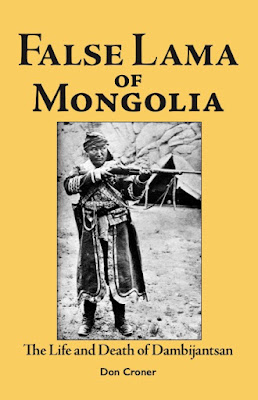
For more on Dambijantsan see False Lama of Mongolia: The Life and Death of Dambijantsan


Tuesday, February 2, 2010

Mongolia | Life of Ja Lama | Chapter 4 | Early Life

Who was Dambijantsan?

A Buddhist monk; a freedom fighter for Mongolian independence; the descendant of Amursanaa (1723–1757), the Western Mongol who led the last great uprising against the Qing Dynasty of China; the incarnation of Mahakala, the Buddhist god of war; bandit, torturer, murderer, or evil incarnate? During his lifetime no one was sure who he really was, and even today the controversy about his life continues.

Born in what is now the Republic of Kalmykia, part of the Russian Federation, Dambijantsen traveled throughout Tibet, India, and China before arriving in Mongolia in 1890 where he tossed gold coins to bystanders and announced to one and all that he had come to free Mongolia from the yoke of the Qing Dynasty of China. After disappearing almost twenty years he returned to lead the attack on Khovd City, the last Chinese outpost in Mongolia. Honored by the Eighth Bogd Gegeen, the theocratic leader of Mongolia, for his efforts in achieving Mongolian independence, he went on to establish his own mini-state in western Mongolia, which he hoped to use as a base for establishing a Mongol-led Buddhist khanate in Inner Asia. His dictatorial nature and unbridled sadism soon came to the fore and he was finally arrested and imprisoned in Russia. After the Russian Revolution he returned to Mongolia, gathered new followers around him, and established a stronghold at the nexus of old caravan routes in Gansu Province, China. He robbed caravans, grew opium, and once again dreamed of creating a new Mongolian khanate in Inner Asia. Finally the new Bolshevik government in Mongolia, fearful of his rising power, issued orders for his assassination. Dambijantsan died in 1922, but in Mongolia legends persist to this day that his spirit still rides on the wind of the Gobi and continues to haunt his former lairs.


For more on Dambijantsan see False Lama of Mongolia: The Life and Death of Dambijantsan


Thursday, January 28, 2010

Mongolia | Life and Death of the Ja Lama | Chapter 9

Who was Dambijantsan?

A Buddhist monk; a freedom fighter for Mongolian independence; the descendant of Amursanaa (1723–1757), the Western Mongol who led the last great uprising against the Qing Dynasty of China; the incarnation of Mahakala, the Buddhist god of war; bandit, torturer, murderer, or evil incarnate? During his lifetime no one was sure who he really was, and even today the controversy about his life continues.

Born in what is now the Republic of Kalmykia, part of the Russian Federation, Dambijantsen traveled throughout Tibet, India, and China before arriving in Mongolia in 1890 where he tossed gold coins to bystanders and announced to one and all that he had come to free Mongolia from the yoke of the Qing Dynasty of China. After disappearing almost twenty years he returned to lead the attack on Khovd City, the last Chinese outpost in Mongolia. Honored by the Eighth Bogd Gegeen, the theocratic leader of Mongolia, for his efforts in achieving Mongolian independence, he went on to establish his own mini-state in western Mongolia, which he hoped to use as a base for establishing a Mongol-led Buddhist khanate in Inner Asia. His dictatorial nature and unbridled sadism soon came to the fore and he was finally arrested and imprisoned in Russia. After the Russian Revolution he returned to Mongolia, gathered new followers around him, and established a stronghold at the nexus of old caravan routes in Gansu Province, China. He robbed caravans, grew opium, and once again dreamed of creating a new Mongolian khanate in Inner Asia. Finally the new Bolshevik government in Mongolia, fearful of his rising power, issued orders for his assassination. Dambijantsan died in 1922, but in Mongolia legends persist to this day that his spirit still rides on the wind of the Gobi and continues to haunt his former lairs.


For more on Dambijantsan see False Lama of Mongolia: The Life and Death of Dambijantsan


Wednesday, May 20, 2009

Russia | Kalmykia | Elista | Golden Temple | Interior

After Circumambulating the Golden Temple and offering appropriate Prayers to the Seventeen Panditas of Nalanda I proceed inside. Normally there is a steady stream of pilgrims and tourists pouring through the temple: Kalmyks from both Elista and the countryside and Russians running the gamut from teenaged punk rockers, to leather-clad motorcyclists, to aging babushkas, many of them shepherded by local guides who describe in detail the contents of the temple. But at eight o’clock in the morning on this weekday the place is almost deserted, giving me a good chance to take a leisurely look around.

Buddha on the main altar

The walls of the temple has been covered with magnificent murals done by Tibetan artists imported from India. While the temple building was completely back in 2005 the interior artwork was just finished in the last month or so.

Wall the left of the main altar (facing the altar)

Detail of wall to the left of the main altar

Detail of wall to the left of the main altar

Wall to the right of the main altar

Detail of wall to the right of the main altar

Detail of wall to the right of the main altar

The back wall

Detail of the back wall

Detail of the back wall

Green Taras on the back wall

Green Tara on the back wall

Green Taras on the back wall

Green Tara on the back wall

Buddhas on a side wall

Buddhas on a side wall

More paintings on the back wall. That’s the Dalai Lama, top center.

Detail of Dalai Lama

Mandala in the ceiling the main hall of the temple. The top side of this mandala is the center of a Huge Conference Table on the fourth floor of the temple.
Top side of the mandala visible on the ceiling of the main hall of the temple

Third floor balcony overlooking the main hall of the temple. After school and on weekends this area serves as a rumpus room for local teen-agers. If you are a teenager looking to hookup with somebody with whom you can discuss the finer points of the Mind Only School and other such topics this is the place to go.
Third floor balcony overlooking the main hall of the temple

Buddha on the main altar from the third floor balcony

Thursday, May 14, 2009

Russia | Kalmykia | Elista | Telo Tulku Rinpoche

The next morning I have breakfast in the hotel restaurant, which is plush with carpets and still more blonde-wooded furniture. The house breakfast is frugal however; an small omelet, some paper-thin slices of cold cuts and cheese and bread, plus an expresso cup of instant coffee. At the table next to me are four Russian businessman in suits. They order a liter and a half bottle of vodka and consume it with their breakfast. Some things in Mother Russia never change.

The night before Andzha had given me a Russian SIMMs Card for my cell phone and now he calls me. Telo Rinpoche had been in India but he had just arrived yesterday with his teacher, the head of Drepung Gomang Monastery in southern India. At noon there will be a greeting ceremony for the Drepung Tripa, the official title of the lama from India, at the big Altan Süm (Golden Temple), the Rinpoche’ headquarters here in Elista, and the Rinpoche will have a few minutes to speak to me in his office beforehand. Also the monastery’s guest apartment is now ready to be occupied and Andzha will take me there before we go to the Golden Temple.

The apartment is in Microrayon #2, about a mile from the Golden Temple. The building is a Khrushchev-era construction exactly like apartment buildings in Ulaan Baatar from the same era. The builders could have used the same blueprints. Even the doors are the same. I have lived in several of these kinds of apartment buildings in UB so I immediately feel right at home. There’s no furniture but there are a a couple of mattresses propped against one wall. I put one of these on the floor and cover it with a carpet, not a handmade silk carpet like the one I sleep on in Ulaan Baatar but a machine-made woolen carpet from Turkey, but, hey, one can’t have all the comforts of home while traveling. In a corner is a pile of blankets and pillows. The kitchen has a gas stove but there is no hot water.

From here we proceed directly to the Golden Temple. This imposing structure is the largest Buddhist temple in Europe. It was completed only in 2005.

Golden Temple

Andzha drives in the private entrance at the back of the monastery and after taking off our shoes in the first floor entry hall take an elevator to the fourth floor where the Telo Rinpoche has his residence and office. From the elevator we step into a large room which at first glance seems to contain an enormous Buddhist-oriented craps table. But no, it is in fact an immense conference table, seating twenty-four, with a mandala embedded in the middle of it.

Conference Table with Mandala in the middle

Closer view of Mandala. The bottom side of the Mandala is visible in the ceiling of the Main Hall of the Temple.
I have a sudden vision of the 25th King of Shambhala sitting here with his staff, including General Hanuman, the Final Incarnation of the Bogd Gegeen, directing the final battle against the barbarian unbelievers. Andzha adds that the main temple hall is directly below this room, and that the bottom side of the mandala, painted with the same design, can be seen in the ceiling of the hall. All the prayers offered in the main temple ascend through the mandala and concentrate themselves here in this conference room.

The Telo Tulku Rinpoche’s luxurious office, appointed like that of a now disgraced CEO of a Too-Big-to-Fail bank in the USA, is off to one side of this awe-inspiring conference room. The redolence odor of rancid butter, mutton fat, and juniper incense common to monasteries in Mongolia, some of which have not felt a broom since before the fall of the Qing Dynasty, is noticeably absent here.

Telo Tulku Rinpoche

The Telo Rinpoche, the latest in a line of incarnations going back to Mangala, one of the original disciples of the Buddha and including Tilopa, one the 84 Mahasiddis of India, and the last Diluv Khutagt of Mongolia, whose book I have mentioned, greets me warmly. He must meet the Drepung Tripa shortly but he says that afterward he will give me a guided tour of the temple. In the meantime what can he do for me? I tell him that I would like to talk to historians who might know something about Dambijantsan, who was born here in Kalmykia and whose life I am researching, and who like the Rinpoche himself is considered to be, in some circles at least, an incarnation of one the 84 Mahasiddis of India, in Dambijantsans case the mahasiddi known as Güwari. The Rinpoche summons his secretary and instructs her to call one of the local research instittutes and track down any scholars who can shed some light on the up until now shadowy existence of Dambijantsan here in Kalmykia.

Then we take the elevator down to the first floor of the temple and proceed out into the immense main hall. Telo Rinpoche goes out to front gate to meet the Drepung Tripa and I remain behind. A couple hundred people have assembled to greet Drepung Tripa, and many are buying khadags (prayer scarves) from a small shop out front to present to him. Finally a procession of monks lead by Telo Rinpoche proceeds from the front gate to the entrance of the main hall of the temple. The Drepung Tripa, who appears to be in his sixties, comes last, bestowing his blessings on all those who approach him.

Telo Tulku Rinpoche (left) leading the procession into the Temple

The Drepung Tripa blessing people outside the Temple

He is the head of Drepung Gomang Monastery in southern India, which was founded by Tibetans who fled Tibet after the Chinese invasion of 1959 and named after Drepung Monastery in Tibet. Gomang was one of the several colleges at Drepung in Lhasa and the one at which most Mongolians monks who studied in Lhasa attended. Zanabazar, the first Bogd Gegeen of Mongolia, stayed at Gomang during his visits to Mongolia.

Ruins of Gomang College at Drepung in Lhasa

Many other famous Mongolian lamas studied here, including Agvan Dorzhiev, the Buryat who eventually became a tutor to the 13th Dalai and who Accompanied the Dalai Lama to Mongolia in 1904 when the latter fled Tibet after the invasion of the Younghusband Expedition.

Agvan Dorzhiev

Dambijantsan also reportedly attended Gomang College at Drepung in Lhasa. It was here that he allegedly killed his monastic roommate after a quarrel, an act which of course ended his monastic career and put him on the path which would eventually lead him to Mongolia. As George Roerich, in his book Trails to Inmost Asia, notes, “It seems the murder was the crucial point of his life for from then on begins his life as an errant warrior monk, full of wonderful adventures, messianic prophecies, and cruel deeds.”

The Drepung Tripa

The Drepung Tripa mounts the throne in the main hall of the temple and a chanting ceremony begins. After he is served a ceremonial offering of tea and rice people line up to again receive his blessing, after which everyone receives a small portion of rice (Drepung, I might add here, means “Rice Heap”). This greeting ceremony concluded the Drepung Tripa proceeds to the Telo Rinpoche’s office on the fourth floor. The Rinpoche asks me to come with along. At this office he is greeted by a camera crew from a Russian television station. It seems they want an interview with him. “I wanted to give you a tour of the temple,” he said, “But now I must talk to these people. But the monks are going to give the Drepung Tripa a complete tour of the temple, so just tag along with them and you will see everything.” The Drepung Tripa and his group go up to the fifth floor and I follow. The public is normally not allowed above the fourth floor, since the fifth floor contains a huge suite reserved solely for the Dalai Lama should he ever visit Kalmykia again. He has not visited since the temple has been built but there are high hopes he will soon.

At the entrance to the Dalai Lama’s suite on the fifth floor a guard stops me, the only person not in monks’ robes, and says, “Sorry, the public is not allowed up here.” Like a groupie who says, ”I’m with the band,” I said, “I am with the Drepung Tripa.” The guard said, “Oh, excuse me, I am so sorry!” Putting his hand together he bowed and said, “Please, please, go in!”

Sitting Room of the Dalai Lama’s Suite

The suite is immense, with magnificent carpets and sumptuous sofas and chairs. Should the Dalai Lama feel homesick, on one wall there is a painting of the Potala, his former home in Lhasa. I have toured the Dalai Lama’s living quarters in the Potala several times and oddly enough they are preserved just the way he left them, although apparently not in anticipation of his return.

Painting of the Potala in the Dalai Lama’s Suite

On the facing wall is a painting of the Golden Temple. To one side of the sitting room is the Dalai Lama’s bedroom, complete with double bed. Instead of a chocolate, there is a prayer scarf on the pillow.

Dalai Lama’s bed: there’s no chocolate on pillow but there is a prayer scarf

Just off the bedroom is a small study and meditation niche with a mat on the floor and low table. Off to the other side of the sitting room are conference rooms and rooms for the Dalai Lama’s attendants.

Dalai Lama’s Meditation and Study Niche

The sixth floor, which is actually a walkway around the cupola at the top of the temple is also normally closed to the public but of course we get to go up for a look. From here we get a good view at the very modest city of Elista, which ends abruptly less than half a mile away, beyond which treeless steppe stretches off to the horizon. It is windy even here, and even bit cool, but the Drepung Tripa lingers, seeming to enjoy the view from all four sides of the cupola.

View of Elista from the cupola of the Temple

Another view from the cupola

The Drepung Tripa enjoying the view from the cupola

From here we descend back down to the first floor for a tour of the monastery’s Scriptorium, which in additional to a large collection of regular books and Tibetan-language sutras has high speed internet free for the public. The Drepung Tripa asks to see several Tibetan language sutras and lingers over them for awhile.

Drepung Tripa perusing tome in the Scriptorium

I cannot help noticing a display case contaiing a collection of books about the Oirat Zaya Pandita (1599–1622), whose path I keep crossing in the most unexpected places.

Namkhaijantsan (1599–1662), The Oirat Zaya Pandita

He is the inventor of the so-called Tod Bichig Script, a variation of the traditional vertical Mongolian script. While researching the dialects of western Mongolia he stayed at Tögrög Monastery in the small town of Mankhan, on the Dund Tsenger River in what is now Khovd Aimag. Dambijantsan’s camp, where in 1912 he assembled his troops for the assault on the Manchu Fortress in Khovd City, was located on the Dund Tsenger Gol not far from Mankhan. The Zaya Pandita also accompanying the little six-old prince Galdan to Lhasa in 1649 when the latter went there to become a monk. Galdan, who later renounced his vows as a monk and became the khan of the Zungarians, or Western Mongols, would launch a disastrous war against the Eastern Mongols, led by Zanabazar, the first Bogd Gegeen. Seeking protection from Galdan, Zanabazar in 1691 accepted the suzerainzy of the Qing Dynasty in China, making Mongolia a province of China and leading to the subjugation of the Eastern Mongols by the Manchus for 220 years. To free Mongolia from China became the overriding goal of the first part of Dambijantsan’s life.

From the Scriptorium we moved on to the very finely appointed museum of the monastery. Among the plethora of displays here, too numerous to detail, was another exhibit about the Zaya Pandita and also one about Agvan Dorzhiev, the enigmatic Buryat, mentioned before, who did much to revitalize Buddhism in Kalmykia at the beginning of the twentieth century. As mentioned, Dorzhiev reportedly studied with Dambijantsan at Drepung Monastery in Lhasa. Next to the Museum we peek into the lusciously appointed Conference and Film Viewing Hall.

Conference Hall

The Drepung Tripa then retired to his quarters. Andzha and I went to the monastery’s canteen for a late lunch of hearty beef and barley soup (Andzha, despite his years as a monk in India, is not a vegetarian). While we were eating he got a call from Telo Rinpoche, who said that a meeting had been set up for me tomorrow at the Kalmykian Institute of Humanistic Research. Apparently the panditas there know something about Dambijantsan.
Sunday, December 7, 2008

Mongolia | Life & Death of the False Lama #10

I ended my earlier Exegesis of Chagatayid Influence in the Ili Basin with the Death of Tughluq Temür, who before he died had appointed the up-and-coming chieftain Temür as an adviser to his son. Temür would soon became known as Tamerlane. Tamerlane (1336–1405), immortalized in Christopher Marlowe’s Tamburlaine the Great (written in 1587–88), was not a Mongol but a Turk, and his career as one of the world’s greatest conquerors lies for the most part outside the scope of my narrative. I have already noted, however, how he married the Chagatayid princess Saray Mulk-khanum, daughter of Qazan, the last ruler of Transoxiana, in an attempt to legitimize his rule. Indeed, he never took for himself the title of khan, but claimed instead to be an emir (commander, or general) acting in the name of the Chagatayids. During his reign the Chagatayids princes of Ulus Chagatay were reduced to the role of powerless figureheads and puppets. The eastern Chagatayids attempted to retain their independence, but in the late 1370s and 1380s Tamurlane made several successful forays into Moghulistan and finally Khizr Khodja, the only surviving son of Tughluq Temür, was forced to come to terms with him. In 1397 he offered up his sister Tukal-khanum as a bride to Tamerlane and accepted the title of khan of Moghulistan, subordinate to the Scourge of God himself. His western flank secure, Khizr Khan, turning his attention east, achieved a certain reputation for himself by declaring a Holy War on Uighuristan and imposing Islam on the hitherto staunchly Buddhist population of the Turpan Depression. After Tamerlane’s death in 1405 the Chagatayids in Moghulistan enjoyed a brief resurgence. In addition to Uighurstan they added Kashgaria—the oasis cites of the western Tarim Basin—to their domains and appeared poised to once again dominate Inner Asia, or at least the westesrn half of it. Yet at the same time other peoples coming to the fore were challenging the Chagatayids for their territories. These included the Kazakhs, who asserted themselves in the western part of the Seven Rivers, the Kyrgyz in the Issuk Kul region, and the Oirats, who soon appeared in the Ili Basin. It is the Oirats, from whom Dambijantsan’s people the Kalmyks came, that interest us most. During the reign of the Chagatayids in Moghulistan, the Oirats, whose Origins I Have Traced Earlier, had been nomadizing in the Zungarian Basin, the Tarbagatai Mountains to the north, and in the western reaches of current-day Mongolia. In the 1420s we find Esen, son of Toghan, founder of the first Oirat Empire, raiding the Ili Basin, where he took as prisoner the then-reigning Vais Khan. After Vais Khan offered up a sister to Esen as a bride he was released, but the Oirats kept a foothold in the region. By the 1450s the Ili River Valley had been incorporated into the Oirat Empire, which at it height was said to stretch from Lake Baikal in the east to Lake Balkash in the west, including much of the Seven Rivers region. After Esen’s assassination in 1455 the first Oirat Empire disintegrated. For the next hundred and fifty years the Ili Basin and adjacent regions would be fought over by various tribes of the Oirat, surviving Chagatayid princes, resurgence Timurids, Kazakhs, and Kyrgyz. (It was in this period, by the way, that we see perhaps the most brilliant florescence of the Chagatai lineage, although admittedly not in our immediate area of interest; Babur (1483-1530), founder of the Mughal Dynasty in India and author of the Baburnama, was a descendant of both Tamurlane and Chagatai.

By the early 1600s we find the Khoshuut, one of the tribes of the old Oirat Empire, roaming in the steppes along the Irtysh River in the Zungarian Basin and what is now eastern Kazakhstan. Up until this time the Oirats had apparently adhered to the ancient animist and shamanic beliefs of their forefathers. In the early 1620s or thereabouts one of their chieftains, Baibagas, converted to the Gelug sect of Tibetan Buddhism. In his zeal he in turn converted other Oirat chieftains: Khu Urluk of the Torgut; Dalai Taiji of the Dörböt; and Khara Khula of the Choros. The Oirats leaders very quickly became zealous Buddhists, and they soon began sending their sons to study in the great Gelug monasteries of Tibet. They also did not hesitate to project their beliefs into the political realm. Baibagas’s brother, Güüsh Khan, who had carved out a khanate around Khökh Nuur (Qinghai Lake) and the Tsaidam Depression, in current-day Qinghai Province, China, rode into Tibet in the late 1630s to defend the 5th Dalai Lama from the King of Tsang, the ruler of much of Tibet, who was persecuting the Gelug Sect. In 1642 he overthrow the king and proclaimed the Dalai Lama both the spiritual and temporal leader of Tibet. Not until 1959, when the current Dalai Lama went into exile, was the theocratic system established with the help of Güüsh Khan interrupted.

The Oirats who migrated to the Caspian Steppes in the 1630s took their newly acquired beliefs with them, resulting in a conclave of Tibeto-Mongolian Buddhists which would continue on in Europe down to the present day. The Golden Temple (Gaden Shedrup Choekhorling), opened on October 5, 1996 and consecrated by the 14th Dalai Lama on November 30, 2004, is reputedly the largest Buddhist temple in Europe, and noisy contingents of Kalmyk Buddhists have in recent years attended Kalachakra initiations given by the Dalai Lama in locations as far-flung as Graz in Austria, Toronto, Canada, and Amaravati in India. It was this Buddhist culture into which Dambijantsan was born in 1860. Khara Khula of the Choros, as we have seen, was the father of Baatar Khongtaiji, founder of the Zungarian Confederation. Baatar Khongtaiji established his main capital on the Imil River near current-day Tacheng, on the Chinese-Kazakhstan border, but he spent much of his time camped in the Ili River Valley. We have also seen how Baatar-Khongtaiji’s son Galdan seized control of the Zungarian Khanate in 1676. In 1678 the 5th Dalai Lama, who apparently wanted to use him as a counterweight against the increasingly powerful Qing Dynasty, gave Galdan the title of Boshigt, “Khan by Divine Grace,” and thus legitimized his rule of the Zungarian Khanate. As an Oirat, and not a Chingisid, or descendant of Chingis Khan, he had no real right to take the title of khan for himself. (His name, Galdan, comes from the Tibetan dga’ldan, defined as the “Tushita Paradise of the Maitreya Buddha.” Between 1678 and 1680 he was apparently headquartered at Kulja, near the old Chagatayid capital of Almalik in the Ili Valley, during which time he annexed Kashgaria and Uighurstan, including the oasis cities of Kashgar and Khotan, Turpan, and Hami.

When we last left Galdan Bolshigt in 1688 he had invaded Khalkh Mongolia and driven Zanabazar, the First Bogd Gegeen of Mongolia and his followers southeast toward the Chinese borderlands. In 1690 news reached Beijing that Galdan Bolshigt and a force of some 30,000 men had reached the Khülün Nuur (Dalai Nuur) area in what is now Inner Mongolia and was proceeding southward along the Khalkh River. On July 26 they overran the first Qing outposts. At first it appeared to the emperor’s advisors in Beijing that the insolent Oirat actually intended to march on Beijing itself. Actually up to 20,000 of Galdan’s men deserted on the march south and the remainder were near starvation. But in early August the Kangxi emperor himself accompanied an army north pass the Great Wall Via the Gubeikou Pass seventy miles north of Beijing. Kanxi himself soon complained of illness and returned to Beijing, but General Fuquan, who held the title of Prince of Yu and was Kangxi’s half-brother, led the army north through the Mulan Hunting Grounds, the private hunting preserve of the Qing emperors. Just south of the current-day town of Saihanba the forested ridges of northern Hebei end with dramatically abruptness and the terrain suddenly changes to rolling, treeless steppes. Not coincidentally, here is also the current-day border between Hebei Province and Inner Mongolia. About ten miles north of the border, on a broad flat expanse of steppe broken only by a conspicuous hill of reddish rock known as Ulaan Butong in Mongolian (Hong Shan in Chinese; “Red Mountain,” or in a more figurative rendering “Red Urn”) the two armies collided on September 3.
The Qing had cannons, a relatively new innovation, and one which would seem to give them unquestioned superiority. At two o’clock in the afternoon the Qing army commenced firing artillery. Across a broad swamp the Mongols lined up their camels as barricades again the artillery and stood their ground, returning a heavy barrage of musket fire. A French Jesuit in the Qing court by the name of Jean F. Gerbillon had accompanied the Qing army from Beijing and later gave an eyewitness account of the battle. Toward evening commander Tong Gougang, uncle of Kangxi, was killed by Mongol musket fire, a devastating blow to the morale of the seemingly superior Qing army.

At nightfall the fighting ended and each army returned to their camp. There had been no clear victor, but nevertheless “Generalissimo” Fuquan sent a dispatch to Beijing claiming the Mongols had been decisively defeated. In fact, further engagements over the next day or two again ended with no clear victor. The tenacious Mongols simply refused to give up. In order to break the stalemate Fuquan called in a high-ranking lama to begin negotiations with Galdan. An agreement was reached whereby Galdan could return to Mongolia after swearing an oath to his “war-god” (probably the Tibeto-Mongolian deity Mahakala) that he would never again invade Qing territory. Thus ended the Battle of Ulaan Butong.

Fuquan was left with the unenviable task of informing the Kangxi emperor that Galdan had not been defeated and captured but had instead been allowed to return to Mongolia. Elated by the earlier dispatch in which Fuquan had claimed a victory, Kangxi and his advisors were infuriated when they found out what actually happened. The oath of a renegade like Galdan, they said, was worthless; he would simply regroup and attack again. Fuquan was ordered to stay put until scouts who were sent reported that Galdan had actually returned to Mongolia, and then he was ordered back to Beijing. He reached the capital on December 22 and was made to wait outside the city walls while his fate was decided. Finally he was court-martialed, dismissed from his military command, removed from the council of princes and advisors, and docked three years’ salary. Many of his officers were also fined and demoted. Stung by his rough handling by Kangxi, Fuquan was down but not out. He retired to his luxurious home in Beijing and became a literary patron, famous for entertaining writers and poets in his well-appointed garden. In 1691, as we have seen, Zanabazar, the First Bogd Gegeen of Mongolia, met with Kangxi at Dolonnuur and forfeited Mongolian independence in exchange for the assistance of the Qing in expelling Galdan from the Khalkh domains. But not until 1696 would Kangxi once again confront Galdan. This time he was determined to stamp out the Zungarian upstart. Three separate armies totaling some 73,000 men, one accompanied by Kangxi himself, headed north into the heartland of the Khalkh in an attempt to corner Galdan. On June 12, 1696 the 14,000-man army led by General Fiyanggü confronted Galdan and 5,000 of his men at a place called, in Chinese sources, Jao Modo, near the Tuul River not far south of current-day Ulaan Baatar (Jao Modo is apparently a Chinese corruption of zuun mod, Mongolian for “100 Trees.” Whether this refers to the current town of Zuun Mod, capital of Töv Aimag, just south of Ulaan Baatar, is unclear.) This time the Mongols could not withstand the Manchu cannon fire. Galdan’s men were massacred, his own wife killed in the battle, and Galdan himself managed to escape with only forty or fifty of his own men. Galdan fled west and finally holed up in what is now Gov-Altai Aimag. He had only 300 men with him and posed little threat to the Qing Dynasty, but the mere fact that he had twice escaped from Qing armies had infuriated Kangxi, who became even more determined to finally defeat and hopefully capture his nemesis. In the spring of 1697 two more Qing armies were dispatched to western Mongolia and once again Kangxi himself accompanied one of them. There are some indications that by now Kangxi considered tracking down Galdan as a kind of sport, like the hunting he had practiced at his immense Mulan Hunting Preserve, only with Galdan as the prey and not wild animals. He was denied the pleasure of finally bringing Galdan Bolshigt to bay. On April 4, 1697, Galdan suddenly died under circumstances which remained cloudy. Some said he committed suicide; others said his Buddhist teachings would have forbidden this (he had been recognized as the incarnation of an important lama as a youth, which would put an added onus on suicide). Still others, including Kangxi himself, believed he was poisoned by his close advisors after he refused their advice to surrender. In any case, Kangxi , still not satisfied, demanded the ashes of his body, which had reportedly been cremated by his followers. According to Chinese accounts, in the fall of 1698 Kangxi was finally mollified by seeing Galdan’s ashes scattered on a military parade ground in Beijing, where they were scattered to the four winds. Interestingly, to this day oral legends in Khovd Aimag discount this version of events, and some maintain that he was buried where he died, a place marked by an ovoo in current-day Gov-Altai Aimag.

Dambijantsan would later claim Galdan Boshigt as one of his role models, and just north of Tsambagarav Mountain he would attempt to create a miniature state which he may have dreamed would be the foundation of a new version of the Zungarian Khanate. And Dambijantsan’s death would became just as shrouded in controversy and legend as Galdan Bolshigt’s own end.

Sunday, November 23, 2008

Mongolia | Life & Death of the False Lama #8

Who was Dambijantsan?

A Buddhist monk; a freedom fighter for Mongolian independence; the descendant of Amursanaa (1723–1757), the Western Mongol who led the last great uprising against the Qing Dynasty of China; the incarnation of Mahakala, the Buddhist god of war; bandit, torturer, murderer, or evil incarnate? During his lifetime no one was sure who he really was, and even today the controversy about his life continues.

Born in what is now the Republic of Kalmykia, part of the Russian Federation, Dambijantsen traveled throughout Tibet, India, and China before arriving in Mongolia in 1890 where he tossed gold coins to bystanders and announced to one and all that he had come to free Mongolia from the yoke of the Qing Dynasty of China. After disappearing almost twenty years he returned to lead the attack on Khovd City, the last Chinese outpost in Mongolia. Honored by the Eighth Bogd Gegeen, the theocratic leader of Mongolia, for his efforts in achieving Mongolian independence, he went on to establish his own mini-state in western Mongolia, which he hoped to use as a base for establishing a Mongol-led Buddhist khanate in Inner Asia. His dictatorial nature and unbridled sadism soon came to the fore and he was finally arrested and imprisoned in Russia. After the Russian Revolution he returned to Mongolia, gathered new followers around him, and established a stronghold at the nexus of old caravan routes in Gansu Province, China. He robbed caravans, grew opium, and once again dreamed of creating a new Mongolian khanate in Inner Asia. Finally the new Bolshevik government in Mongolia, fearful of his rising power, issued orders for his assassination. Dambijantsan died in 1922, but in Mongolia legends persist to this day that his spirit still rides on the wind of the Gobi and continues to haunt his former lairs.


For more on Dambijantsan see False Lama of Mongolia: The Life and Death of Dambijantsan


Saturday, November 15, 2008

Mongolia | Life and Death of the False Lama #6

Earlier I wrote about the Exodus of the Kalmyks and how Dambijantsan’s tribe, the Dörböts, had been left behind in Kalmykia . . .

At the time Dambijantsan was born, at the beginning of the 1860s, Tibetan Buddhism, despite the continued pressure to convert the Kalmyks to Russian Orthodoxy, was still prevalent in Kalmykia, the land of the Kalmyks. In all likelihood Dambijantsan was born into a family which adhered to Buddhism to one degree or another. The first news we hear of him is that at the age of seven he was supposedly enrolled as a novice in a Buddhist monastery in Dolonnuur, in what is now the Chinese province of Inner Mongolia. Maisky heard this story while in western Mongolia in 1919, when Dambijantsan was still alive. Dolonnuur was firmly in the orbit of the Eastern Mongols, the Chahar of Inner Mongolia and Khalkh of what was then considered Outer Mongolia, and at first glance it appears strange that a young Dörböt from the Volga River in Russia would have gravitated there. Kalmyks wishing to enter a monastery outside of Kalmykia, we would think, would have been more drawn to western China, including the modern-day provinces of Xinjiang, Qinghai, and Gansu, the traditional strongholds of the Torguts, Dörbots, and other Oirats, both those who not migrated westward in the early seventeenth century and those who had returned in the great exodus of 1771. Fred Adelman, in his introduction to Pozdneev’s Mongolia and Mongols makes precisely this objection, and John Gaunt in his doctoral thesis on Dambijantsan repeats it: “it would be unlikely to find a Volga Kalmuk at Doloon Nuur, as they were not oriented toward Inner Mongolia’s monastic net.”

The French scholar Isabelle Charleux, an expert on Inner Mongolian monasteries, offers a different interpretation: “There were many monks and students [at Dolonnuur] from all of the Mongol world, given the reputation of the Dolonnuur monasteries and their high reincarnated masters that attracted people from very far away . . . The Dolonnuur monasteries were not only connected with the Khalkh Mongols; but also with the Inner Mongolians of Alashan and Kholun Buir . . . Also the migrant population of the Chahar banners included many Oirat Mongols. If Dambijantsan’s parents were especially fond of the Dolonnuur monasteries—because they knew a lama there, because of the reputation of the monasteries, etc.—they would have sent their child there.”

A Russian researcher adds that Dambijantsan’s parents moved to Inner Mongolia “for all the usual reasons”—presumably they were traders—when he was a very small boy, which would explain how the seven-year old boy also ended up there. Therefore it is entirely possible that this entry into Dambijantsan’s curriculum vitae was not simply a later invention meant to burnish this reputation among the Khaklh Mongols but that he actually was enrolled as a monk at Dolonnuur at an early age. In any case, this is the last we hear of his parents.

Dolonnuur (doloon = seven, nuur = lake; Seven Lakes) is located in the grasslands (now suffering from increasing desertification) 210 miles north of Beijing, about fifty-two miles beyond the first major pass leading to the Mongolian Plateau.

Ovoo at the first pass on the Mongolian Plateau

Statue of Khubilai Khan at the first pass on the Mongolian Plateau

The area is much hallowed in Mongolian history. Fourteen miles from the current town of Dolonnuur is the site of Shangdu, originally established in 1256 as the headquarters of Chingis Khan’s grandson Khubilai. After Khubilai founded the Yüan Dynasty he made what is now Bejing the primary capital of his empire, but he retained Shangdu as his summer capital, where he and his court retired each year to escape the enervating heat of the North China Plain. Shangdu was destroyed in the so-called “Red Scarf Rebellion” of 1358, a precursor to the upheavals which led to the fall of the Yuan Dynasty in 1368 and the rise of the Ming Dynasty. Later the city became known to some as the Xiancheng, or Apparition City, since people claimed that at certain times the old city as it was in the days of Khubilai appeared suddenly before their eyes and then disappeared just as quickly, leaving only the ruins as we see them today. Shangdu is also remembered as the subject of Coleridge’s much celebrated poem "Xanadu”:
In Xanadu did Kubla Khan
A stately pleasure-dome decree:
Where Alph, the sacred river ran
Through caverns measureless to man
Down to a sunless sea . . .
Ruins of Khubilai’s Palace at Shangdu

The ruins are now a popular tourist attraction and the area still serves as a summer getaway, only now not for Mongol potentates but for Beijing’s middle classes. More important to our story, however, it was at nearby Dolonnuur that in 1691 a fateful meeting took place between the Kangxi emperor of China and Zanabazar, the First Bogd Gegeen of Mongolia and the nominal head of the Khalkh Mongols.

Tourist Camp near Shangdu

When we last left Khara Khula he was organizing the four tribes of the Oirat into the Oirat Confederation. He died in 1634 and his son Baatar-Hongtaiji assumed the throne. In 1635 the Dalai Lama officially recognized Baatar-Hongtaiji as the leader of the Oirats and gave him the title of Yerdyen. By 1640 Baatar-Hongtaiji’s realm become known as the Zungarian Khanate. The name derives from the Mongol zuun gar, “left hand“, or “eastern side;”; although the Oirats dwelt in the western end of the lands inhabited by Mongol peoples, the Choros tribe to which Khara Khula and Baatar-Hongtaiji belonged was the easternmost of the Oirat confederation and thus on the “left hand“ looking southward, as the Mongols always oriented themselves.

Following a long internecine struggle between Baatar-Hongtaiji’s offspring, replete with fratricide and rivers of blood, Galdan, probably the youngest of his eleven or so sons, seized the reins of the Zungarian Khanate. Under Galdan the Zungarian Khanate eventually encompassed a huge swath of Inner Asia, including the western edge of current-day Mongolia, the current-day Chinese province of Xinjiang, including the Silk Road cities of Hami, Turpan, and Kashgar, the legendary cities of Bukhara of Samarkand in what is now Uzbekistan, and the eastern part of current-day Kazakhstan. Although little remembered today, during Galdan’s reign the Zungarian Khanate was a formidable adversary of both Czarist Russia and Qing-Dynasty China.

Galdan would become one of the role models of Dambijantsan, and we will return for a more detailed examination of his career in good time. Suffice it to say here that in 1688 Galdan, hoping to add the territory of the Khalkh Mongols to the Zungarian Empire, invaded what is now the country of Mongolia. Meeting little opposition from the disorganized Khalkh, his army first trashed the great monastery of Erdene Zuu, built on site of the old Mongol capital of Kharkhorum, and the Monastery at Khögno Khan Uul (now known as Khögnö Taryn Khiid), just to the east. Advancing farther eastward, Galdan’s men then demolished Saridgiin Khiid, located in the Khentii Mountains north of Ulaan Baatar, the monastery which had been established by Zanabazar himself and intended to be the center of Buddhism in Mongolia. Zanabazar, his brother Chakhuundorj the Tüsheet khan, the leaders of the other Khalkh khanates, and, according to one source, at least 30,000 of their followers fled southeastward before the advance of Galdan’s troops, eventually reaching the edge of the Mongolian Plateau near Dolonnuur, land of the Chahar Mongols, who had already accepted the authority of the Qing Dynasty. Here the Khalkh Mongols, by now almost destitute, threw themselves at mercy of the Qing emperor Kangxi.

Dolonnuur
was at that time already an important monastic center, with no less then twelve incarnate lamas in residence. The town, strategically located at the edge of the Mongolian plateau, was also a busy Chinese-Mongolian entrepôt. Because of deposits of copper ore nearby it became a center of mining and smelting, and its factories were well-known for their weapons, and later its workshops became better known for the bronze Buddhist Artwork of the Dolonnuur School.

Dolonnuur School White Tara in the Bogd Khan Winter Palace Museum

The Kangxi emperor, apprized of the arrival of the Khalkh Mongols in his domains, decided to meet with their leaders and if possible bring them into the fold of the Qing Dynasty. He left Beijing on May 9, 1691 and made his leisurely way north, stopping to do a spot of hunting on the way. From May 29 to June 3 Kangxi finally meet with Zanabazar and the other Khalkh leaders in Dolonnuur. A great banquet was followed by a display of Qing might in the form of cannons, newly acquired from Jesuits in Bejing, the firing of which caused the Mongols “to tremble with fear and admiration,” at least according to Qing sources. The upshot of all this was that in exchange for protection from the forces of Galdan Bolshigt and a promise from Kangxi to restore to the Khalkh their lost lands in Mongolia, Zanabazar accepted the suzerainty of the Qing Dynasty, in effect making Mongolia a province of China. The country which Chingis Khan and his sons had conquered and his grandson Khubilai had once ruled as the first emperor of the Mongol Yüan Dynasty now dominated Mongolia. Mongolia would remain under Chinese control until 1911, when the Qing Dynasty fell. Those 220 years of subjugation by the Qing Empire are seen by some as a direct consequence of Zanabazar’s capitulation to Kangxi, and as a result many Mongolians resent him to this day. Dambijantsan himself would devote the greater part of his life to undoing what Zanabazar had done and restoring the independence of Mongolia.

But that was all in the future. In 1691, In honor of his meeting with Zanabazar and the capitulation of the Mongols, Kangxi ordered the construction of what would become the Khökh Süm, or Blue Temple. (One prominent Mongolian incarnation, the Kanjurwa Khutagt [1914–1980], maintains that on the contrary Mongol nobles built the temple in honor of Kangxi, a telling interpretation of events from a Mongol viewpoint)

Front of the Khökh Süm, which is currently being restored

The Khökh Süm was completed around 1700 and it eventually began the center of a sizable monastery. About a half mile away, the Shar Süm, or Yellow Temple, was built between 1729 and 1731 and it too became the foundation of a monastery.

Ruins of the Shar Süm

Ruins of the Shar Süm

Both monasteries were overseen by a line of incarnate lamas known as the Jangjya Khutagts. Sedendonub, the first Jangjya Khutagt, was instructed by Kangxi himself to “spend the chilly wintertime in Peking and in the summertime heat govern here and the direct the local clergy.” The Jangjya Khutagts maintained residences at both the Blue Temple and and the Yellow Temple.

The Jangjya Khutagt’s residence at the Khökh Süm

Side buildings at the Jangjya Khutagt’s residence at the Khökh Süm

The second Jangjya Khutagt, Rölpé Dorjé, was described by one scholar as “an intimate of the Qianlong emperor and thus perhaps the most powerful Tibetan hierarch in the Qing Empire.” Dolonnuur’s importance as a monastic center was underlined by the fact that the Third Panchen Lama visited here during his trip to China in 1780. The Panchen Lamas along with the Dalai Lamas were the highest ranking incarnate lamas in Tibet. The Panchen Lama arrived in Dolonnuur on the 20th day of the 6th month, and according to hagiographic Tibetan accounts was greeted by one million people, although this is almost certainly an exaggeration. In any case, while in Dolonnuur the Panchen Lama reportedly “performed a purification ritual that pacified the restless demons of Mongolia.” He also gave a Yamantaka initiation to the Jangjya Khutagt and read prayers dedicated to the sacred land of Shambhala, a realm about which he had already written a guidebook entitled Shambhala Lamyig.

From Dolonnuur the Panchen Lama proceeded to the Qing Summer Resort at Jehol where he was amazed to discover not only a Huge Replica of the Potala in Lhasa, already alluded to, but also a replica of his own Tashilhunpo Monastery in Shigatse. This complex of temples and facades, known as the Xumifoushou Miao (Happiness and Longevity Temple of Mt. Sumeru) was hurriedly constructed in 1779 and early 1780 by order of the Qianlong emperor. In front of it he had placed yet another stele declaring that the complex had been built to provide the Panchen Lama with “a restful place for meditation.” The Xumifoushou Miao too is now a major tourist attraction. Unfortunately, the Panchen Lama never returned to Tibet from this trip. From Jehol he proceeded Beijing to where he contracted small pox and died in late November of 1780.

The Russian ethnographer A. M. Podzneev visited Dolonuur in 1893. By then the monastic center seems to have lost some of its luster. The Yellow Temple had some 400 monks and the Khökh Temple some 500, not a lot compared to monasteries in Lhasa in Tibet and Örgöö (now Ulaan Baatar] in Mongolia. The fourth Jangjya Khutagt, who died in 1891, spent most of his life in Beijing and had not visited Dolonnuur in fifty years. Pozdneev was by that time a very seasoned traveler in Mongolia and China but even he was shocked by conditions in Dolonnuur: “It would be hard to imagine anything dirtier and in greater disarray than Doloon Nuur’s street and alleys. The street in all Chinese cities are normally narrow and dirty, but here they are even narrower and dirtier . . . In the rainy season these ditches used as thoroughfares are so full of water and mud that some of the streets become iiterally impassable.”

Presumably this is more-or-less the same Dolonnuur Dambijantsan would have experienced in the late 1860s when he arrived there at the age of seven and became a novice monk.

The streets of Dolonnuur are in better shape today