Showing posts with label Beijiing. Show all posts

Wednesday, October 24, 2012

China | Beijing | Ms. R’s Dumplings

On my first free evening in town Ms. R invited me to her apartment to sample her legendary dumplings.
Ms. R demonstrating her formidable cleaver skills
Ms. R preparing her fabled dumplings
Ms. R presiding over her dinner table. Dumplings on the left.
We were joined for dinner by Ms. W, a friend of Ms. R’s from Urumqi, in Xinjiang, the westernmost province of China and home of the Uighur people. Like many educated Uighurs Ms. W speaks almost perfect, unaccented English, even though she had never been to an English speaking country. Ms. R herself speaks Uighur, Uzbek, Chinese, English, and Spanish.
Ms R’s friend Ms. W
Ms. R and Ms W displaying sisterly affection
Over dinner we had a scintillating conversation, to say the least. After exhausting the subject of perfumes—Deep Six is now the scent of choice for Ms. R and her friends, I am told—we moved on to a discussion of Chagatai Turk, the language which was once spoken in the Chagatai Khanate. Chagatai was of course the second son of Chingis Khan and upon Chingis’s death he was awarded as his inheritance much of what is now Uzbekistan, Kazakstan, and Kyrgzstan, including the fabled cities of Bukhara and Samarkhand. The Chagatai Turk language developed about 1400 AD but is now considered extinct. One of the more notable literary productions in Chagatai Turk was Babur’s autobiography, the Baburnama.

Babur, who as you know founded the Moghul Empire in India, was the great-great-great grandson of Tamerlane: Sword of Islam, Conqueror of the World. Although not of royal blood himself, Tamurlane married Mulk-khanum, the daughter of Qaram, who was descended from Chagatai and thus from Chingis himself. Babur was apparently the fruit of this coupling, and thus a Chingisid-Chagataid himself, although given the fact that Tamurlane had dozens of wives the exact bloodlines must remain obscure. In addition to founding the Moghul Empire, Babur was a legendary party animal, as he fully recounts in his memoirs. When he wasn’t sacking cities he was getting high on wine and hashish and amusing himself with his considerable harem, with the occasional handsome young man thrown in for added titillation. Babur’s son Humayun became emperor of India in 1530. He died on January 19, 1556, after a fall on the steps of his library. Humayun’s Tomb can now be seen in New Delhi.

Friday, February 13, 2009

China | Beijing | Confucius Temple and Amarsanaa

After my visit to the Silk Street Market I scampered on out to the huge Tibeto-Mongolian Yonghegong Monastery. First I wanted to get my prayer beads restrung—the string on mine had become dangerously frazzled—at the Tibetan Thangka shop just down the street from the entrance of Yonghegong, but I soon discovered that since my last visit the Tibetan Thangka shop had been turned into a Tibetan restaurant and bar. They tried to lure me in for a plate of Momos and a pot of butter tea, but I resisted, since I had more pressing business. I moved on down the street to one of the many shops selling religious paraphernalia and bought a supply of Nanmu incense, made from the wood of the Nanmu Tree. Supposedly Nanmu incense was introduced into China by Lobsang Palden Yeshe, the 6th Panchen Lama of Tibet, who gave some as a gift to the Qing Emperor Qianlong on the occasion of the latter’s seventieth birthday in 1778. (The 6th Panchen Lama, it might be parenthetically noted, also wrote a famous Guidebook to Shambhala.) Unfortunately, while in Beijing being feted by Qianlong the Panchen Lama contracted smallpox and transmigrated. Rumors that he was purposely exposed to smallpox in order to elimimate him have never been confirmed. (Qianlong’s father, Yongzheng, was likewise accused of offing Zanabazar, the First Bogd Gegeen of Mongolia, at the Yellow Temple in Beijing.) In any case, Nanmu quickly became the Emperor’s favorite incense. It has the unusual quality of smelling much stronger on rainy days, and is said to clear the nose and sharpen one’s thoughts. It also drives away mosquitoes.

I had intended to pop into Yonghegong Monastery to see if the Shambhala Thangka which is supposedly in storage here had been put out on display since the last time I visited, when it was no where to be seen, but the sight of the dozen or more big tourist buses out front and the hundreds if not thousands of people milling around the entrance quickly discouraged me. It was a balmy 58º F and a lot of Chinese in addition to the usual hordes of Western and Japanese tourists were out on excursions. I had already visited the place a half dozen times or more and saw no need for braving the crowds yet again.

Instead I mosied down a side street to the Confucius Temple. Visiting here was my real reason for coming to Beijing, Tea and carpets aside. Compared with the hubbubish atmosphere prevailing at Yonghegong the Confucius Temple grounds were an oasis of calm and tranquility. Only a handful of elderly Chinese were tottering around the temple grounds, which cover 22,000 square meters or almost 5.5 acres.

Confucius (circa 551-479 BC).

Tranquil grounds of the Confucius Temple

Tranquil grounds of the Confucius Temple

Tranquil grounds of the Confucius Temple

Cypress trees at the Confucius Temple

The Confucian Temple was built during the Mongol Yuan dynasty in China by order of the Yuan Emperor Chengzong, grandson of Khubilai Khan.

Mongol Emperor Chengzong (1265-1307, r. 1294–1307)

Construction began in 1302 and was finished in 1306. It was intended as place where the emperors could go to make offerings to Confucius. The Mongols were of course not Confucianists, but they no doubt felt they had to ingratiate themselves with the Confucian-dominated Chinese bureaucracy if they wanted to successfully rule China.

Confucius was perhaps most famous for his many aphorisms. Some examples:
Before you embark on a journey of revenge, dig two graves.

Everything has its beauty but not everyone sees it.

Forget injuries, never forget kindnesses.

He who will not economize will have to agonize.

I hear and I forget. I see and I remember. I do and I understand.

Ignorance is the night of the mind, but a night without moon and star.

It does not matter how slowly you go so long as you do not stop.

Men's natures are alike, it is their habits that carry them far apart.

Girl who flies airplane upside down has crack up.

Our greatest glory is not in never falling, but in getting up every time we do.

Respect yourself and others will respect you.

Study the past if you would define the future.
Entrance to the main part of the temple complex

Chu Jian Cypress

Most of the cypress trees in the temple compound were planted during the Yuan Dynasty, in the fourteenth century. Many of them are named and have elaborate histories. During the Ming Dynasty, which replaced the Yuan, a wicked minister by the name of Yan Song came here to offer sacrifices. When he passed this cypress tree a high wind sprang up and a branch, driven by the wind, lifted up his black gauze hat (worn by Ming officials as a sign of rank) and exposed his face. Later the tree was said to have the ability to distinguish wicked courtiers from loyal ones. It eventually became known as the Chu Jian Cypress.

Another cypress dating back to the Yuan Dynasty

An Incense Burner. I would love to have one of these for my hovel.

The main reason I came to Beijing and to the Confucius Temple, however, was to see the monument erected by Qing Emperor Qianlong to commemorate the defeat of the Zungarians in 1755. This last great uprising of the Western or Zungarian Mongols was led by Amarsanaa. One hundred and thirty-three years after the the death of Amarsanaa, the notorious Avenger Lama Dambijantsan would claim be his descendant and/or reincarnation and embark on a campaign to overthrow Manchu rule of Mongolia.

Plaque marking the stele erected by Qianlong

Pavilion housing Qianlong’s stele commemorating the defeat of Amarsanaa and the Zungars

Qianlong’s stele commemorating the defeat of Amarsanaa and the Zungars

Turtle on which Qianlong’s stele is mounted

Although the Zungarians were defeated in 1755 the Hui, or Chinese Moslems, of Xinjiang fought against the Qing until they were finally subdued—for the time being—in 1759. From this time on Xinjiang, Now the Westernmost Province of China, was part of the Qing empire.

Pavilion housing a stele commemorating the subjugation of the Huis in 1759.

Thursday, February 12, 2009

China | Beijing | Silk Street Market | Carpets

From Maliandao Tea Street I scarpered over to the notorious Silk Street Market. This is a landmark in Beijing; it used to be an open air market but has now been moved into a large department store-style building. There are reportedly over 1700 shops in the complex and on an average weekday some 20,000 shoppers flood the place, with from 50,000 to 60,000 a day on weekends. The place is infamous for counterfeit brand-name goods and the world’s most aggressive sales people. The management of the complex has provided these helpful English Language guidelines for sales staff in the stores:


I really was not in the market for anything today but I have been coming here for years so I like to chat with the people in the shops where I have bought things before. Despite seeing tens of thousands of customers a week they always greet you like a long-lost friend. First I went to the fabric and tailor shop where I usually have my clothes made (it is impossible to buy my sizes off the shelf in China; difficult anywhere actually). It was nine o’clock on a Sunday morning and the boss of the place, a women in her fifties, was not there. When I asked one of the clerks about her she said, “She’s sleeping; when you are rich you get to sleep in.” I said I wasn’t buying anything, but had come to check out any new fabrics they had in stock. I spent an enjoyable hour lovingly caressing and fondling the heart-stoppingly elegant raw silks, luscious cashmeres, lovely satins, mind-bogglingly magnificent brocades, delectably soft cottons, and sumptuous linens, all the while chatting with the charming to say nothing of knowledgeable staff.

Delectable Fabrics and Lovely Staff

If this isn’t a sight to make your heart palpitate you better check to see if you have not already assumed room temperature.
The gracious Big Boss at the Fabrics Shop, absent on my latest visit.

From the fabric shop—actually one of probably a hundred fabric shops in the complex, a true fabric fondler’s Paradise—I mosied on over to one of the carpet shops I have frequented in the past. Here, as at the fabric shop, the boss—a Mr. Wen—was sleeping in but the eye-dazzling Ms. Chen was on the scene. I have bought carpets here before and Ms. Chen was of course thrilled to the core to see me again.

Here is a rug which I bought at this shop on an earlier visit to Beijing and which now adorns the pounded-earth floor of my hovel in Zaisan Tolgoi.
I told her I was just looking today, but she was more than happy to show me some of the new items they had in stock.

A breath-takingly gorgeous 8oo knot per-square-inch antique silk rug selling for 7500 yuan ($1098)
Another view of same luxuriously opulent carpet

Same magnificent carpet and the equally tantalizing Ms. Chen

Another mouth-wateringly luscious 600 knot per-square-inch antique (dating from the 1920s) silk carpet, this one selling for 2900 yuan ($425)
I did not buy any carpets today but promised the enchanting Ms. Chen I would be back to see her again soon.

Sunday, November 23, 2008

Mongolia | Life & Death of the False Lama #8

Who was Dambijantsan?

A Buddhist monk; a freedom fighter for Mongolian independence; the descendant of Amursanaa (1723–1757), the Western Mongol who led the last great uprising against the Qing Dynasty of China; the incarnation of Mahakala, the Buddhist god of war; bandit, torturer, murderer, or evil incarnate? During his lifetime no one was sure who he really was, and even today the controversy about his life continues.

Born in what is now the Republic of Kalmykia, part of the Russian Federation, Dambijantsen traveled throughout Tibet, India, and China before arriving in Mongolia in 1890 where he tossed gold coins to bystanders and announced to one and all that he had come to free Mongolia from the yoke of the Qing Dynasty of China. After disappearing almost twenty years he returned to lead the attack on Khovd City, the last Chinese outpost in Mongolia. Honored by the Eighth Bogd Gegeen, the theocratic leader of Mongolia, for his efforts in achieving Mongolian independence, he went on to establish his own mini-state in western Mongolia, which he hoped to use as a base for establishing a Mongol-led Buddhist khanate in Inner Asia. His dictatorial nature and unbridled sadism soon came to the fore and he was finally arrested and imprisoned in Russia. After the Russian Revolution he returned to Mongolia, gathered new followers around him, and established a stronghold at the nexus of old caravan routes in Gansu Province, China. He robbed caravans, grew opium, and once again dreamed of creating a new Mongolian khanate in Inner Asia. Finally the new Bolshevik government in Mongolia, fearful of his rising power, issued orders for his assassination. Dambijantsan died in 1922, but in Mongolia legends persist to this day that his spirit still rides on the wind of the Gobi and continues to haunt his former lairs.


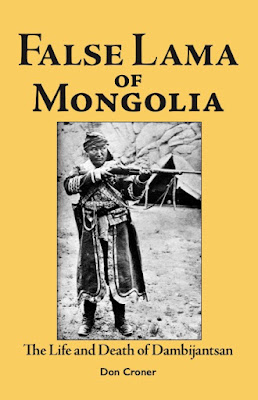
For more on Dambijantsan see False Lama of Mongolia: The Life and Death of Dambijantsan


Saturday, November 15, 2008

Mongolia | Life and Death of the False Lama #6

Earlier I wrote about the Exodus of the Kalmyks and how Dambijantsan’s tribe, the Dörböts, had been left behind in Kalmykia . . .

At the time Dambijantsan was born, at the beginning of the 1860s, Tibetan Buddhism, despite the continued pressure to convert the Kalmyks to Russian Orthodoxy, was still prevalent in Kalmykia, the land of the Kalmyks. In all likelihood Dambijantsan was born into a family which adhered to Buddhism to one degree or another. The first news we hear of him is that at the age of seven he was supposedly enrolled as a novice in a Buddhist monastery in Dolonnuur, in what is now the Chinese province of Inner Mongolia. Maisky heard this story while in western Mongolia in 1919, when Dambijantsan was still alive. Dolonnuur was firmly in the orbit of the Eastern Mongols, the Chahar of Inner Mongolia and Khalkh of what was then considered Outer Mongolia, and at first glance it appears strange that a young Dörböt from the Volga River in Russia would have gravitated there. Kalmyks wishing to enter a monastery outside of Kalmykia, we would think, would have been more drawn to western China, including the modern-day provinces of Xinjiang, Qinghai, and Gansu, the traditional strongholds of the Torguts, Dörbots, and other Oirats, both those who not migrated westward in the early seventeenth century and those who had returned in the great exodus of 1771. Fred Adelman, in his introduction to Pozdneev’s Mongolia and Mongols makes precisely this objection, and John Gaunt in his doctoral thesis on Dambijantsan repeats it: “it would be unlikely to find a Volga Kalmuk at Doloon Nuur, as they were not oriented toward Inner Mongolia’s monastic net.”

The French scholar Isabelle Charleux, an expert on Inner Mongolian monasteries, offers a different interpretation: “There were many monks and students [at Dolonnuur] from all of the Mongol world, given the reputation of the Dolonnuur monasteries and their high reincarnated masters that attracted people from very far away . . . The Dolonnuur monasteries were not only connected with the Khalkh Mongols; but also with the Inner Mongolians of Alashan and Kholun Buir . . . Also the migrant population of the Chahar banners included many Oirat Mongols. If Dambijantsan’s parents were especially fond of the Dolonnuur monasteries—because they knew a lama there, because of the reputation of the monasteries, etc.—they would have sent their child there.”

A Russian researcher adds that Dambijantsan’s parents moved to Inner Mongolia “for all the usual reasons”—presumably they were traders—when he was a very small boy, which would explain how the seven-year old boy also ended up there. Therefore it is entirely possible that this entry into Dambijantsan’s curriculum vitae was not simply a later invention meant to burnish this reputation among the Khaklh Mongols but that he actually was enrolled as a monk at Dolonnuur at an early age. In any case, this is the last we hear of his parents.

Dolonnuur (doloon = seven, nuur = lake; Seven Lakes) is located in the grasslands (now suffering from increasing desertification) 210 miles north of Beijing, about fifty-two miles beyond the first major pass leading to the Mongolian Plateau.

Ovoo at the first pass on the Mongolian Plateau

Statue of Khubilai Khan at the first pass on the Mongolian Plateau

The area is much hallowed in Mongolian history. Fourteen miles from the current town of Dolonnuur is the site of Shangdu, originally established in 1256 as the headquarters of Chingis Khan’s grandson Khubilai. After Khubilai founded the Yüan Dynasty he made what is now Bejing the primary capital of his empire, but he retained Shangdu as his summer capital, where he and his court retired each year to escape the enervating heat of the North China Plain. Shangdu was destroyed in the so-called “Red Scarf Rebellion” of 1358, a precursor to the upheavals which led to the fall of the Yuan Dynasty in 1368 and the rise of the Ming Dynasty. Later the city became known to some as the Xiancheng, or Apparition City, since people claimed that at certain times the old city as it was in the days of Khubilai appeared suddenly before their eyes and then disappeared just as quickly, leaving only the ruins as we see them today. Shangdu is also remembered as the subject of Coleridge’s much celebrated poem "Xanadu”:
In Xanadu did Kubla Khan
A stately pleasure-dome decree:
Where Alph, the sacred river ran
Through caverns measureless to man
Down to a sunless sea . . .
Ruins of Khubilai’s Palace at Shangdu

The ruins are now a popular tourist attraction and the area still serves as a summer getaway, only now not for Mongol potentates but for Beijing’s middle classes. More important to our story, however, it was at nearby Dolonnuur that in 1691 a fateful meeting took place between the Kangxi emperor of China and Zanabazar, the First Bogd Gegeen of Mongolia and the nominal head of the Khalkh Mongols.

Tourist Camp near Shangdu

When we last left Khara Khula he was organizing the four tribes of the Oirat into the Oirat Confederation. He died in 1634 and his son Baatar-Hongtaiji assumed the throne. In 1635 the Dalai Lama officially recognized Baatar-Hongtaiji as the leader of the Oirats and gave him the title of Yerdyen. By 1640 Baatar-Hongtaiji’s realm become known as the Zungarian Khanate. The name derives from the Mongol zuun gar, “left hand“, or “eastern side;”; although the Oirats dwelt in the western end of the lands inhabited by Mongol peoples, the Choros tribe to which Khara Khula and Baatar-Hongtaiji belonged was the easternmost of the Oirat confederation and thus on the “left hand“ looking southward, as the Mongols always oriented themselves.

Following a long internecine struggle between Baatar-Hongtaiji’s offspring, replete with fratricide and rivers of blood, Galdan, probably the youngest of his eleven or so sons, seized the reins of the Zungarian Khanate. Under Galdan the Zungarian Khanate eventually encompassed a huge swath of Inner Asia, including the western edge of current-day Mongolia, the current-day Chinese province of Xinjiang, including the Silk Road cities of Hami, Turpan, and Kashgar, the legendary cities of Bukhara of Samarkand in what is now Uzbekistan, and the eastern part of current-day Kazakhstan. Although little remembered today, during Galdan’s reign the Zungarian Khanate was a formidable adversary of both Czarist Russia and Qing-Dynasty China.

Galdan would become one of the role models of Dambijantsan, and we will return for a more detailed examination of his career in good time. Suffice it to say here that in 1688 Galdan, hoping to add the territory of the Khalkh Mongols to the Zungarian Empire, invaded what is now the country of Mongolia. Meeting little opposition from the disorganized Khalkh, his army first trashed the great monastery of Erdene Zuu, built on site of the old Mongol capital of Kharkhorum, and the Monastery at Khögno Khan Uul (now known as Khögnö Taryn Khiid), just to the east. Advancing farther eastward, Galdan’s men then demolished Saridgiin Khiid, located in the Khentii Mountains north of Ulaan Baatar, the monastery which had been established by Zanabazar himself and intended to be the center of Buddhism in Mongolia. Zanabazar, his brother Chakhuundorj the Tüsheet khan, the leaders of the other Khalkh khanates, and, according to one source, at least 30,000 of their followers fled southeastward before the advance of Galdan’s troops, eventually reaching the edge of the Mongolian Plateau near Dolonnuur, land of the Chahar Mongols, who had already accepted the authority of the Qing Dynasty. Here the Khalkh Mongols, by now almost destitute, threw themselves at mercy of the Qing emperor Kangxi.

Dolonnuur
was at that time already an important monastic center, with no less then twelve incarnate lamas in residence. The town, strategically located at the edge of the Mongolian plateau, was also a busy Chinese-Mongolian entrepôt. Because of deposits of copper ore nearby it became a center of mining and smelting, and its factories were well-known for their weapons, and later its workshops became better known for the bronze Buddhist Artwork of the Dolonnuur School.

Dolonnuur School White Tara in the Bogd Khan Winter Palace Museum

The Kangxi emperor, apprized of the arrival of the Khalkh Mongols in his domains, decided to meet with their leaders and if possible bring them into the fold of the Qing Dynasty. He left Beijing on May 9, 1691 and made his leisurely way north, stopping to do a spot of hunting on the way. From May 29 to June 3 Kangxi finally meet with Zanabazar and the other Khalkh leaders in Dolonnuur. A great banquet was followed by a display of Qing might in the form of cannons, newly acquired from Jesuits in Bejing, the firing of which caused the Mongols “to tremble with fear and admiration,” at least according to Qing sources. The upshot of all this was that in exchange for protection from the forces of Galdan Bolshigt and a promise from Kangxi to restore to the Khalkh their lost lands in Mongolia, Zanabazar accepted the suzerainty of the Qing Dynasty, in effect making Mongolia a province of China. The country which Chingis Khan and his sons had conquered and his grandson Khubilai had once ruled as the first emperor of the Mongol Yüan Dynasty now dominated Mongolia. Mongolia would remain under Chinese control until 1911, when the Qing Dynasty fell. Those 220 years of subjugation by the Qing Empire are seen by some as a direct consequence of Zanabazar’s capitulation to Kangxi, and as a result many Mongolians resent him to this day. Dambijantsan himself would devote the greater part of his life to undoing what Zanabazar had done and restoring the independence of Mongolia.

But that was all in the future. In 1691, In honor of his meeting with Zanabazar and the capitulation of the Mongols, Kangxi ordered the construction of what would become the Khökh Süm, or Blue Temple. (One prominent Mongolian incarnation, the Kanjurwa Khutagt [1914–1980], maintains that on the contrary Mongol nobles built the temple in honor of Kangxi, a telling interpretation of events from a Mongol viewpoint)

Front of the Khökh Süm, which is currently being restored

The Khökh Süm was completed around 1700 and it eventually began the center of a sizable monastery. About a half mile away, the Shar Süm, or Yellow Temple, was built between 1729 and 1731 and it too became the foundation of a monastery.

Ruins of the Shar Süm

Ruins of the Shar Süm

Both monasteries were overseen by a line of incarnate lamas known as the Jangjya Khutagts. Sedendonub, the first Jangjya Khutagt, was instructed by Kangxi himself to “spend the chilly wintertime in Peking and in the summertime heat govern here and the direct the local clergy.” The Jangjya Khutagts maintained residences at both the Blue Temple and and the Yellow Temple.

The Jangjya Khutagt’s residence at the Khökh Süm

Side buildings at the Jangjya Khutagt’s residence at the Khökh Süm

The second Jangjya Khutagt, Rölpé Dorjé, was described by one scholar as “an intimate of the Qianlong emperor and thus perhaps the most powerful Tibetan hierarch in the Qing Empire.” Dolonnuur’s importance as a monastic center was underlined by the fact that the Third Panchen Lama visited here during his trip to China in 1780. The Panchen Lamas along with the Dalai Lamas were the highest ranking incarnate lamas in Tibet. The Panchen Lama arrived in Dolonnuur on the 20th day of the 6th month, and according to hagiographic Tibetan accounts was greeted by one million people, although this is almost certainly an exaggeration. In any case, while in Dolonnuur the Panchen Lama reportedly “performed a purification ritual that pacified the restless demons of Mongolia.” He also gave a Yamantaka initiation to the Jangjya Khutagt and read prayers dedicated to the sacred land of Shambhala, a realm about which he had already written a guidebook entitled Shambhala Lamyig.

From Dolonnuur the Panchen Lama proceeded to the Qing Summer Resort at Jehol where he was amazed to discover not only a Huge Replica of the Potala in Lhasa, already alluded to, but also a replica of his own Tashilhunpo Monastery in Shigatse. This complex of temples and facades, known as the Xumifoushou Miao (Happiness and Longevity Temple of Mt. Sumeru) was hurriedly constructed in 1779 and early 1780 by order of the Qianlong emperor. In front of it he had placed yet another stele declaring that the complex had been built to provide the Panchen Lama with “a restful place for meditation.” The Xumifoushou Miao too is now a major tourist attraction. Unfortunately, the Panchen Lama never returned to Tibet from this trip. From Jehol he proceeded Beijing to where he contracted small pox and died in late November of 1780.

The Russian ethnographer A. M. Podzneev visited Dolonuur in 1893. By then the monastic center seems to have lost some of its luster. The Yellow Temple had some 400 monks and the Khökh Temple some 500, not a lot compared to monasteries in Lhasa in Tibet and Örgöö (now Ulaan Baatar] in Mongolia. The fourth Jangjya Khutagt, who died in 1891, spent most of his life in Beijing and had not visited Dolonnuur in fifty years. Pozdneev was by that time a very seasoned traveler in Mongolia and China but even he was shocked by conditions in Dolonnuur: “It would be hard to imagine anything dirtier and in greater disarray than Doloon Nuur’s street and alleys. The street in all Chinese cities are normally narrow and dirty, but here they are even narrower and dirtier . . . In the rainy season these ditches used as thoroughfares are so full of water and mud that some of the streets become iiterally impassable.”

Presumably this is more-or-less the same Dolonnuur Dambijantsan would have experienced in the late 1860s when he arrived there at the age of seven and became a novice monk.

The streets of Dolonnuur are in better shape today

Tuesday, April 10, 2007

China | Beijing | Yonghegong

As I mentioned in a previous post there is supposed to be a Shambhala Thangka in the collection of the Yonghegong, or Lama Temple in Beijing. The last time I had been there it was not out on public display, but I decided to pop in again anyhow on the outside chance that it could now be seen.

Yonghegong is the biggest surviving Buddhist temple in Beijing. Completed in 1694, it originally served as the residence of Qing Emperor Kangxi’s son Yong Zheng. In 1725, shortly after Yong Zheng became emperor, he upgraded the complex and gave it the name Yonghegong, meaning “Harmony and Peace Palace.” It was Yong Zheng who some believe ordered the assassination of Zanabazar, the First Bogd Gegeen of Mongolia in 1723. In any event, Zanabazar died that year in the Yellow Temple in Beijing. Whatever his role in Zanabazar’s death, Yong Zheng, following the instructions of his father Kangxi, built Amarbayasgalant Monastery in northern Mongolia to hold Zanabazar’s remains.
Stele in the front courtyard recounting the history of Yonghegong in Mongolian and Chinese
In 1744 Yong Zheng’s successor Qian Long turned the complex into a monastery, and along with the Yellow Temple it became an outpost of Tibeto-Mongolian Buddhism in Beijing. It survived the Cultural Revolution (1966-1977) more-or-less intact supposedly because of the direct intervention of Premier Zhou Enlai. The complex was reopened in 1981. Among the chief attractions now is the sixty-foot-tall Standing Maitreya in the Main Temple. Carved from the trunk of a white sandalwood tree, it is said to be the largest statue in the world made from a single piece of wood (duly certified in 1990 by the Guiness Book of World Records, a Chinese obsession). A whole posse of monks is on hand to prevent people from taking photographs of the wooden Maitreya, so no photos of that.
The Main Temple containing the 60-foot-high wooden Maitreya
Statute of Samantabhadra. One of the Four Buddhist Mountains of China, Emei Shan, is devoted to Samantabhadra.
I found no trace of the Shambhala thangka, which must still be in storage somewhere, so I mosied across the street to the many shops selling religious paraphernalia to stock up on Nanmu incense, made from the wood of the Nanmu tree. Supposedly Nanmu incense was introduced into China by the Panchen Lama of Tibet, who gave some as a gift to the Qing Emperor Qian Long on the occasion of the latter’s seventieth birthday. It quickly became Emperor’s favorite incense. It has the unusual quality of smelling much stronger on rainy days, and is said to clear the nose and sharpen one’s thoughts. It also drives away mosquitoes.

About a block down the street from the temple entrance is a small Tibetan shop ran by a young Tibetan man and woman. They have a nice selection of thangkas, but as one might expect at this venue a little over-priced. The young man was kind enough to restring my mala for me free-of-charge. Next time you are in Beijing and need your beads restrung this is definitely the place to go.

China | Beijing | Maliandao Tea Street

Having exhausted my supplies of Yunnan and Qi Mun black teas and running dangerously low on Puerh tea I had no alternative but to wing down to Beijing to replenish my supplies. The day before I left Ulaan Baatar we were treated to a ferocious dust storm and snow flurries simultaneously—Mongolia is of the few places in the world where this can happen—but in Bejing real spring had already arrived, with temperatures up into the low 70s F. Overhead was a faultless dome of blue sky, without a hint of Beijing’s fabled pollution.

I immediately grabbed my local tea consultant, Ms. R, and head for Maliandao Tea Street, one of the world’s greatest tea emporiums. This is a standard stop for me in Beijing. Although there are reportedly over a thousand tea stores on the street I always return to the shop of Ms. Na, who has a especially strong selection of black teas.

The estimable Ms. Na showing off a new cake of Puerh

I bought a kilo each of the highest grade Qi Mun and Yunnan Black and three cakes of Puerh.
Ms. R sampling the Qi Mun

Tie Kuan Yin Oolong

Although I am not a big fan of Oolong tea at Ms. Na’s instigation I sampled some new Tie Kuan Yin (Iron Goddess of Mercy) Oolong which she had just gotten in and ended up buying 250 grams. It is so hard to say no to the entreaties of the charming and gracious Ms. Na!

The breath-takingly lovely Ms. R virtually glowing after sampling the Tie Kuan Yin

Another tea seller in the same store

Nice selection of Puerhs