After our visit to
Khosheut Khurul we return down back south and then take the cutoff to Astrakhan City, twenty-eight miles to the east. Eventually we cross a low rise and there spread out before us is the city of Astrakhan. I must admit it was an impressive sight—beyond the broad Volga River on a low hill stood a cluster of huge gleaming white churches surmounted by soaring onion-shaped domes of bright green and gold. As we came closer the white walls of the Kremlin, or fortress, in the heart the city hove into view. We cross the Volga River bridge and turn south on the road along the river. Someone in Elista had told me to stay at the Azimut Hotel in Astrakhan and had given me directions. Albert and Tsagaan, both of whom had gone to college in Astrakhan and were quite familiar with the city, had never heard of it. We finally located the hotel right on the embankment along the Volga. Albert did know about this place from his college days but back then it was called the Lotus Hotel. It has been recently remodeled and is now part of the Azimut hotel chain, which has hotels throughout Russia. It is billed as an upscale businessman’s hotel, but I soon discover that the rooms are tiny, no bigger than one of the closets in my Ulaan Baatar hovel, and resemble what could be a Smithsonian Institution exhibit entitled “Typical American Hotel Room, Circa 1950.” They could have filmed the shower scene of “Psycho” in the bathroom. But in a concession to the 21st century there is high-speed wireless internet.
I meet with Albert and Tsagaan for a farewell cup of coffee in the hotel coffee shop—the “Coffee Americano” was so-so—and then they depart. They want to get back to Lagan before dark. I must stay I could not hoped for better hosts on the Lagan-to-Astrakhan portion of my trip.
Rather than start my explorations of the city this evening I content myself with strolling around the embankment of the Volga River. The well-maintained embankment, complete with comfortable benches, flower gardens, and fountains, is crowded with promenaders. There are several river-side restaurant with outdoor patios and I have dinner in one of them.

Promenade along the Volga River

Boat Landing along the Volga River Embankment

Restaurant Boats moored along the Volga River Embankment

Outdoor Restaurant beside the Embankment
I wait until the next morning to begin my explorations of the city. Astrakhan, located near the mouth of the Volga, Europe’s largest river by length, volume of water, and area of watershed and the main artery leading into the very heart of Russia, is a city seeped in history. Indeed, the immense Pontic-Caspian Steppe to the north of present day Astrakhan is one of cradles of Mankind. It was inhabited by the almost mythical Indo-Aryans more than 4,000 years ago. Then came of roll-call of tribal people from the Classical Era—Cimmerians,
Scythians, and
Sarmatians, followed by the Goths (who bequeathed their name on
Execrable Music and even worse
Fashions), Bugars, Huns (as in “Attila”) and Avars. Then came the Golden Horde of Batu, grandson of Chingis Khan, and the Nogai,
Tatars, and hordes of other tribal peoples.
To the south of Pontic-Caspian Steppe, the lower Volga, straddled by the Lowland Caspian Desert, and Volga Delta were inhabited by nomadic Turkic tribes as far back as at least the 5th century A. D. From the 6th to 11th the area was home to the Turkic Khazars, notable for adopting Judaism as their state religion. Their capital was near the current city of Astrakhan. In the 11th, 12th , and early 13th centuries Kipchaks and Cumans nomadized in the area. In the middle of the 13th century on the Golden Horde seized control of the region. By this time there was a city known as Xacitarxan about seven miles upstream from the current city. In 1395 Tamurlane stormed through and burned the city of Xacitarxan to the ground. With the collapse of the Golden Horde in the mid-1400s the Astrakhan Khanate, founded by Qasim I, was established on the lower Volga and what is now the Republic of Kalmykia to the west, with the rebuilt city of Xacitarxan as its capital. The main components of the khanate were Tatar and Nogai tribesmen. In 1556 Ivan the Terrible of Russia conquered the lower Volga valley and established a fortress, or
kremlin, at the current site of Astrakhan city. Ottoman armies invaded the lower Volga in the 1560s and in 1569 invested the city of Astrakhan. They were soon forced to retreat, and in 1670 the Ottoman Sultan acknowledged Russian control of the lower Volga River. From then on the Volga, the longest river in Europe, became an entirely Russian river.
Astrakhan quickly became a major Russian entrepôt for trade, linking the interior of Russian with other lands bordering the Caspian Sea, including what is now Iran and the countries of the Caucasus. In the early eighteenth century the city served as a staging ground for Russia’s advance into Central Asia, including what are now the countries of Kazakhstan, Turkmenistan, and Uzbekistan. The city took on a multinational flavor, its streets teeming with Russians, Tartars, Turks, Chechens, Azerbaijanis, Caucasian mountain men, Armenians, Iranians, Kazakhs, Uzbeks, and even a sizable contingent of Indians from the Subcontinent, to say nothing of the Kalmyks who from the 1630s on had nomadized on the steppes to the east and west.
My first destination is the Kremlin, on a low hill a couple of blocks behind my hotel. The streets leading to Kremlin are quiet, tree-lined, and flanked by two story nineteenth-century buildings.

Nineteenth Century buildings in the downtown area
Construction of the the Kremlin walls began about 1580, after the armies of Ivan the Terrible had conquered the city. There are two churches inside the Kremlin, but the rest of the interior is now essentially a city park, a peaceful oasis in the middle of the city. Surprisingly, there is no admission fee. In China it would cost ten bucks to access a place like this.

Approaching the Kremlin

Ascension Cathedral in the Kremlin, built c. 1700

Ascension Cathedral

Ascension Cathedral

Trinity Cathedral (1697–1699)

Kremlin Wall and Tower

Gorgeous Irises in bloom in the Kremlin
After a leisurely stroll around the interior of the Kremlin and the offering of orisons (I like to cover all the bases) in the Ascension Cathedral, redolent of frankincense and hung with splendid icons, I head across the city square, still bedecked with wreathes from the recent May 9 Celebration of Soviet victory against the Germans in 1945, to Volodarsky Street. This street, I had read, was once the center of Astrakhan’s sizable
Indian Community.
The shopping arcades [of the Indians] were on the territory of Beliy town.The Russian goverment encouraged in every possible way the arrival of Asian merchants in Russia, creating favourable conditions for them. So, they had the right to be sued according to laws of their country, they had freedom of conscience and freedom of religious rites. The Indians settled in Astrakhan substantially. They paid the smallest rent—12 rubbles a year from each store, they were released from any other duties and obligations. They brought goods from Persia, Bukhara, India. It was silk, cotton fabric, furs, copper, leathers, carpets, wool, gems, fruits, wines, frankincense, gold and silver. The Indians traded not only in Astrakhan but also in other cities of Russia. From Moscow, Yaroslavl, Kazan they brought goods to the East. Solidarity, resourcefulness and commercial streak of Indian people contributed much to their success in trade. They owned more than a half of stores in Astrakhan . . .

Volodarsky Street
Volodarsky Street now is a pedestrians-only shopping venue. The Indians are long gone and no visible sign of their shopping arcades remain, much to my disappointment. I was hoping to find some Indian carpet stores. I did pop into a book store. In the Esoteric Section they had Russian editions of Madame Blavatsky’s
The Secret Doctrine and a several other
Blavatsky Works. I looked to see of this was the Russian edition translated from the English by
Helena Roerich, wife of
Nicholas Roerich. If it was, the publishers made no note of it. There were also Russian language editions of Helena Roerich’s
Leaves of Morya’s Garden and Nicholas Roerich’s
Shambhala. I already have all of these titles in English language editions but in order to fill in the lamentable lacunae in the Russian Language collection of
My Scriptorium I went ahead and bought the Russian language editions.
From the western end of Volodarsky Street I continued north along the Volga River Embankment, passing numerous well-restored old buildings. I even found a tea shop telling
Puerh Tea.

Nicely restored old building
Eventually I came to a canal running east from the main channel of the Volga River. I must now admit that the reason I gave earlier for this trip to Russia—the
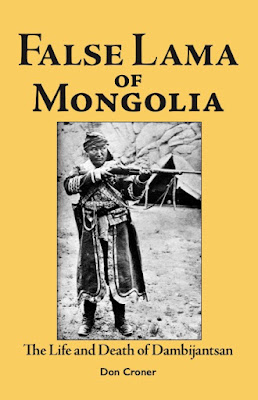
Money Owned to Me by the Kalmyks in Kalmykia, was just a pretext. The real reason for coming to Russia and finally to Astrakhan was to visit the street on which
Dambijantsan lived during his exile in Astrakhan in 1917 and early 1918. The street is just on the other side of this canal.
 Sanjaachodbachoigijaltsan

 Sanjaachodbachoigijaltsan’s student Sodnom


 Sanjaachodbachoigijaltsan’s student Norovsüren
 Sanjaachodbachoigijaltsan’s student Sanjaa Dubmaa
 Here I am (on the right) posing with Sodnom


 at its head (of course the Roerichs wanted to model this country on
  by
by 


