Tuesday, May 13, 2008

Mongolia | Khovd Aimag | Ja Lama and the Siege of Khovd

Who was Dambijantsan?

A Buddhist monk; a freedom fighter for Mongolian independence; the descendant of Amursanaa (1723–1757), the Western Mongol who led the last great uprising against the Qing Dynasty of China; the incarnation of Mahakala, the Buddhist god of war; bandit, torturer, murderer, or evil incarnate? During his lifetime no one was sure who he really was, and even today the controversy about his life continues.

Born in what is now the Republic of Kalmykia, part of the Russian Federation, Dambijantsen traveled throughout Tibet, India, and China before arriving in Mongolia in 1890 where he tossed gold coins to bystanders and announced to one and all that he had come to free Mongolia from the yoke of the Qing Dynasty of China. After disappearing almost twenty years he returned to lead the attack on Khovd City, the last Chinese outpost in Mongolia. Honored by the Eighth Bogd Gegeen, the theocratic leader of Mongolia, for his efforts in achieving Mongolian independence, he went on to establish his own mini-state in western Mongolia, which he hoped to use as a base for establishing a Mongol-led Buddhist khanate in Inner Asia. His dictatorial nature and unbridled sadism soon came to the fore and he was finally arrested and imprisoned in Russia. After the Russian Revolution he returned to Mongolia, gathered new followers around him, and established a stronghold at the nexus of old caravan routes in Gansu Province, China. He robbed caravans, grew opium, and once again dreamed of creating a new Mongolian khanate in Inner Asia. Finally the new Bolshevik government in Mongolia, fearful of his rising power, issued orders for his assassination. Dambijantsan died in 1922, but in Mongolia legends persist to this day that his spirit still rides on the wind of the Gobi and continues to haunt his former lairs.


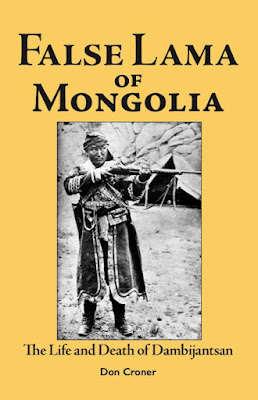
For more on Dambijantsan see False Lama of Mongolia: The Life and Death of Dambijantsan. 


Saturday, February 9, 2008

Mongolia | Baga Nuur | Tsagaan Sar

Wandered out to the town of Baga Nuur to see Zevgee and his family for Tsagaan Sar, the Mongolian New Year. This used to be a fairly tedious trip, but now that the road is paved the whole way it takes only an hour and forty-five minutes to get there. This is the first winter Zevgee has lived in Baga Nuur. Before he lived at his winter camp about forty miles up the Kherlen River valley. This winter he has left the care of his livestock to one of his son-in-laws and has retired to a comfortable log cabin in Baga Nuur.

Zevgee, Mojik, and Zevgee’s wife Tumen-Olzii

Traditional plate of boov, or ceremonial cakes

Sheep back and tail

Zevgee and Mojik

Mojik and Tumen-Olzii

Friday, February 8, 2008

Mongolia | Ulaan Baatar | New Year | Tsagaan Sar

Today is the first day of Tsagaan Sar, the Mongolian New Year. (See Tsagaan Sar 2005 and Tsagaan Sar 2007) Welcome to the The Earth Mouse Year, which is the 22nd year of the 17th Rabjung, according to the Kalachakra Calendar. As you may know, Aniruddha, the 21st Kalkin King, is now reigning in Shambhala.

Monday, January 28, 2008

Mongolia | Ulaan Baatar | Scriptorium

Welcome to the Scriptorium!
One corner of my hovel in the howling wilderness of Zaisan Tolgoi is devoted to my Scriptorium. New Additions to the Scriptorium are made on a monthly and sometimes weekly basis.
One section of my Scriptorium
Just this week there have been four new additions, three fiction and one non-fiction. The first fiction title is Michael Chabon's Gentleman of the Road. I had read Chabon’s first novel The Mysteries of Pittsburgh, which was interesting only because I myself had once lived in Pittsburgh, in the Shadyside District where much of the action takes place, but I had not read anything by him since. But Gentlemen of the Road takes place in 10th-century Khazaria, the Jewish kingdom which then existed on the Steppes Along the Volga River north of the Caspian Sea, and who could resist a setting like that? Later, in the seventeenth century, several tribes of the Oirat, or Western Mongols, including the Torguts and Dörböts, would migrate to this same area north of the Caspian Sea and become known as the Kalymks. The infamous Ja Lama was a Dörbot Kalmyk from this area. The main characters in Chabon’s book are two swindlers and con men, a Jew from Regensburg, in what is now Germany, and a gigantic black Abyssinian from Africa—the title’s Gentlemen of the Road—who get caught up in a scheme to place a Khazar prince on the Khazarian throne. But then it turns out that the Khazar prince is actually a princess! The Gentlemen of the Road should have been tipped off to this when the prince/princess refused to urinate in their presence. Like many con men they could not believe they were being conned. Who could resist a story like this?


Ever since reading The Miniaturist, a tale about a miniature painter in the Indian court of Jalaluddin Muhammad Akbar (جلال الدین محمد اکبر), also known as Akbar the Great (1542 –1605), a distant descendant of Chingis Khan, I have been a big fan of Kunal Basu.

Thus I could hardly resist his book The Opium Clerk, a tale about a Indian clerk working for the East India Company in the late 1800s. Lots of interesting details about the production of opium in India, and some of the action takes place in Canton, where the East India Company unloaded a lot of their opium. On a contemporary note some might say it’s payback time for the Opium Wars, which opened up China to foreign opium, resulting in the addiction of tens of millions of Chinese. Like, who now owns a sizable chunk of Merrill, Lynch and Citibank?

I am also a big fan of Yasmina Khadra, already having read his The Swallows of Kabul, plus The Attack and The Sirens of Baghdad. Yes, I said “his” books, since despite his female pen name the author is a man. Yasmina Khadra (Arabic:ياسمينة خضراء) is the pen name of the Algerian author Mohammed Moulessehoul (born January 10, 1955). Moulessehoul, who was an officer in the Algerian army when he first starting writing, adopted a woman's pseudonym to avoid military censorship. He revealed his true identity in 2001 and now lives in exile in France. So I sprung for one more of his books, In the Name of God, a story about how villagers in Algeria got caught up in fanatical Islamic fundamentalism. Just reading this one—review to follow.

The one non-fiction title added to the Scriptorium this week was The Turks in World History. I stopped by the Silk Road Restaurant the other day and was paging through this book while I had a cup of coffee. On page 12 was an illustration entitled “Nomadic Camp Scene.” The original was done in the fifteenth or sixteenth century somewhere between Herat and Tabriz in what is now Iran. Glancing up from the book I was startled to see a copy of this exact same painting on the wall in front of me. This is just one of the numerous Silk Road-themed reproductions on display at the Silk Road Restaurant. There are also reproductions of the Uighur Princes and Uighur Princesses from the Bezeklik Caves, near Turpan in Xinjiang, China. By the way, the originals of these paintings are now in the Indian Art Museum in Dalhem, on the outskirts of Berlin, Germany. Then on page 42 there is a photo of the Tonyukuk Monuments near Nalaikh, not far from Ulaan Baatar. All and all, this looks to be quite an interesting book. There does seem to be one glaring omission: there is no mention of the Turk Gunj.

Tuesday, January 15, 2008

Mongolia | Gov-Altai Aimag | Tsogt

On the way back from Eej Khairkhan Uul we stopped at the village of Tsogt, high on the wind-swept plateau between the basin of the Gobi Desert to the south and the Biger Depression to the north. The village itself is at an elevation of over 7500 feet. Once an important way-station on the Uliastai–Shar Kuls–Gongpochuan–Suzhou Caravan Route, it also figured prominently in the life of Dambijantsan. He recruited several disciples here and two of his wives. The wives’ names were Myadag and Nyamaa. Myadag reportedly was responsible for making Dambijantsan’s boots and Nyamaa his deels. Myadag and Nyamaa both returned to Tsogt after Dambijantsan was killed. Nyamaa apparently lived until at least the 1960s. Nyamaa claimed that she made Dambijantsan a deel of yellow silk which opened on the left instead of the right. She could not explain why she did this. According to local legend this was the deel Dambijantsan was killed in.

There was also a man named Saaral Jamsran who lived in Tsogt. One day in late 1922 a local official, apparently at that time a Bolshevik commissar, called him in and introduced him to three men who asked if he knew the way to Gongpochuan in Gansu Province. He said he did, and they said “Good, now you are our guide. You must take us there.” He asked why they wanted to go to Gongpochuan. “It’s none of your affair. Just serve as our guide,” one of the men said. Saaral Jamsran agreed. Unbeknownst to him the three men had been sent to assassinate Dambijantsan. One day before they reached Gongpochuan he asked again what they were going to do there. This time one of the man explained that they were just on a hunting trip, hoping to bag some wild sheep or ibex. Saaral Jamsran offered to tell their fortune by reading the patterns on a scorched shoulder blade of a sheep. He did so and then said, “Well, I can see your hunting trip is going to be very successful and that you will find your prey.” The next day they arrived at Gongpochuan. After the assassins killed Dambijantsan, it was, according to local legend, Saaral Jamsran who killed his famous white dog. Saaral Jamsran lived in Tsogt and died in 1960.

While in Tsogt I was able to met with eighty-two year oid Sodnompil and his seventy-four year-old wife Tsiideleg. Tsiideleg says that while at Gongpochuan Dambijantsan sent a message to the head of Tsogt village asking that he send him a “pretty young woman” and “a pretty boy.” She was unable to explain why Dambijantsan wanted a “a pretty boy.” The official was afraid of Dambijantsan and did in fact send him a woman named Otgon and a twenty year-old youth—perhaps pretty but not a boy—named Lavig to Gongpochuan. After Dambijantsan was assassinated they both returned to Tsogt. She also said that her father saw Dambijantsan’s head when it was brought by his assassins from Gongpochuan. One day, she says, he was out looking after his herds when he saw a small caravan of sixteen camels led by two men approaching Tsogt. He rode over to chat with the caravan men. They said they had just come from Gongpochuan and that Dambijantsan had been killed. As proof of this statement they showed him Dambijantsan’s bloody head. Tsiideleg’s father said it was “a horrible thing,” and he quickly rode away without asking anymore questions.
Sodnompil and Tsiideleg
Sodnompil was able to add some information about Lama Ravdan at Eej Khairkhan Uul. He says his father once gave Ravdan a horse. Everyday Lama Ravdan would take this horse and water it at a small rivulet known as Tsoojiin (“Lock”) Gol, on the south side of Eej Khairkhan He also says Lama Ravdan was well-known for producing rain. He says there was a herdsman on the west side of Eej Khairkhan Uul who also farmed some small fields. There was a drought one summer and his crops were dying. Lama Ravdan came and offered to make it rain. He sat down and began various meditations. Although there was a perfectly clear sky a dark cloud soon appeared from beyond Eej Khairkhan Uul and then drifted above the farmer’s fields. Soon it rained and then the cloud disappeared. Lama Ravdan, Sodnompil claimed, became very well known after this incident.

Tsogt was also the site of a monastery known as Tsogtiin Tsogchin Chas. It was destroyed in the late 1930s. The ruins were once surrounded by numerous gers. Then people started noticing lights hovering over the ruins at night and hearing strange noises. This continued for several years. Finally the people got spooked and began moving their gers to the other side of town. Today there are no gers anywhere around the ruins of the monastery.
Just visible foundations of the temples at Tsogt. The area around the temples is now completely deserted.

Monday, January 14, 2008

Mongolia | Ulaan Baatar | Minus 40 Degrees F and C!

Today is the day! At 8:30 am we finally reached that magical moment when the Fahrenheit and Celsius scales coincide! Halleluiah!

Friday, December 14, 2007

Mongolia | Gov-Altai Aimag | Eej Khairkhan Uul

Six days after leaving Ülzii Bilegt we were back in Bayan Tooroi, where we checked into the comfortable guest house of the Gobi Protected Area A Administration. There was no running water in the guest house but there is a separate shower building with solar-heated water. The girls washed their clothes, took showers, slathered themselves with a host of creams and unguents, applied their makeup, and emerged with nary a trace of their fourteen days in the Gobi remaining. The next day we went to the famous mountain of Eej Khairkhan Mountain west of Bayan Tooroi.
Eej Khairkhan Uul
I recalled the legend I had heard when I was here several years earlier. It seems that once, a long time ago, Eej Khairkhan was married to Aj Bogd Mountain far off to the southwest. But Aj Bogd was old, his head was topped with white year round, and his wife was not happy. Far off to the northeast she could see Burkhan Buudai Mountain. Burkhan Buudai was so handsome, standing tall and proud against the torquoise sky. Aj Bogd’s wife could not take her eyes off of him. With each passing day she liked Aj Bogd less and felt more and more desire for Burkhan Buudai. Finally she decided she must flee to Burkhan Buudai. But Aj Bogd became suspicious of his wife. Every night after she went to sleep he would hide her deel so she would have nothing to wear if she decided to run away. One night his wife woke and decided the time had come to run off to her heart’s desire. But she could not find her deel. In her haste she put on Aj Bogd Uul’s deel and ran off to Burkhan Buudai. Her husband woke up and saw her fleeing across the desert. In his anger he grabbed a big handful of sand and threw it at her. His deel was much too large for his wife and the hem was dragging on the ground behind her. The sand landed on the tail of the deel and held her down. She could not move. She has remained to this day in her present location halfway between Aj Bogd Uul and Burkhan Buudai Uul. The sand which fell on the tail of her deel can still be seen as the big dunes to the southwest of the mountain. But fate was not entirely unkind. Her past was forgotten and she is now longer remembered as an unfaithful wife. Her beautiful form standing alone in the desert brought succor to countless lonely caravan men who could see her from far off and eventually she became known as Eej Khairkhan (“Mother Dearest”) Mountain.
The two breasts of Eej Khairkhan Uul. The cleft below, in the middle, is thought to be the entrance to her yoni: the two hills on either side of the cleft may be seen as her labia majora.
Strange rock formations at Eej Khairkhan Uul
More strange rock formations
Still more strange rock formations
The most famous natural feature of Eej Khairkhan is a series of nine cascading pools of water known as the Pots.
One of the Pots
The Pots
The Pots
Near the base of the mountain is the hermitage of the monk known as Ravdan. Ravdan, a Torgut Mongol, was a disciple of Dambijantsan’s who lived at Gongpochuan. After Dambijantsan was assassinated in 1923 he came here and settled at Eej Khairkhan Uul. He kept one white horse and one white camel and soon became known as the “Lama with One White Horse and One White Camel,” perhaps an echo of Dambijantsan’s nickname of the “Two White Camel Lama.” Ravdan lived alone at the hermitage he built but there was a woman named Munidari who lived nearby and brought him food everyday. Some say the two got married; others say not. Ravdan died in 1928. Munidari went on living by herself for many years. Ravdan’s hermitage is now a much revered pilgrimage site.
Ravdan’s Retreat
Ravdan’s Retreat
Interior of Ravdan’s Retreat
Uyanga could not contain her exuberance at Ravdan’s Retreat
Mojik cogitating at Ravdan’s Retreat

Wednesday, December 12, 2007

Mongolia | Gov-Altai Aimag | Ülzii Bilegt

Who was Dambijantsan?

A Buddhist monk; a freedom fighter for Mongolian independence; the descendant of Amursanaa (1723–1757), the Western Mongol who led the last great uprising against the Qing Dynasty of China; the incarnation of Mahakala, the Buddhist god of war; bandit, torturer, murderer, or evil incarnate? During his lifetime no one was sure who he really was, and even today the controversy about his life continues.

Born in what is now the Republic of Kalmykia, part of the Russian Federation, Dambijantsen traveled throughout Tibet, India, and China before arriving in Mongolia in 1890 where he tossed gold coins to bystanders and announced to one and all that he had come to free Mongolia from the yoke of the Qing Dynasty of China. After disappearing almost twenty years he returned to lead the attack on Khovd City, the last Chinese outpost in Mongolia. Honored by the Eighth Bogd Gegeen, the theocratic leader of Mongolia, for his efforts in achieving Mongolian independence, he went on to establish his own mini-state in western Mongolia, which he hoped to use as a base for establishing a Mongol-led Buddhist khanate in Inner Asia. His dictatorial nature and unbridled sadism soon came to the fore and he was finally arrested and imprisoned in Russia. After the Russian Revolution he returned to Mongolia, gathered new followers around him, and established a stronghold at the nexus of old caravan routes in Gansu Province, China. He robbed caravans, grew opium, and once again dreamed of creating a new Mongolian khanate in Inner Asia. Finally the new Bolshevik government in Mongolia, fearful of his rising power, issued orders for his assassination. Dambijantsan died in 1922, but in Mongolia legends persist to this day that his spirit still rides on the wind of the Gobi and continues to haunt his former lairs.


For more on Dambijantsan see False Lama of Mongolia: The Life and Death of Dambijantsan. 


Tuesday, December 11, 2007

Mongolia | Gov-Altai Aimag | Shar Khuls to Ülzii Bilegt

Since we only had 14 mlies to go to Ülziii Bilegt we did not leave our camp at Shar Khuls until ten o’clock. As we rode through the oasis I wondered about the whereabouts of the Gobi bear that is supposed to live at the oasis. Gobi bears are extremely rare. Sükhee says there are perhaps only twenty-five or thirty in the entire south Gobi of Mongolia. One of his jobs as nature preserve ranger is to monitor the Gobi bear population. The Gobi A Nature Preserve also had a program to feed the bears and Sükhee takes part in this, so he knows quite a bit about Gobi bears. The last time I was at Shar Khuls there was a bear here. We encountered its tracks everywhere and saw numerous piles of still steaming dung. The camels were completely spooked and refused to stay in the oasis itself. We had to camp a hundred yards out in the desert. But now there was no sign of the bear. Sükhee says they are extremely elusive and are very seldom seen under normal conditions.
South of Shar Khuls Oasis
We emerged from the southern end of the oasis and continued south through a wide valley. This was the route of famous Amarbuyant Khiid–Anxi caravan route that went past Dambijantsan’s Fortress at Gongpochuan, described to me by Shukee in Shinejinst. At one point we encounter a group of five ovoos. Now ovoos are hardly unusual in Mongolia, but these are the first we have encountered on our trip here in the south Gobi. And they are of strange design. They are no just heaps of rocks like most ovoos but barrel-shaped constructions of fitted rock. The insides of the barrel-like ovoos are filled with sand and gravel. Tsogoo says that local people have never been quite sure who made these ovoos or why, but there has been speculation that they were built by Dambijantsan. Why here at this place remains a mystery.
Ovoos on Amarbuyant Khiid–Anxi caravan route
Trail south
We ride on through a place where the valley narrows. As usual the camel men and the girls and our one pack camel are riding in a bunch out front and I am trailing about one hundred feet behind, fingering my mala as I repeat mantras. As the group passes by a spur of sandstone that protrudes into the valley I notice that everyone suddenly stops. Tsogoo shouts something and jumps off his camel. Mojik shouts at me, “Don, get off your camel!” Mojik, Uyanga, and Sükhee turn their camels to the right and start frantically beating them with their taishirs. Sükhee shouts “Mazaalai,” and then to my utter astonishment I see a huge Gobi bear come loping full speed around the corner of the spur of rock. Tsogoo has his camel by the lead rope and is running off on foot off to the right. My camel has apparently not seen the bear and I jerk its head around to the right and whip it with my taisher. I have to get out the path of the bear. When the bear is no more than seventy or eighty feet from Tsogoo it suddenly stops in its tracks, does a 180º degree turn and runs off over a ridge to the right. I get a good look as it runs away. Gobi bears, known as mazaalai, are not supposed to be big, but this one appeared to be about the same size as a large black bear, lean and rangy, but over four feet high at the shoulders and weighting upward to 300 pounds.
Mazaalai tracks
We regroup near the spur of rock. Tsogoo is so shaken he is hyperventilating. In all their years in the Gobi neither he nor Sükhee had ever had such a close encounter with a bear. “Bad, very bad,“ he keeps muttering. “We could have been killed.” Finally he has to sit down to catch his breath. Mojik keeps saying, “I don't believe this, I don't believe this.” Uyanga has a different take on the encounter: “This is a story to tell my grandchildren.”

Why did Tsogoo jump off his camel, and then tell the others to jump off? I wondered. Mojik explains that he was afraid the camels would see the bear, go completely berserk and throw their riders, maybe right in the path of the bear. He thought we would have a better chance on foot. I for one was going to take my chances on my camel. Oddly, the camels in the group in front never seemed to have seen the bear. I know mine did not. Even more oddly, the wind was blowing straight into our faces. Why had our camels not scented the bear? We spend a half an hour catching our breath, retelling the episode over and over again, and then finally move on.
We regroup after our bear scare
Soon the valley widens into a vast expanse of desert extending off to the southeast. Off to the left is a range of light colored ridges with stark black mountains looming behind. Soon we come to the mouth of a narrow canyon leading into the mountains. Scattered among the gravel outwash from the canyon are trunks and huge roots of tooroi trees, carried here by the torrential flash floods which sometimes occur here in the Gobi. Somewhere up the canyon there has be a stand of tooroi trees. This is the entrance to Dambijantsan’s secret hideout of Ülzii Bilegt. We turn out camels and head into the canyon opening.
Entrance to the canyon leading to Ülzii Bilegt

Monday, December 10, 2007

Mongolia | Gov-Altai Aimag | Shar Khuls Oasis

The next morning we round the easternmost spurs of Zaraa Khairkhanii Nuruu and by ten o’clock we could make out to the southeast the Shar Khulsnii Nuruu. Shar Khuls oasis is somewhere on the northern side of these mountains. I had been to Shar Khuls before, but I had approached the oasis from Amarbuyant Khiid directly from the north. Tsogoo and Sükhee had also been there before, but not by this direct camel route, and now they were not sure where the oasis was. Carelessly I had not bothered to bring the GPS coordinates for Shar Khuls since I did not anticipate any problems finding it. Now we sit on a high ridge and study the Shar Khulnii Nuruu for an hour before making out an opening in the mountains about ten miles away which Tsogoo concludes must be Shar Khuls Oasis. We ride on and an hour later can just make out through binoculars dark patches of vegetation which must be trees. These would be the first trees we have seen since leaving Bayan Toroi 115 miles to the north.

Thus our experience was very similar to that of the Roerich Expedition which arrived at Shar Khuls on May 5, 1927. George Roerich noted in his Trails to Inmost Asia:
“Towards four o’clock in the afternoon . . . we noticed several dark spots at the foot of the mountains and at the entrance into a narrow gorge hidden behind a long spur. Someone in the caravan column cried out ‘Trees!’ We could not believe our eyes, for most of us were firmly convinced that at best, we would see only miserable juniper shrubs. But there in the distance were actual trees, desert poplars (Populus euphratica) that grew along the banks of the river. How refreshing it felt to enter the coolness of the forested gorge, and camp on the green meadows.”
The Roerichs—painter, mystic and hard-core Aghartian-Shambhalist Nicholas Roerich; his wife Elena, who had translated The Secret Doctrine of Madame Blavatsky into Russian; his Harvard educated son and Tibetan translator George; and various factotums—had left India in March of 1925 for what would be a three-year sojourn through Inner Asia. As I noted in an earlier post, “Nicholas Roerich claimed he was looking for inspiration for his paintings, and his son George was supposedly engaged in various ethnological and linguistic researches. From the three books churned out by Nicholas Roerich about the expedition it is pretty clear however that they were actually looking for the kingdom of Shambhala.” It was Madame Blavatsky who in The Secret Doctrine had posited the idea that Shambhala might be found somewhere in the Gobi Desert. (Apparently the Roerichs were not aware of Khamariin Khiid in Dornogov Aimag, now considered by many to be a Portal to Shambhala.) From India they had traveled north into the Tarim Basin in what is now Xinjiang Province, China, visiting the Rawak Stupa near Khotan, and then traveled north to Urumqi, the capital of Xinjiang. After a brief detour to Moscow where they had attempted to entangle the Soviet Secret Police in a plot to establish an actual state modeled on the Kingdom of Shambhala in Central Asia they proceeded first to the Russian Altai Mountains and then to Mongolia, arriving in Ulaan Baatar in September of 1926. Here Nicholas Roerich presented one of his paintings entitled “The Ruler to Shambhala”—this may or may not be painting now known as the Red Warrior in the Zanabazar Fine Arts Museum in Ulaan Baatar—to the Mongolian government. They left Ulaan Baatar by motorized vehicle on April 13, 1927 and arrived at Amarbuyant Monastery in Bayankhongor Aimag a week or so later. Here they hired camels and continued south on their sojourn through Mongolia, China, and Tibet, eventually ending up in Sikkim, India.

A few years earlier I had followed their route from Amarbuyant Khiid to Shar Khuls by Camel, a distance of 105 miles which took six days to cover by camel. This was also the route taken by the 13th Dalai Lama in 1904, when he fled to Mongolia to escape the Younghusband Expedition which had earlier invaded Tibet. The 13th Dalai had himself camped at Shar Khuls Oasis and stayed at Amarbuyant Khiid for ten days.
The northern end of Shar Khuls Oasis
Shar Khuls Oasis
We reach Shar Khuls at three in the afternoon, set up camp on the gravel bars at the northern end of the oasis, and are soon tucking into a big meal of boiled mutton and homemade noodles. The wind has died completely and in the afternoon sun it is quite warm. Compared to the last three days the conditions are downright luxurious. Nearby a spring issues forth a six-inch wide stream of water which flows for maybe one hundred feet before disappearing beneath the sands. This is the main water source for Shar Khuls. Tsogoo, Sükhee, and the girls all decide to wash their hair and get cleaned up.
Sükhee helping Tsogoo with his ablutions
Tsogoo has a nasty bruise on the side of his chest and is still convinced he broke something, probably a rib or two. I had kept him dosed down with prescription painkillers and when these ran out gave him Advil. Oddly, he claims the Advil offers more relief that the supposedly more powerful painkillers. He has Mojik prepare a huge poultice from tea (Yunnan Gold black tea, which I am only too happy to sacrifice to this cause) which he places on the bruise, holding it in place with a wool scarf wrapped around his chest. He says he still has some pain but he will be fine. He even decides he needs a haircut.
Uyanga shearing Tsogoo
Shar Khuls was once the crossroads of two important caravan routes. One ran north-south from Amarbuyant Khiid and across the Black Gobi and Maajin Shan to Anxi in current day Gansu Province. This route passed by Dambijantsan’s Fortress at Gongpochuan. The other route ran east-west from Hohhot in what is now Inner Mongolia, China, to Gucheng (now known as Qitai) on the northern side of the Tian Shan in Xinjiang, China. (I had visited Qitai back in May but could not find a trace of the caravanserai for which the town had once been famous.) Because of its important as a caravan crossroads it had not escaped the attentions of Dambijantsan. George Roerich:
“Situated not far from the Mongol border, the gorge was always a favorite haunt of robbers. Ja Lama maintained outposts here to look after the caravans coming from China, Tibet, and Mongolia. Even after Ja Lama’s death, the gorge was still visited by robber bands. Only a month before our passing a big camel caravan en route for Ku-ch’eng [Qitai] was plundered in the gorge and one of its drivers killed. Our Mongol guides advised us to be very careful and to keep watch in the night.”
Dambijantsan’s hideout while plundering the caravans using these routes might well have been at Ülzii Bilegt, our next destination.
The tooroi trees of Shar Khuls Oasis
At one time Chinese renegades and outlaws from Gansu Province in China had settled here to grew opium. George Roerich says they found the former dwellings of these opium growers at Shar Khuls, but that these Chinese had left some twenty years ago. Yet one of my informants, an eighty-two year old man named Tsedev who now lives near Shinejinst in Bayankhongor Aimag, claims that the opium growers were still there in Dambijantsan’s time. As a young man he had traveled the Amarbuyant Khiid–Anxi caravan route many times and had once lived for awhile at Gongpochuan. He claimed that Dambijantsan, who was opposed to all use of drugs and alcohol, killed the Chinese opium growers at Shar Khuls and destroyed their plants. He said that when he was a young man he saw the skeletons of Chinese killed by Dambijantsan at Shar Khuls.
82 year-old Tsedev of Shinejinst
The 13th Dalai Lama was met here at Shar Khuls by a delegation of the famous chanting monks from Amarbuyant Khiid. They accompanied him by camel for the six day trip to Amarbuyant, chanting all the way.

Later Mojik and I go to check out the Dalai Lama’s Spring, a tiny outflow in a grotto beneath a cliff of basalt. According to local lore the 13th Dalai Lama blessed this spring and prophesied that one day the water from here would serve as a great cure for local people. On my last trip local people had told me that people had in fact started coming here to drink the water in hopes of a cure for a peculiar throat ailment which seems to afflict residents of the south Gobi. Just above the spring is the 13th Dalai Lama’s Ovoo, reputedly built by the 13th Dalai Lama himself.

Mojik getting water from the spring which had been blessed by the 13th Dalai Lama
Ovoo which locals claim was built by the 13th Dalai Lama during his stay at Shar Khuls Oasis
Tsogoo taking the camels to water

Mojik contemplating a bowl of Iron Goddess of Mercy oolong tea.

The Roerichs would later say that Shar Khuls Oasis was the best camping spot they encountered on their entire trip from Ulaan Baatar through Mongolia, China, Tibet and on to Sikkim in the Himalayas. We certainly had a nice stay, but I was eager to move on to Ülzii Bilegt, Dambijantsan’s hideout in the mountains to the south.
Shar Khuls Oasis