Saturday, November 10, 2007

Mongolia | Gov-Altai Aimag | Tsagaan Burgasny Bulag to Otgonii Bulag

While I slept I kept one ear open for the camel men and camels. At two on the morning when I got up and looked outside they had still not arrived. Then at 4:00 a.m. I glanced out again and in the light of a slightly less than Full Waning Moon (84.148% illumination) I saw our eight camels all in a sitting position, thoughtfully chewing their cuds. Amazingly the camel men had arrived without the usual ruckus of shouted commands and snorting and baying camels and apparently had gone off to sleep in the ger of the watchman. I got up at 5:30, built a camp fire of saxual wood at the base of the mountain near the guest house and when the sun rose at 6:09 I was contentedly sipping the fourth or fifth bowl of five-year-old Puerh Tea of the dozen or so that I usually have for breakfast. The camel men did not get up until 9:30, explaining that they had rode most of the night and had only arrived at 3:30 a.m. After a few bowls of tea (I gave them Lapsang Souchong, or Caravan Tea) and some bortsog they immediately began to pack the camels. We had three water containers, a metal milk can holding 40 liters and two plastic jugs holding 20 liters each. Since we expected to reached Otgonii Bulag, the next source of water, by noon of our second day, we took only one 20 liter jug of water from here at Tsagaan Bugasny Bulag. Sükhee and Tsogoo sorted the loads and divided them between our three pack camels and by 11:00 we were off. From here to Ülzii Bilegt, the site of Dambijantsan’s Hideout, is exactly 200 kilometers ATCF, or 124 miles, a distance we hoped to cover in six or seven days.
Our camels resting at Tsagaan Bugasny Bulag
Sükhee checks our meat supply: one sheep and one goat
Tsogoo and Sükhee balancing the camel loads
Our route first took us through a mountain range known as Edriin Nuruu, which rises out of the desert floor at around 4000 feet elevation about five miles west of Tsagaan Burgasny Bulag and trends eastward through Gobi-Altai Aimag and into Bayankhongor Aiimag. The highest peak in the range is 6811-foot Yumt Uul, not far east of of Tsagaan Burgasny Bulag. We proceeded up a narrow draw known as Khar Khundii, crossed a low pass, and descended through another draw known as Khüren Dovkhiin Khooloi.
Proceeding into the Edriin NuruuThe jagged peaks of Edriin Nuruu
Crossing the pass through the Edriin Nuruu
Emerging from Edriin Nuruu out onto the desert floor
We stopped for a late lunch at a place called Sukhai Khudag, located right where the trail debouches from the mountains out onto the flat desert floor. There is a well (khudag) here, but it is currently dry. “Sukhai” is a kind of bush that grows in large clumps reaching ten or twelve feet high. The small trunks of the bush, which don’t get much larger than a broom handle, are the favorite material for the handles of taishir, the short whips used by camel men to encourage their camels.
Sukhai bushes in autumn colors
The rest of the day we traveled across flat desert sparsely vegetated with saxaul and wormwood bushes. After the difficult passage through the mountains the camels quickly assumed their well-regulated paces. Camels of course can trot, and camel races are quite the thing, especially in Omnogov Aimag, but on a long-distance trip like this, with the pack camels carrying precariously balanced loads, the camels are seldom trotted. Trotting aside, camels have two walking speeds, slow and slower. When they are relatively fresh and rested, as ours were at the moment, they plod along hour after hour at an average of 5.4 kilometers (3.35 mlies) per hour. At the end of a long tiring day, or after a few long days of travel, they often shift into lower gear, covering an average of 4.7 kilometers (2.93 miles) an hour) per hours. I have tracked the pace of camels for hours and the pace never really varies much from these two speeds. This makes it quite easy to calculate traveling times. Assuming the terrain is more-or-less level and your camels are still fresh, you can expect to travel about thirty-seven kilometers in eight hours of travel. This was the pace we would try to maintain throughout the trip.

While plodding along I questioned Tsogoo about our mounts. Camels have a life-span of about thirty years, and my camel was about twenty-years old. I was a bit surprised to discover that it was about six months pregnant. Camels have a gestation period of one-year, mating usually around March and giving birth in March of the following year. Mojik’s camel was the offspring of my camel and was also six months pregnant. I expressed my concern that this trip might be difficult for these mothers to-be. On a previous camel trip in Bayankhongor the camel one of the camel men had been riding had aborted its six-month old fetus while we were on the march. The camel stood moaning over the dead fetus for about ten minutes—I swear there were tears in her eyes—before the camel man mounted up and we went on our way without any further ado. Tsogoo told me not be worry, however; he claimed that a trip like this was nothing for six-month pregnant camel. In fact, the exercise might have salubrious effects on the camel, which otherwise would have just sat around all day chewing its cud. Just to careful, he told me, not to kick the camel in the stomach or hit it in the stomach with my taishir.

He also allowed that he had brought the two pregnant camels along for a reason. Pregnant camels, he claimed, are very protective of even their unborn young, and as a result are not prone to acting up and engaging in any wild shenanigans. He did not know how experienced Mojik and I were at riding camels so he thought pregnant ones—tending to be calmer and more well-mannered—might be best for us. He claimed that two pregnant camels would also have a calming effect on the rest of the camels. This was especially important since two of the camels he had brought along were three-year-olds who had not been been fully trained to kneel and sit down on command. In order to make these camels kneel Tsogoo had tied a rope around their right ankle and then ran the rope behind their front hump. When he wanted one of them to kneel he pulled on rope, jerking the right leg up from under the camel. Unable or unwilling to stand on only one leg the camel quickly kneeled down on its front legs. Unable to stand for long on its back legs in this position it then sat down completely, although often not without complaint. To show its displeasure it often spit clods of green, vile smelling cud at anyone with in range. An old camel hand like Tsogoo took this in stride. He didn’t even bother brushing the clods of cud off his deel. He just let it dry and fall off of it own accord.
Heading south from Edriin Nuruu
We rode that night until about 6:45, fifteen minutes after the sun set, and camped on the gravel flats, amidst plenty of saxaul wood. What with the late start and lunch break we covered only twenty-six kilometers for the day. As usual in the desert I did not set up a tent—just threw a carpet out on the sand and slept under the stars, or as they say, “in the Big Tent.” A dead calm night and amazing warm—45º at three in the morning. Orion dominates the southeast sky in the morning hours. The moon is now illuminated 75%, limiting star viewing somewhat, but I expect some spectacular skies before the trip is over—the New Moon is on the 11th.

We moved on at 9:00 the next morning and reached Otgonii Bulag, in a canyon on the north side of Otgon Uul, at about 12:00. The small spring, located along one of the canyon walls, is covered with green algae, but Tsogoo assures us that the water is quite good. It is icy cold and sweet-tasting, but the true test will come at our lunch break when we make tea from it. We fill all of our three containers for a total of 80 liters of water. From here to the next water at Shar Khuls is 145 kilometers (90 miles), which should take us three and a half days to cover.
Camp Boss Uyanga dipping water out of Otgonii Bulag
Uyanga tickled pink by the pure, sweet water of Otgonii Bulag
My camel enjoying a sip of water at Otgonii Bulag.
I ask you, have you ever seen a lovelier camel?

Saturday, November 3, 2007

Mongolia | Gov-Altai Aimag | Bayan Tooroi to Tsagaan Burgasny Bulag

After a memorable night enjoying the delectable delights of the Bayan Tooroi Oasis—a description of which I will omit here, since it lies outside the boundaries of the narrative of our journey to Ülzii Bilegt—we moved on to the ger of a man named Tsogoo from whom we intended to rent camels.
Tsogoo and two of his magnificent camels
Tsogoo’s ger is 18.3 kilometers west of Bayan Tooroi and 23 kilometers east of Eej Khairkhan Uul, in an area known as Zakhuin Gov, much of which covered with ders, a kind of grass which grows in thick clumps reaching heights of over six feet and which is much beloved by camels.
Tsogoo's camels with Eej Khairkhan Uul in the distance
Tsogoo, forty-five years old, is a locally well-known camel herder who we were told by usually reliable sources knew the route from here to Shar Khuls and on to Ülzii Bilegt like his own jugular vein, or the back of his hand, or some other equally familiar body part. With him was a thirty year old man named Sükhee who has also agreed to come with us. He normally works as a ranger in the Gobi Protected Area A, the huge nature preserve which begins just south of Bayan Tooroi and extends south the whole way to the Chinese border. (Gobi Protected Area B is farther west, in Khovd Aimag, in case you’re wondering.) With him along we would not have to worry about unpleasant encounters with rangers in the nature preserve—a reoccurring theme during my previous visits to Gobi Protected Area A—since he himself was the ranger, if you grasp my point. He also claimed to knew the way to Shar Khuls and even claimed to have visited Ülzii Bilegt five or six years earlier while accompanying some people doing research on mazaalai, the extremely rare Gobi bear found only at certain oases in the south Gobi, including Shar Khuls. A mazaalai used to hang around Ülzii Bilegt, Sükhee told us, but he was unable to say if it was still there now.

We spent the morning picking out camels—we would need eight, five and riding and three for baggage and water—and preparing saddles, bridles, lead ropes, and whatnot. I also bought a sheep and a goat which were quickly dispatched and reduced to manageable sized pieces. I was told that it had been quite warm in the Gobi and there was some danger of our meat spoiling during our two-week trip. Hence the goat, the meat of which will keep much longer than sheep meat. We would eat the sheep first and then move on to the goat.

It was soon decided that instead of beginning our camel trip here we would drive by jeep to the Bear Research Station at Tsagaan Burgasny Bulag (bulag = spring) on the north side of Edriin Nuruu (nuruu = mountain range), thirty kilometers south of Tsogoo’s ger. Tsogoo and Sükhee would proceed to here with the camels and the next morning we leave for Shar Khuls.
Tsaidam, or salt flats
From Tsogoo’s ger we drove south across vast salt flats to the northern foothills of Erdriin Nuruu and up a canyon to Tsagaan Burgasny Bulag. Here the administration of the Gobi Protected Area A maintains a tidy little guest house for researchers who come here to study bears and other fauna and flora of the Gobi Desert. Indeed, upon arriving here we encountered a van load of Mongolian and Chinese scientists from Inner Mongolia in China who had stopped by for a quick look around. They quickly departed.
Guest House at Bear Research Station
A young man and woman and their small daughter live year-round here in a ger and serve as caretakers.
Wife and daughter of caretaker at Tsagaan Bugasny Bulag
The man explained that the Gobi Protected Area A Administration hoped to capture a Gobi bear and bring it here so scientists could study it in captivity. They also hoped that paying tourists would come to see the bear and stay in the guest house, thus providing funding for further research. This sounded like a hare-brained scheme to me, but since Gobi bears were outside of my field of interest I did not pursue the matter. The man also confirmed that from here south to Ülzii Bilegt—a distance of exactly 200 kilometers—there was no people whatsoever. We would be completely on our own. Water was available here, but the next water would be at Otgonii Bulag, 38.7 kilometers south of here.

When we were shopping in Altai I had expected camp boss and cook Uyanga to buy noodles, a staple of any trip into the countryside. She had not, explaining that she, like any self-respecting Mongolian housewife, would make her own kherchsen guril—noodles freshly made from flour. After tea (Yunnan Gold) we retired to the cook shed to prepare three kilos of kherchsen guril and four kilos of bortsog, or fried bread, another staple of the countryside. I mentioned to Mojik that I was surprised Uyanga would go to all the trouble to make noodles when we could have easily bought them ready-made in the store. Mojik informed me that both she and Uyanga do not approve of store-bought noodles. They have a tendency, so Mojik claimed, to linger in the intestinal tract for three or four days, often with unpleasant results, while freshly made noodles move right on through with admirable dispatch. I was completely unaware of this. The things you learn on a camel trip!
Mojik making kherchsen guril
The waning gibbous moon rose at 7:23 and the sun set ten minutes later at 7:33. The moon was high in the sky by the time we finished preparing the noodles and bortsog. When we turned in at 10:30 the camel men had still not arrived.

Wednesday, October 24, 2007

Mongolia | Gov-Altai Aimag | Biger to Bayan Tooroi

The town of Biger, near the bottom of the Biger Depression at an elevation of 4404 feet, or some 5095 feet lower than Dütiin Pass, is famous for a number of things, including vodka made from yak milk and vegetables which thrive in the nearby oases.
Yak milk vodka made at local distillery. Eat your heart out, Smirnoff!
Careening into the small town square we were surprised to find a small fair in progress. People from the various bags in the area—an administrative area very roughly equivalent to an American township—were in town to show off and hopeful sell their various products.
Local produce for sale
Nice display of aaruul—dried curds—from Bag #3
We were immediately struck by the huge potatoes for sale. Local boosters claim the Biger Depression is home to the largest potatoes in Mongolia. We had already bought potatoes in Altai but could not resist adding five more kilos of these gargantuan tubers to our supplies.
Uyanga and typical Biger spud

There were also saddles for sale. Forgot to ask the price of this one.
Interesting as the vegetables and whatnot were I was eager to track down Namsum, the local retired school teacher with whom several years earlier I had ascended Burkhan Buudai Uul, and question him some more about Dambijantsan. When we asked for directions to his house, however, we received the disconcerting news that he had transmigrated two years ago.
Namsum on the way to Burkhan Buudai Uul, several years earlier
Namsum with a snow leopard skull we found on Burkhan Buudai Uul
With no reason to linger any longer in Biger we headed south, climbing through the Gov-Altai Mountains to another pass oddly enough also known as Dütiin Davaa, the same as the pass on the northern side of the Depression. Although it had been quite balmy in Biger at 4400 feet on the 9428-foot pass there was fresh snow.
Valley leading through the Gov-Altai Mountains to Dütiin Davaa
Fresh snow near Dütiin Davaa
From the pass we dropped down to the small town of Tsogt, which as mentioned earlier was the beginning of the Tsogt–Gongpochuan caravan route mentioned by Shukee in Shinejinst. Beyond Tsogt we climbed to Üreltiin Davaa and then began the long descent down through the Üreltiin Canyon to the Gobi Desert. In the distance, from the floor of the desert, soared Eej Khairkhan Mountain, the most famous landmark in the area. The mountain is named Eej Khairkhan (Mother Dearest) supposedly because its twin peaks resemble two breasts. By early evening we arrived at the oases of Bayan Tooroi. Here we would spent the night before meeting our camel guys the next day.
The magnificent mammaries of
Eej Khairkhan thrusting into the azure sky

Sunday, October 21, 2007

Mongolia | Gov-Altai Aimag | Altai to Biger

Back in Ulaan Baatar I stopped by Great Genghis Expeditions and asked their in-house guru Professor Terbish if he had ever heard of Dambijantsan’s hideout in the Gobi. Terbish is one of the world’s leading experts on Gobi flora and fauna and has traveled extensively through Mongolia’a deserts. He said he seemed to recall that one of his colleagues in the biology department of the Mongolia State University had once stumbled upon the ruins while researching Gobi bears in the south Gobi. The man was out of town as the moment but he would contact him as soon as possible and get more details. A week later I stopped by Terbish’s office again and discovered that his colleague had indeed found the ruins and that he even had the GPS coordinates for them. They were located at a place called Ülzii Bilegt in southern Bayankhongor Aimag, about twelve miles ATCF southeast of Shar Khuls, not far from the border with Gob-Altai Aimag. This was an extremely remote area, noted Terbish. There are no herdsmen living within a hundred miles of the place.

As mentioned earlier, I had already been to Shar Khuls By Camel Via The Old Caravan Route That Started At Amarbuyant Monastery. This was one of the two routes to Dambijantsan’s fortress at Gongpochuan in Gansu Province, China, mentioned by Shukhee in Shinejinst. The other started in the town of Tsogt in Gov-Altai Aimag. I had been in Tsogt before and knew there was a road from here to the oasis of Bayan Tooroi, the southernmost town in Gov-Altai Aimag. The ruins at Ülzii Bilegt, I determined, were 134 mile south of Bayan Tooroi.

Of course I had to visit Ülzii Bilegt. I decided I would fly to Altai, the capital of Gov-Altai Aimag, proceed to Bayan Tooroi by vehicle, and there hire camels for the journey 134 miles south to the ruins at Ülzii Bilegt. From Bayan Tooroi I would also attempt to trace the Bayan Tooroi-Shar Khuls section of the old Tsogt-Gongpochuan caravan route mentioned by Shukhee. I reckoned that the trip from Bayan Tooroi to Ülzii Bilegt via Shar Khuls and back would take about 14 days by camel.

I quickly hired on as historical consultant and translator my friend Mojik, who had helped me with my Guide to Locales Connected to the Life of Zanabazar, First Bogd Gegeen of Mongolia. She was just back from a stint in Heidelburg, where she added German to her already formidable array of languages. Fortunately she had not gotten involved in any duels in Heidelburg and was raring to go on a camel trip.

Mojik: Note the lack of dueling scars.
I also enlisted as camp boss and cook a twenty-five year-old woman named Uyanga who appeared fully capable of dealing with obstreperous camel men.

Uyanga: “Bring’em on!”

The three of us flew to the town of Altai, capital of Gov-Altai aimag, a two and half hour flight on one of MIAT’s ancient prop planes. Altai, at 7234 feet is the highest aimag capital in Mongolia. The hills to the south of the city were streaked with snow on the day we arrived. We proceeded to the market and bought ten kilos of potatoes, two kilos of onions, three kilos of carrots, three large heads of cabbage, two kilos of turnips, three kilos of sugar, ten kilos of flour, two liters of cooking oil, a kilo of salt, two kilos of hard candies, and a box of Choco-Pies. The latter two items were for Mojik, who like all translators has a sweet tooth. (Note to researchers: an interesting monograph could be written about why translators crave sweets.) Meat I would buy in Bayan Tooroi in the form of a sheep and a goat.

Of course, a large part of provisioning any camel trip is the choice of teas. I had brought these along from Ulaan Baatar, having stocked up during my Last Tea-Buying Trip to China. For this trip I choose a disk of five-year old Puerh, a half kilo of Yunnan Gold black tea, a half-kilo of Lapsang Souchang black tea, and a quarter kilo of of Tie Guan Yin oolong tea, the latter for the more delicate palates of the ladies. (I like it myself, of course, but not generally outdoors, in the desert, where more robust brews are generally called for.) Lapsang Souchang, also known as Caravan Tea, was especially appropriate for a camel trip. A specialty of Fujian Province of China, the leaves are dried over fires of pine wood, which give the tea its distinctive smoky taste. In the old days smoke curing was intended to preserve the tea as it traveled on the backs of camels across the Gobi from China to Russia. Even today it makes for an ideal brew on the desert, the smoky taste mingling nicely with the smoke from saxual-wood campfires.

The next day we started out by van for Bayan Tooroi, 102 mile to the south. Sixteen miles southwest of Altai we crossed 9099-foot Dütiin Davaa (Pass). The ovoo here at Dütiin was reportedly erected by a very famous lama named Buural Lamkhai (c.1860-c.1910). As late as the nineteenth century Gov-Altai and especially the region around Dütiin Davaa was well-known for its shamans. They were notorious for causing mischief of one kind or another and were especially skilled at inflicting curses on people. The local herdsmen were afraid of them and they were in constant conflict with the local Buddhist lamas. Once Buural Lamkhai and some of his disciples set out on a trip to Khovsgol Aimag in northwest Mongolia. They had no sooner started out than two shamans, followers of the chief shaman in the area, stole their horses. Buural Lamkhai went into mediation and then began chanting. This went on for several days. Soon the chief shaman fell ill; his arms and legs became numb and he was unable to move. Suspecting that Buural Lamkhai was the cause of his ailments he ordered his two followers to return the stolen horses and then begged the lama to come and heal him. This Buural Lamkhai did. The chief shaman recovered his health but his shamanic power was broken. To commemorate his victory over the shamans Buural Lamkhai built this ovoo here at Dütiin Davaa and established a temple nearby named Bureg Nomyn Khaan Khiiid. The temple has since been destroyed, but all travelers on the road still stop at the pass and make offerings to Buural Lamkhai’s ovoo.


Ovoo built by Buural Lamkhai at 9099 -foot Dütiin Davaa


The Biger Depression and the Gov-Altai Range to the south


Another view of the Biger Depression and mountains to the south

From the far side of Dütiin Davaa we begin our gradual descent into the Biger Depression. This huge natural sump, with no outlet to the sea, drains an area very roughly fifty miles from east to west and twenty miles from north to south. At its bottom is a salt lake, Biger Nuur, measuring several miles long, its size varying considerably on the time of year and the amount of recent rainfall. The lake itself, again depending on its current level, is at about an altitude of 4200 feet. On the south the depression ramps up to a range of mountains with several peaks of over 11,000, and the north to a range known as Shar Shorootiyn Nuruu, with peaks of over 10,300 feet.

A prominent peak of the range to the south, 11,092 Burkhan Buudai Uul, is one of the sacred mountains of Gov-Altai Aimag. A few years earlier I had ascended Burkhan Buudai Uul by horse with a man named Namsum, a retired history teacher from the town of Biger at the bottom of the Biger Depression. Namsum had told me an intriguing story about how his grandfather had once met Dambijantsan. Apparently this took place after Dambijantsan’s return from Russia c.1917. Having heard that the famous Ja Lama—then known as Ja Bagsh (teacher) was in the area the grandfather went to pay him a visit. Since he knew Ja Bagsh favored white camels he took along nine white camels which he intended to give him as a gift. Upon entering the ger where Ja Bagsh was staying the man was first struck by his appearance. He did not look like a Mongolian, he claimed, but more like a Khazakh or even a Russian. Also, he claimed that Ja Bagsh spoke the Khalkh dialact of Mongolian very poorly and that he could barely understand him. All in all, he formed a very bad impression of the famous Dambijanstan and finally went away without giving him the camels.

This bit about the Khalkh dialect intrigues. There are big discrepancies in the accounts of what languages Dambijantsan spoke and how well he spoke them. Others who knew him claimed he spoke the Khalkh dialect almost perfectly. I will discuss this subject in more detail later.

In any case, according to Namsum’s grandfather, Dambijantsan later returned and stole the gold-plated ganchirs, the ornaments found on the eaves of temple roofs, from Biger Nomin Khanii Khiid, the big monastery near the town of Biger. This was hardly in keeping with Dambijantsan’s reputation as a teacher of the Dharma.

Ruins of Biger Nomin Khanii Khiid
This monastery was founded in 1830 by a Tibetan monk named Luvsangeleg who had come to Mongolia at the invitation of Zasagt Khan Gelegyampil. Eventually up to 300 monks lived here and it was considered one of the richest monasteries in Mongolia. It was destroyed in 1937 or 1938. One hundred and thirty camel loads of paintings, scrolls, books, statues, and various other religious implementia were hauled a few miles away and burned. Before this, however, monks had managed to spirit away a number of statues containing in all 137 kilos of gold, according to Namsum (this figure sounds a bit suspicious to me: at current prices this amount of gold be would be worth $3,730,715), and bury them in the desert nearby. In the 1960s a Soviet Russian Geological Expedition, using metal detectors, reportedly found the statues and carted them off. Namsum said that a sheep belonging to one of his relatives had fallen into the hole left by the excavators, which is what first tipped off the locals as to what had happened.

Ruins of Biger Nomin Khanii Khiid

Mongolia | Bayankhongor Aimag | Ja Lama's Hideouts

Who was Dambijantsan?

A Buddhist monk; a freedom fighter for Mongolian independence; the descendant of Amursanaa (1723–1757), the Western Mongol who led the last great uprising against the Qing Dynasty of China; the incarnation of Mahakala, the Buddhist god of war; bandit, torturer, murderer, or evil incarnate? During his lifetime no one was sure who he really was, and even today the controversy about his life continues.

Born in what is now the Republic of Kalmykia, part of the Russian Federation, Dambijantsen traveled throughout Tibet, India, and China before arriving in Mongolia in 1890 where he tossed gold coins to bystanders and announced to one and all that he had come to free Mongolia from the yoke of the Qing Dynasty of China. After disappearing almost twenty years he returned to lead the attack on Khovd City, the last Chinese outpost in Mongolia. Honored by the Eighth Bogd Gegeen, the theocratic leader of Mongolia, for his efforts in achieving Mongolian independence, he went on to establish his own mini-state in western Mongolia, which he hoped to use as a base for establishing a Mongol-led Buddhist khanate in Inner Asia. His dictatorial nature and unbridled sadism soon came to the fore and he was finally arrested and imprisoned in Russia. After the Russian Revolution he returned to Mongolia, gathered new followers around him, and established a stronghold at the nexus of old caravan routes in Gansu Province, China. He robbed caravans, grew opium, and once again dreamed of creating a new Mongolian khanate in Inner Asia. Finally the new Bolshevik government in Mongolia, fearful of his rising power, issued orders for his assassination. Dambijantsan died in 1922, but in Mongolia legends persist to this day that his spirit still rides on the wind of the Gobi and continues to haunt his former lairs.


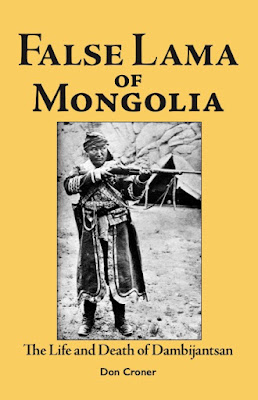
For more on Dambijantsan see False Lama of Mongolia: The Life and Death of Dambijantsan. 


Tuesday, September 25, 2007

Mongolia | Bayankhongor Aimag | Ekhiin Gol Oasis

Wandered on out to Bayankhongor for a quick visit to Ekhin Gol Oasis, the southernmost settlement of the aimag. After dropping down from the high plateau around Shinejinst to the Gobi Desert the first oasis we encountered was Zuunmod.
Zuunmod Oasis
From Zuunmod we went south to Nogoon Tsav, a picturesque assortment of green (nogoon), red, white and black rock formations. Dinosaur bones are occasionally found here.
Nogoon Tsav
Rock formations south of Nogoon Tsav

The Wedding Ovoos. Locals who get married alway stop here to built an ovoo and down a bottle or two of vodka.
After traveling for over sixty miles through the barren desert it is a downright shock to come to the luxurious greenery of Ekhiin Gol Oasis.
Ekhiin Gol Oasis
All kinds of vegetables grow here in amazing profusion, including tomatoes (for which the oasis is famous), cabbage, cucumbers, carrots, onions, potatoes, and all kinds of melons.
Also sunflowers!
One of the seven springs which feed Ekhiin Gol Oasis
My main reason for visiting Ekhiin Gol was to track down information on Dambijantsan, a.k.a. Dambijaltsan, Dambija, Ja Lama, Ja Bagsh, Toushegun Lama, False Lama, Avenger Lama, Two Camel Lama, and Chia (Jia in Pinyin) Lama. Earlier this year I had tried to visit Dambijantsan’s Fortress in the Black Gobi. Now I wanted to meet with an eighty-year old man named Zeskhüü whose wife, now deceased, was the daughter of Dambijantsan’s chief lieutenant. This man had a wealth of information about Dambijantsan which he was not at all hesitant to share. We talked to him for a total of five or six hours. I will have details of his revelations about Dambijantsan later.
Zeskhüü
Zeskhüü

Shandas, who accompanied me on the trip. She is an excellent translator and a very personable young woman. It was a privilege to meet her (click photo for enlargement).
Shandas again

Mongolia | Tov Aimag | Horse Trip #5

On the way back from Khagiin Khar Nuur we made a slight detour to the ruins of Saridgiin Khiid, the monastery founded in the 1654 by Zanabazar, the First Bogd Gegeen of Mongolia. Zanabazar built this monastery with the idea that it would become the center of Buddhism in Mongolia. Several of his most famous art-works, including his Five Transcendental Buddhas, were meant to be displayed here. It was not to be; in 1688 the monastery was destroyed by Zanabazar’s arch-rival Galdan Bolshigt. I had visited the ruins twice before, as described in my Guide To Locales Connected with the Life of Zanabazar. Saraa and Günj said they wanted to see the site so I agreed to go again.
Ruins of the 108-Pillar Tsogchin Temple
Corner of the 108-Pillar Tsogchin Temple
Clay figurines, known as shuteen in Mongolian, which Zevgee claims date to the time of Zanabazar. Someone had dug them out of the ruins and placed them on stone altars.
Saraa at the altars