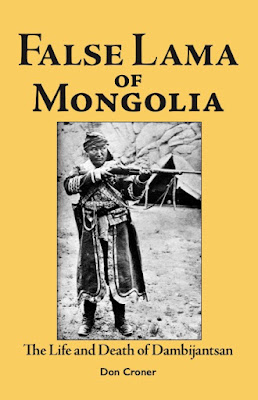
At the time Dambijantsan was born, at the beginning of the 1860s, Tibetan Buddhism, despite the continued pressure to convert the Kalmyks to Russian Orthodoxy, was still prevalent in Kalmykia, the land of the Kalmyks. In all likelihood Dambijantsan was born into a family which adhered to Buddhism to one degree or another. The first news we hear of him is that at the age of seven he was supposedly enrolled as a novice in a Buddhist monastery in Dolonnuur, in what is now the Chinese province of Inner Mongolia. Maisky heard this story while in western Mongolia in 1919, when Dambijantsan was still alive. Dolonnuur was firmly in the orbit of the Eastern Mongols, the Chahar of Inner Mongolia and Khalkh of what was then considered Outer Mongolia, and at first glance it appears strange that a young Dörböt from the Volga River in Russia would have gravitated there. Kalmyks wishing to enter a monastery outside of Kalmykia, we would think, would have been more drawn to western China, including the modern-day provinces of Xinjiang, Qinghai, and Gansu, the traditional strongholds of the Torguts, Dörbots, and other Oirats, both those who not migrated westward in the early seventeenth century and those who had returned in the great exodus of 1771. Fred Adelman, in his introduction to Pozdneev’s
Mongolia and Mongols makes precisely this objection, and John Gaunt in his doctoral thesis on Dambijantsan repeats it: “it would be unlikely to find a Volga Kalmuk at Doloon Nuur, as they were not oriented toward Inner Mongolia’s monastic net.”
The French scholar
Isabelle Charleux, an expert on Inner Mongolian monasteries, offers a different interpretation: “There were many monks and students [at Dolonnuur] from all of the Mongol world, given the reputation of the Dolonnuur monasteries and their high reincarnated masters that attracted people from very far away . . . The Dolonnuur monasteries were not only connected with the Khalkh Mongols; but also with the Inner Mongolians of Alashan and Kholun Buir . . . Also the migrant population of the Chahar banners included many Oirat Mongols. If Dambijantsan’s parents were especially fond of the Dolonnuur monasteries—because they knew a lama there, because of the reputation of the monasteries, etc.—they would have sent their child there.”
A Russian researcher adds that Dambijantsan’s parents moved to Inner Mongolia “for all the usual reasons”—presumably they were traders—when he was a very small boy, which would explain how the seven-year old boy also ended up there. Therefore it is entirely possible that this entry into Dambijantsan’s
curriculum vitae was not simply a later invention meant to burnish this reputation among the Khaklh Mongols but that he actually was enrolled as a monk at Dolonnuur at an early age. In any case, this is the last we hear of his parents.
Dolonnuur (doloon = seven, nuur = lake; Seven Lakes) is located in the grasslands (now suffering from increasing desertification) 210 miles north of Beijing, about fifty-two miles beyond the first major pass leading to the
Mongolian Plateau.

Ovoo at the first pass on the Mongolian Plateau

Statue of Khubilai Khan at the first pass on the Mongolian Plateau
The area is much hallowed in Mongolian history. Fourteen miles from the current town of Dolonnuur is the site of
Shangdu, originally established in 1256 as the headquarters of Chingis Khan’s grandson Khubilai. After Khubilai founded the Yüan Dynasty he made what is now Bejing the primary capital of his empire, but he retained Shangdu as his summer capital, where he and his court retired each year to escape the enervating heat of the North China Plain. Shangdu was destroyed in the so-called “Red Scarf Rebellion” of 1358, a precursor to the upheavals which led to the fall of the Yuan Dynasty in 1368 and the rise of the Ming Dynasty. Later the city became known to some as the Xiancheng, or Apparition City, since people claimed that at certain times the old city as it was in the days of Khubilai appeared suddenly before their eyes and then disappeared just as quickly, leaving only the ruins as we see them today. Shangdu is also remembered as the subject of Coleridge’s much celebrated poem "Xanadu”:
In Xanadu did Kubla Khan
A stately pleasure-dome decree:
Where Alph, the sacred river ran
Through caverns measureless to man
Down to a sunless sea . . .

Ruins of Khubilai’s Palace at Shangdu
The ruins are now a popular tourist attraction and the area still serves as a summer getaway, only now not for Mongol potentates but for Beijing’s middle classes. More important to our story, however, it was at nearby Dolonnuur that in 1691 a fateful meeting took place between the Kangxi emperor of China and Zanabazar, the First Bogd Gegeen of Mongolia and the nominal head of the Khalkh Mongols.

Tourist Camp near Shangdu
When we last left Khara Khula he was organizing the four tribes of the Oirat into the Oirat Confederation. He died in 1634 and his son Baatar-Hongtaiji assumed the throne. In 1635 the Dalai Lama officially recognized Baatar-Hongtaiji as the leader of the Oirats and gave him the title of
Yerdyen. By 1640 Baatar-Hongtaiji’s realm become known as the Zungarian Khanate. The name derives from the Mongol
zuun gar, “left hand“, or “eastern side;”; although the Oirats dwelt in the western end of the lands inhabited by Mongol peoples, the Choros tribe to which Khara Khula and Baatar-Hongtaiji belonged was the easternmost of the Oirat confederation and thus on the “left hand“ looking southward, as the Mongols always oriented themselves.
Following a long internecine struggle between Baatar-Hongtaiji’s offspring, replete with fratricide and rivers of blood,
Galdan, probably the youngest of his eleven or so sons, seized the reins of the Zungarian Khanate. Under Galdan the Zungarian Khanate eventually encompassed a huge swath of Inner Asia, including the western edge of current-day Mongolia, the current-day Chinese province of
Xinjiang, including the Silk Road cities of Hami,
Turpan, and
Kashgar, the legendary cities of Bukhara of Samarkand in what is now Uzbekistan, and the eastern part of current-day Kazakhstan. Although little remembered today, during Galdan’s reign the Zungarian Khanate was a formidable adversary of both Czarist Russia and Qing-Dynasty China.
Galdan would become one of the role models of Dambijantsan, and we will return for a more detailed examination of his career in good time. Suffice it to say here that in 1688 Galdan, hoping to add the territory of the Khalkh Mongols to the Zungarian Empire, invaded what is now the country of Mongolia. Meeting little opposition from the disorganized Khalkh, his army first trashed the great monastery of
Erdene Zuu, built on site of the old Mongol capital of Kharkhorum, and the
Monastery at Khögno Khan Uul (now known as Khögnö Taryn Khiid), just to the east. Advancing farther eastward, Galdan’s men then demolished
Saridgiin Khiid, located in the Khentii Mountains north of Ulaan Baatar, the monastery which had been established by
Zanabazar himself and intended to be the center of Buddhism in Mongolia. Zanabazar, his brother Chakhuundorj the Tüsheet khan, the leaders of the other Khalkh khanates, and, according to one source, at least 30,000 of their followers fled southeastward before the advance of Galdan’s troops, eventually reaching the edge of the Mongolian Plateau near Dolonnuur, land of the Chahar Mongols, who had already accepted the authority of the Qing Dynasty. Here the Khalkh Mongols, by now almost destitute, threw themselves at mercy of the Qing emperor Kangxi.
Dolonnuur was at that time already an important monastic center, with no less then twelve incarnate lamas in residence. The town, strategically located at the edge of the Mongolian plateau, was also a busy Chinese-Mongolian entrepôt. Because of deposits of copper ore nearby it became a center of mining and smelting, and its factories were well-known for their weapons, and later its workshops became better known for the bronze
Buddhist Artwork of the Dolonnuur School.
The Kangxi emperor, apprized of the arrival of the Khalkh Mongols in his domains, decided to meet with their leaders and if possible bring them into the fold of the Qing Dynasty. He left Beijing on May 9, 1691 and made his leisurely way north, stopping to do a spot of hunting on the way. From May 29 to June 3 Kangxi finally meet with Zanabazar and the other Khalkh leaders in Dolonnuur. A great banquet was followed by a display of Qing might in the form of cannons, newly acquired from Jesuits in Bejing, the firing of which caused the Mongols “to tremble with fear and admiration,” at least according to Qing sources. The upshot of all this was that in exchange for protection from the forces of Galdan Bolshigt and a promise from Kangxi to restore to the Khalkh their lost lands in Mongolia, Zanabazar accepted the suzerainty of the Qing Dynasty, in effect making Mongolia a province of China. The country which Chingis Khan and his sons had conquered and his grandson Khubilai had once ruled as the first emperor of the Mongol Yüan Dynasty now dominated Mongolia. Mongolia would remain under Chinese control until 1911, when the Qing Dynasty fell. Those 220 years of subjugation by the Qing Empire are seen by some as a direct consequence of Zanabazar’s capitulation to Kangxi, and as a result many Mongolians resent him to this day. Dambijantsan himself would devote the greater part of his life to undoing what Zanabazar had done and restoring the independence of Mongolia.
But that was all in the future. In 1691, In honor of his meeting with Zanabazar and the capitulation of the Mongols, Kangxi ordered the construction of what would become the
Khökh Süm, or Blue Temple. (One prominent Mongolian incarnation, the Kanjurwa Khutagt [1914–1980], maintains that on the contrary Mongol nobles built the temple in honor of Kangxi, a telling interpretation of events from a Mongol viewpoint)

Front of the Khökh Süm, which is currently being restored
The Khökh Süm was completed around 1700 and it eventually began the center of a sizable monastery. About a half mile away, the
Shar Süm, or Yellow Temple, was built between 1729 and 1731 and it too became the foundation of a monastery.

Ruins of the Shar Süm

Ruins of the Shar Süm
Both monasteries were overseen by a line of incarnate lamas known as the Jangjya Khutagts. Sedendonub, the first Jangjya Khutagt, was instructed by Kangxi himself to “spend the chilly wintertime in Peking and in the summertime heat govern here and the direct the local clergy.” The Jangjya Khutagts maintained residences at both the Blue Temple and and the Yellow Temple.

The Jangjya Khutagt’s residence at the Khökh Süm

Side buildings at the Jangjya Khutagt’s residence at the Khökh Süm
The second Jangjya Khutagt, Rölpé Dorjé, was described by one scholar as “an intimate of the Qianlong emperor and thus perhaps the most powerful Tibetan hierarch in the Qing Empire.” Dolonnuur’s importance as a monastic center was underlined by the fact that the Third Panchen Lama visited here during his trip to China in 1780. The Panchen Lamas along with the Dalai Lamas were the highest ranking incarnate lamas in Tibet. The Panchen Lama arrived in Dolonnuur on the 20th day of the 6th month, and according to hagiographic Tibetan accounts was greeted by one million people, although this is almost certainly an exaggeration. In any case, while in Dolonnuur the Panchen Lama reportedly “performed a purification ritual that pacified the restless demons of Mongolia.” He also gave a Yamantaka initiation to the Jangjya Khutagt and read prayers dedicated to the sacred land of Shambhala, a realm about which he had already written a guidebook entitled
Shambhala Lamyig.
From Dolonnuur the Panchen Lama proceeded to the
Qing Summer Resort at Jehol where he was amazed to discover not only a
Huge Replica of the Potala in Lhasa, already alluded to, but also a replica of his own Tashilhunpo Monastery in Shigatse. This complex of temples and facades, known as the
Xumifoushou Miao (Happiness and Longevity Temple of Mt. Sumeru) was hurriedly constructed in 1779 and early 1780 by order of the Qianlong emperor. In front of it he had placed yet another stele declaring that the complex had been built to provide the Panchen Lama with “a restful place for meditation.” The Xumifoushou Miao too is now a major tourist attraction. Unfortunately, the Panchen Lama never returned to Tibet from this trip. From Jehol he proceeded Beijing to where he contracted small pox and died in late November of 1780.
The Russian ethnographer A. M. Podzneev visited Dolonuur in 1893. By then the monastic center seems to have lost some of its luster. The Yellow Temple had some 400 monks and the Khökh Temple some 500, not a lot compared to monasteries in Lhasa in Tibet and Örgöö (now Ulaan Baatar] in Mongolia. The fourth Jangjya Khutagt, who died in 1891, spent most of his life in Beijing and had not visited Dolonnuur in fifty years. Pozdneev was by that time a very seasoned traveler in Mongolia and China but even he was shocked by conditions in Dolonnuur: “It would be hard to imagine anything dirtier and in greater disarray than Doloon Nuur’s street and alleys. The street in all Chinese cities are normally narrow and dirty, but here they are even narrower and dirtier . . . In the rainy season these ditches used as thoroughfares are so full of water and mud that some of the streets become iiterally impassable.”
Presumably this is more-or-less the same Dolonnuur Dambijantsan would have experienced in the late 1860s when he arrived there at the age of seven and became a novice monk.

The streets of Dolonnuur are in better shape today
 Tash Rabat Caravanserai
 Looking up the valley from Tash Rabat. The old Silk Road went up this valley.
 View south from 13,018-foot Tash Rabat Pass