Friday, December 18, 2009

Mongolia | Ulaan Baatar | Book Launch

Wandered by one of Ulaan Baatar’s Notoriously Louche Coffee Houses for the Big Book Launch of Carl Robinson’s monumental Mongolia: Nomad Empire of the Eternal Blue Sky, which should very quickly become the Alpha and Omega of guidebooks to Mongolia. Normally I would never darken the door of a den of coffee swillers, being strictly a Tea Man myself, but I was anxious to meet Mr. Robinson, with whom I have communicated extensively via the internet but never before had the pleasure of meeting in person.

I contributed one story—The Abduction of the Eight Bogd Gegeen—and a dozen or so photos to this magnificently produced tome. One of the photos was a full page spread of my pal Zevgee, with whom I have done a dozen or so Horse and Camel Trips, sitting in front of the ovoo on the top of Burkhan Khaldun Mountain.
Zevgee at the summit of Burkhan Khaldun. This is not the photo in the book. If you want to see that photo Buy The Book.
Zevgee’s Better Half Tümen Ölzii (right) and the marrow-meltingly gorgeous to say nothing of ever-charming and extremely intelligent Oyuna (since this photo was taken she has become a lawyer, but that does not necessarily make her a bad person) at the lake near the base of Burkhan Khaldun.

Sunday, December 13, 2009

Mongolia | Zaisan Tolgoi | Balsamic Moon

The Balsamic Moon begins today, December 13. As you probably know, the Balsamic Moon is the Moon phase starting three, or sometimes four, days before a New Moon. The New Moon this month occurs on the 16th at 8:02 p.m. local time.
The Balsamic Moon is the perfect time to stir out uncertainty and confusion because it is the time for psychic clearing. Wishes are more readily fulfilled as the way is cleared to feeling core need. A wish made at the Balsamic Moon is more likely to come true because needs are felt more deeply now. The more deeply a need is felt, the more invocative energy goes into the Moon cycle and the more likely this need will be met. Fulfillment comes at Full Moon in response to what is seeded at the New. Seed intentions may be more consciously sown when the Crescent Moon appears to be beginning.
The Balsamic Moon Rises today at 5:18 a.m. local time (check for Moon Rise In Your Area), just at the time I am usually completing my morning orisons, which is especially auspicious.

As I predicted, the Last Moon Cycle Was A Dilly. This Moon Cycle, with the Full Moon falling, by coincidence, on January 1 this year, should be a Doozie, which is an upgrade from a Dilly. Expect a lot of weird stuff to happen on New Year’s Eve and the next day! (I mean, of course, weirder than usual for New Year’s Eve and Day.)

By the way, Orion, the Hunter, is currently presenting a spectacular sight in the evening sky to the southeast. Before slouching off into the drinking dens and Louche Coffee Houses where most of you (you know who you are, so it’s no use trying to deny it!) spend your evenings in dissipation take a moment to glance up and enjoy this awesome display.

Sunday, December 6, 2009

Turkey | Silk Road | Chintamani | Carpets

Earlier I speculated on how the Shambhala Mythologem may have Arrived in Istanbul Via the Silk Road. Now the carpet cognoscente at the scintillatingly entertaining and informative Tea and Carpets Blog are pointing out what may be Buddhist influences in Ottoman Court Carpets:
Some of the most striking carpets of the Ottoman era are as white as a painter’s canvas and covered with finely drawn, mysterious icons. The never-changing symbols repeat in array after array, like waves building strength, creating a powerful, mesmerizing effect The mysterious icons are the “chintamani,” three balls hovering over a pair of cloud-like wavy lines. And for much of the 16th and 17th centuries, they held a special fascination for Ottoman court artists.

In carpet literature, the design is often said to derive from a Buddhist emblem. The word chintamani itself comes from Sanskrit and in Buddhist philosophy signifies a treasure ball or wish-granting jewel. A Buddhist background for the design is an appealing argument because it also recalls the distant past of the Turkic tribes who migrated to Anatolia from Central Asia and created the succession of dynasties that culminated in the Ottoman Empire.
A Chintamani Carpet from the Ottoman Era

According to one definition of Chintamani:
Cintamani, also spelled as Chintamani (or the Chintamani Stone), is a wish-fulfilling jewel within both Hindu and Buddhist traditions. In Buddhism it is held by the bodhisattvas Avalokiteshvara and Ksitigarbha. It is also seen carried upon the back of the Lung ta (wind horse). Within Hinduism it is connected with the gods, Vishnu and Ganesha.
The Chintamani Symbol is of course also connected with notorious Shambhalist Nicholas Roerich.
Three circle motif in Roerich’s painting “Oriflamma”
Chintamani motif in Roerich’s painting “Sign of Chintamani”
The connection between the Sufis of Istanbul and Shambhala is still under investigation. In the meantime, since The Ottomans are Back might we soon see a resurgence of Chintamani Carpets?

Saturday, December 5, 2009

Mongolia | Khovd Aimag | Dambijantsan | Khoit Tsenkher Cave

Who was Dambijantsan?

A Buddhist monk; a freedom fighter for Mongolian independence; the descendant of Amursanaa (1723–1757), the Western Mongol who led the last great uprising against the Qing Dynasty of China; the incarnation of Mahakala, the Buddhist god of war; bandit, torturer, murderer, or evil incarnate? During his lifetime no one was sure who he really was, and even today the controversy about his life continues.

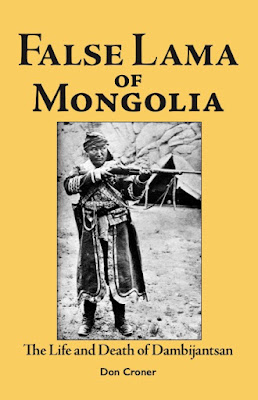
Born in what is now the Republic of Kalmykia, part of the Russian Federation, Dambijantsen traveled throughout Tibet, India, and China before arriving in Mongolia in 1890 where he tossed gold coins to bystanders and announced to one and all that he had come to free Mongolia from the yoke of the Qing Dynasty of China. After disappearing almost twenty years he returned to lead the attack on Khovd City, the last Chinese outpost in Mongolia. Honored by the Eighth Bogd Gegeen, the theocratic leader of Mongolia, for his efforts in achieving Mongolian independence, he went on to establish his own mini-state in western Mongolia, which he hoped to use as a base for establishing a Mongol-led Buddhist khanate in Inner Asia. His dictatorial nature and unbridled sadism soon came to the fore and he was finally arrested and imprisoned in Russia. After the Russian Revolution he returned to Mongolia, gathered new followers around him, and established a stronghold at the nexus of old caravan routes in Gansu Province, China. He robbed caravans, grew opium, and once again dreamed of creating a new Mongolian khanate in Inner Asia. Finally the new Bolshevik government in Mongolia, fearful of his rising power, issued orders for his assassination. Dambijantsan died in 1922, but in Mongolia legends persist to this day that his spirit still rides on the wind of the Gobi and continues to haunt his former lairs.


For more on Dambijantsan see False Lama of Mongolia: The Life and Death of Dambijantsan


Friday, December 4, 2009

Mongolia | Ulaan Baatar | Ski Resort

Well, Hell has frozen over; no, wait, actually it’s a Ski Resort on Bogd Khan Uul, not far from my hovel. There goes the neighborhood.

Mongolia | Khovd Aimag | Dambijantsan’s Winter Camp

Who was Dambijantsan?

A Buddhist monk; a freedom fighter for Mongolian independence; the descendant of Amursanaa (1723–1757), the Western Mongol who led the last great uprising against the Qing Dynasty of China; the incarnation of Mahakala, the Buddhist god of war; bandit, torturer, murderer, or evil incarnate? During his lifetime no one was sure who he really was, and even today the controversy about his life continues.

Born in what is now the Republic of Kalmykia, part of the Russian Federation, Dambijantsen traveled throughout Tibet, India, and China before arriving in Mongolia in 1890 where he tossed gold coins to bystanders and announced to one and all that he had come to free Mongolia from the yoke of the Qing Dynasty of China. After disappearing almost twenty years he returned to lead the attack on Khovd City, the last Chinese outpost in Mongolia. Honored by the Eighth Bogd Gegeen, the theocratic leader of Mongolia, for his efforts in achieving Mongolian independence, he went on to establish his own mini-state in western Mongolia, which he hoped to use as a base for establishing a Mongol-led Buddhist khanate in Inner Asia. His dictatorial nature and unbridled sadism soon came to the fore and he was finally arrested and imprisoned in Russia. After the Russian Revolution he returned to Mongolia, gathered new followers around him, and established a stronghold at the nexus of old caravan routes in Gansu Province, China. He robbed caravans, grew opium, and once again dreamed of creating a new Mongolian khanate in Inner Asia. Finally the new Bolshevik government in Mongolia, fearful of his rising power, issued orders for his assassination. Dambijantsan died in 1922, but in Mongolia legends persist to this day that his spirit still rides on the wind of the Gobi and continues to haunt his former lairs.


For more on Dambijantsan see False Lama of Mongolia: The Life and Death of Dambijantsan


Monday, November 30, 2009

Mideast | Yezidis | Shambhala


Temple of the Yezidis in northern Iraq
Now it appears the Yezidis, practitioners of arguably the oldest religion in the world, are claiming that the Kings of Shambhala are actually a manifestation of their Peacock Angel:

In Tibet the Peacock Angel appears to be manifest as Amitibha, the peacock-riding dhyani buddha who sits upon his Peacock Throne in the heaven of Sukhavati and occasionally takes a physical incarnation as the King of the World in legendary Shambhala, the land of immortals that flies the Peacock Flag. Shambhala, meaning the “Place of happiness,” is a place designed as eight territories or “petals” and recognized to be the heart chakra of planet Earth. In the center of the planetary heart chakra is the palace of the King of Shambhala, who thus functions as not only planetary monarch but soul of the world (just as the human soul resides within the human heart chakra). According to one legend, the Peacock Angel not only spread his colors around the globe but additionally merged his spirit with that of the Earth and became the world soul. Thus, his physical body is the Earth and his will is reflected in the actions of all creatures that live upon the face of the Earth.

Peacock Angel of the Yezidis
 
Shambhala
See The Truth about the Yezidis and also News about the Yezidis. As you no doubt already know Yezidis have Come Under Attack by Fundamentalist Jihadis in Iraq.

Also see
Secrets of the Knights Templar and the Peacock Angel and Gurdjieff and Yezidism. You don’t need me to connect the dots here.

Saturday, November 28, 2009

Mongolia | Links | Himalayan Art Resources

The Good Folks at Himalayan Art Resources have put up a page with Links to Many of My Blog Posts and Web Pages. Also see the Blog of Himalayan Art Cognoscente Jeff Watt.

Wednesday, November 25, 2009

Mongolia | Bogd Khan and Mongolian Independence

Whatever his Personal Peccadilloes, for almost a decade the Bogd Gegeen had persistently pursued the cause of Mongolian independence. As early as 1894 the Bogd Gegeen had sent a secret letter to St. Petersburg via one of his chief disciples, a man named Badamdorj, asking whether the Russian government would provide arms and other material aid in the event Mongolia staged an uprising against Manchu rule and established an independence state. He also queried whether Russia would send troops to assist in such an endeavor in the event they were needed. The Bogd Gegeen had his sights set high at the time, envisioned a new Pan-Mongolian state encompassing much of the old original Mongolian homeland. If the uprising succeeded, he wondered in his letter, “May we be allowed to rule the whole of the ancient Mongol territory, making the White Wall [Great Wall] stand as the frontier of Mongol territory?“ The Russians took the letter under advisement, agreeing to the Bogd’s proposals in theory but suggesting that the time was not yet right for an armed uprising. Better to wait until an obvious pretext or opportunity arose before taking any overt action, officials in St. Petersburg cautioned.

The pretext appeared to present itself in late 1908. On Nov. 8 the ineffectual thirty-seven year-old Qing emperor Guangxu died. He had suffered from a nervous condition so severe that loud noises made him ejaculate, and since 1898 he had been under house arrest by order of the Empress Dowager Cixi, his mother by adoption, who ruled in his stead. On the very next day the Dragon Lady Cixi, who had overseen the Qing Dynasty either as regent or power-behind-the-throne for forty-seven years, also transmigrated. The most lurid rumors surrounded the deaths. According to one Cixi had Guangxu strangled by her chief eunuch because she had a presentiment of her own death and did not want him to outlive her. Thus over the years she been accused of killing her first husband, her own son, her co-regent the Empress Cian, assorted by-standers, and now Guangxu, her adopted son. According to yet another rumor Cixi herself had been gruesomely dispatched by a bullet in the vagina by warlord Yuan Shikai. Most of these rumors have been dismissed by modern historians, but the very fact that that were so widely believed at the time demonstrates the Grand Guignol atmosphere which surrounded the the final days of the Qing Dynasty. The twelfth emperor of the Qing, little two-year old Pu Yi, was duly installed on the Dragon Throne on December 2, 1908, but by then hardly anyone believed the dynasty could survive.

In 1909 the Bogd Gegeen, sensing which way the wind was blowing in Qing China, issued the following decree to the Mongolian princes:
Now is the time to make firm our Mongol faith and church, to protect our territory and homeland; and to decide a policy for dwelling in long-lasting peace and happiness. Merely to sit still and let slip this opportunity would mean, far from dwelling in peace and happiness, that we should look upon all kinds of suffering and become unable to rule over our own land and territory . . . Let all of you lamas, princes, and officials consider well your own devices and promptly let me hear what each of you has thought and considered. It will not do for you to sit indifferent, obstructing the important affairs of all the pitiful Mongols who honor and respect your every word and humbly look up to you.
As he probably expected, his noble advisors threw the matter back into his lap. “What do we know? Whatever the Bogd thinks right and clearly instructs from on high and vouchsafes to us, that we shall duly carry out as a command to the best of our endeavor,” was their reply. The Bogd Gegeen promised them that at the following year’s Danshug (ceremonial festival) in Örgöö he would announce his plan of action for Mongolian independence. In the summer of 1910 all the great princes of the four aimags again assembled in Örgöö and asked for the Bogd’s decision. “The secrets of Heaven may not be revealed in advance,” he informed them, “but if all of you could confirm without fail that you would duly obey and fulfill whatever I say, I can make a policy.” This they did, presenting the Bogd with a document with all of their seals on it promising to take whatever course of action he suggested.

In July of 1911 the Mongolian aristocracy again assembled in Örgöö to make their annual offerings to the Bogd Gegeen. These out-of-town visitors usually camped just south of the Bogd’s palaces on the Tuul RIver, near the base of a hill which for this reason became known as Zaisan Tolgoi (Nobleman’s Hill). The issue of Mongolian independence was now at the fore. In a meeting with the Bogd Gegeen they asked, “Supposing the Ch’ing [Manchus] come with a punitive expedition,there are in Mongolia no arms and we have no military training or equipment.What shall we do?” The Bogd replied “If you have the will to set up a state and give our Mongolia peace and security, I will be responsible for making the Manchu troops go back.”
Zaisan Tolgoi, where the Mongol noblemen made offerings
Thus assured, they decided to at last declare the independence of Mongolia and make the Bogd Gegeen both the temporal and spiritual ruler of the new sovereign state. The Bogd also agreed to dispatch a three-man delegation to St. Peterburg to inform the Russians of their decision and to seek aid in the form of cash and weapons. When the Qing amban in Örgöö, a man named Sandoo, learned that the delegation had already left the city he sent twenty soldiers north to the border with Russia to intercept and arrest the delegates before the left Mongolia. They arrived too late, however, and the delegation managed to slip across the border. According to one report, Sandoo, “was almost out of his mind with anger” when he was eventually informed that the delegation had managed to reach St. Petersburg. The delegation arrived back in Örgöö with the news that the Russians were again advising caution, but had tentatively agreed to provide 15,000 rifles and 7.5 million rounds of ammunition in the event armed conflict broke out with the Manchus. Sandoo then sent a missive to the Bogd Gegeen threatening the death penalty for anyone seeking aid against the Qing from foreign powers. The Bogd Gegeen, no doubt aware that Sandoo did not have the wherewithal to carry out these threats, simply ignored the Qing amban.

Then came the October 10 Wushang Uprising in the Chinese city of Wuhan, after which dissident army officers proposed a new provisional government to be headed by Sun-Yat-sen. The Qing Dynasty, although not yet ruled dead, was in its death throes. Mongolia independence had already been declared and now the time had come to assert it. On the evening of November 18, 1911, the Bogd Gegeen sent a four man delegation to the office of Sandoo with a decree which read, “Sandoo amban and his officials and troops are ordered to leave the confines of Mongolia within three days. In the case of failure, troops will be utilized to drive them out . . .”A Russian living in Örgöö at the time reported that “when they read to the amban the decree of the gegeen, the amban was startled and fell back onto a chair and could not say anything for a long time.” It was no doubt hard for him to believe that 220 years of Qing rule in Mongolia was over.

Sandoo (1876–192?), the last Qing Amban in Öröö, was in fact part Mongolian, although he had been born, brought up, and educated in China. He had arrived in Örgöö to serve as amban on February or March of 1910. He was not an uncultured individual. He eventually wrote at least seven volumes of poetry and took a deep interest in the archeology and history of Mongolia. While in Mongolia he visited the stele of the Khökh Turk ruler Kultegin (685–731) in what is now Arkhangai Aimag. He apparently erected some kind of temple to commemorate the stele and etched a short inscription on its back side. He also visited the stele of Kultegin’s advisor Tonyukuk near the current day town of Nailakh, east of Ulaan Baatar, and made copies of the inscriptions, which he sent back to Beijing for the benefit of interested scholars.

His literary and scholarly interests could not, however, protect him from the rising anti-Manchu sentiments in Örgöô. Not long after his arrival in the city he attempted to intercede when a mob of Mongolian lamas attacked and looted the premises of the Chinese trading company Da I-Yu. The lamas pelted him with stones and he barely escaped with his life.

After receiving the Bogd Gegeen’s November 18 decree Sandoo dithered for twelve days, unwilling to abandon his post but bereft of support from Beijing. On November 30 a still more sternly worded ultimatum was handed to him. Scared out of his wits, Sandoo and attendant officials sought protection in the Russian Consulate. Most of the soldiers in the one hundred-man Qing garrison remaining in the city deserted. On December 4 Sandoo and his entourage, protected by an escort of Russian Cossacks, traveled north to Khyakhta and crossed the border into Russia. In Verkhneudinsk (now Ulaan-Ude) they caught a train back to Beijing.

Local bards were never slow in commenting on current affairs in Mongolia, and one immediately composed a song about the Amban’s expulsion which was then bawled out with glee in the city’s marketplaces and streets:
The stinky lanterns that twinkled every evening
Are burnt out
Where is gone the notorious amban
Who commanded the masses?
The lanterns refer to the street lights that Sandoo had introduced into Örgöö. Apparently they burned a smelly oil. Like the Örgöö amban himself they soon disappeared.

Nepal | Animal Sacrifices | Virtual Hugs

Glad to see that Tenpa at Tibetan Digital Altar and V. D. Konchug Norbu at Bitterroot Badger’s Bozeman Buddhist Blog have given each other a virtual hug by both calling attention to the Appalling Animal Sacrifices taking place in Nepal today and tomorrow. It will be remembered that when Sonam Gyatso, the Third Lama, Converted the Mongolian Altan Khan to Buddhism one of the first things he did was ban any more animal or human sacrifices by the Mongols:
Sonam Gyatso then delivered a discourse to the assembled throng. He implored them to give up the practice of human and animal sacrifices which so often accompanied the death of a important Mongol (Chingis Khan's own son Ögedai reportedly had forty "moon-faced virgins" and numerous horses and other livestock sacrificed in honor of his father's memory) and told them to destroy their ongghot, the shamanic idols which many Mongolians kept in their homes and worshipped. Instead of blood sacrifices he suggested that the Mongols offer part of the deceased possessions to temples and monasteries and offer prayers to the deceased. He also implored the Mongols not to conduct bloody raids on their neighbors, including the Chinese, the Tibetans, and other Mongol tribes, and instead try to live in peaceful coexistence with their neighbors. He also suggested they make prayers and conduct other religious practices on the days of the new, half, and full moons. Finally he taught them a meditation on Avalokiteshvara, the bodhisattva of compassion, and the accompanying six-syllable mantra Om Mani Padme Hum.