Sunday, May 3, 2009
Mongolia | Ulaan Baatar | Kalachakra Temple | Mandala
Labels:
Kalachakra,
Mongolia,
Shambhala,
Ulaan Baatar
Friday, May 1, 2009
Mongolia | Taiwan Tea | Bao Zhong Oolong
Bao Zhong tea is a very Lightly Oxidized Oolong Tea, right on the cusp between green tea and oolong tea. Many people who try it think that it is indeed a green tea, although it is slightly oxidized, making it an oolong tea. In any case, with the arrival of the new crop of Bao Zhong can the First Appearance of a Wild Flower here in Zaisan Tolgoi be far behind? These are exciting times we are living in!
Labels:
Oolong Tea,
Taiwan,
Zaisan Tolgoi
Wednesday, April 29, 2009
Monday, April 27, 2009
China | Xinjiang | Dragon Fighter
There is a new book out about Rebiya Kadeer, from Urumqi, in Xinjiang Province, who was once reputed to be the richest women in China and was later arrested and thrown into prison on what was widely considered to be trumped-up charges. (Among other suspicious activities, she once met with evil Microsoft potentate Bill “666” Gates.) See Dragon Fighter: One Woman's Epic Struggle for Peace with China.
Despite being persona non grata in China her name is still displayed on the front of one of the department stores she owned in Urumqi (in Uighur Arabic Script). Interestingly, the Uighurs originated in Mongolia—the ruins of their Old Capital City can still be seen in Arkhangai Aimag, north of Kharkhorin. And of course, the Mongolian Vertical Script is based on the old Uighur Vertical Script . . .
Saturday, April 25, 2009
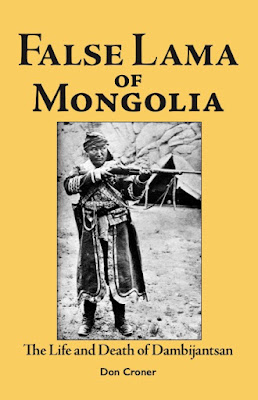
Mongolia | Life & Death of the False Lama #18
Who was Dambijantsan?
A Buddhist monk; a freedom fighter for Mongolian independence; the descendant of Amursanaa (1723–1757), the Western Mongol who led the last great uprising against the Qing Dynasty of China; the incarnation of Mahakala, the Buddhist god of war; bandit, torturer, murderer, or evil incarnate? During his lifetime no one was sure who he really was, and even today the controversy about his life continues.
Born in what is now the Republic of Kalmykia, part of the Russian Federation, Dambijantsen traveled throughout Tibet, India, and China before arriving in Mongolia in 1890 where he tossed gold coins to bystanders and announced to one and all that he had come to free Mongolia from the yoke of the Qing Dynasty of China. After disappearing almost twenty years he returned to lead the attack on Khovd City, the last Chinese outpost in Mongolia. Honored by the Eighth Bogd Gegeen, the theocratic leader of Mongolia, for his efforts in achieving Mongolian independence, he went on to establish his own mini-state in western Mongolia, which he hoped to use as a base for establishing a Mongol-led Buddhist khanate in Inner Asia. His dictatorial nature and unbridled sadism soon came to the fore and he was finally arrested and imprisoned in Russia. After the Russian Revolution he returned to Mongolia, gathered new followers around him, and established a stronghold at the nexus of old caravan routes in Gansu Province, China. He robbed caravans, grew opium, and once again dreamed of creating a new Mongolian khanate in Inner Asia. Finally the new Bolshevik government in Mongolia, fearful of his rising power, issued orders for his assassination. Dambijantsan died in 1922, but in Mongolia legends persist to this day that his spirit still rides on the wind of the Gobi and continues to haunt his former lairs.
For more on Dambijantsan see False Lama of Mongolia: The Life and Death of Dambijantsan.
Labels:
Amarsanaa,
Blavatsky,
Dambijantsan,
Galdan,
George Gurdieff,
Ja Lama,
Zaya Pandita
Saturday, April 11, 2009
China | Qinghai Province | Roerich Shambhala Stupa
After spending the winter of 1926–27 in Ulaan Baatar, Holed Up in a Building which is now being turned into the Roerich-Mongolia Museum, on April 13, 1927 the Roerich Expedition left the Mongolian capital and headed west by motor car to Amarbuyant Monastery, in what is now Bayankhongor Aimag. From Amarbuyant they traveled south by camel to Shar Khuls Oasis, following the Route Used by the 13th Dalai Lama in 1904. From Shar Khuls they proceeded further south across to Black Gobi to the Mazong Mountains, where they passed by the Desert Fortress of the notorious Ja Lama.
From here they took the traditional route to Tibet, passing near the town of Anxi, and by the last week of June reached the Nan Shan, the mountains on the northern rim of the Tibetan Plateau. At a place called Sharagolji (probably a corruption the Mongolian Shar Gol = “Yellow River”) they camped for six weeks while awaiting the beginning of the Fall caravan season onward to Tibet. According to the account of George Roerich, in his book Trails in Inmost Asia:
To commemorate the spot of our camp, Professor Roerich [his father, Nicholas] decided to build a stupa and our Mongolian friends busied themselves preparing stones and bricks for the construction. Soon the stately white structure of the stupa rose among our tents.
According to Ruth A. Drayer, in her book Nicholas and Helena Roerich, Revised Edition: The Spiritual Journey of Two Great Artists and Peacemakers:
Nicholas Roerich wrote in his book Altai-Himalaya:
It was a peaceful time. Roerich painted the Bogdo-Ulas [apparently the Bogd Khan Uul south of Ulaan Baatar, but perhaps Ikh Bogd Uul, which they would have passed on their way to Amarbuyant Monastery] several times, then sketched and painted Guardian of the Entrance, The Great Horseman, and others. The Humboldt peaks glowed white with snow, and the air was invigorating. The stillness reminded them of the Himalayan heights. At night, the group held wonderful discussions on the new Prayer to Shambhala, the prophecies of the Panchen Lama, or the need for a pan-Asiatic language to reconcile, at least elementally, the three hundred dialects of Asia. Roerich yearned to convey to the West through his paintings and books—and through the establishment of the New Country—the importance that Maitreya, Shambhala, and Gessar Khan have in Asia.
They were camped in the area where the Mahatma had rested on way to Mongolia forty years before, so they decided to commemorate the spot with a suburgan [stupa] of Shambhala. Everyone gaily joined in the construction, building the understructure of stones, reinforced with clay and grass. The top was made of wood, covered with tin from a gasoline tank, and the entire surface was given a sturdy coat of Humboldt lime and reverently painted with red, yellow, and green designs by a Buriat lama using Roerich's paints. The suburgan was completed July 2.
Nicholas Roerich wrote in his book Altai-Himalaya:
Here are some photos of the stupa, courtesy of the Roerich Museum in New York City, a veritable cornucopia of All Things Roerichian.In front of the tent of Shambhala, the lamas prayed for the coming of the Blessed Rigden Jyepo and placed a polished mirror before the image. Water was poured onto the mirror and the glass seemed to come alive with strange figures appearing on the surface. When it blurred, it resembled one of the magic mirrors in ancient stories. A procession walked around the shrine with burning incense while the lama held onto a thread suspended from the roof. The altar was filled with gifts of turquoise, coral, and beads, an image of the Buddha, a silver ring with a most significant inscription, prophecies for the future, and other precious objects that had been placed there by an old lama who had helped with the construction. We also lay the Ak-dorje and the Maitreya Sangha within. After a long service, the white thread that connected the lama and the suburgan was severed, and the monument stood there alone in the purple of the desert, forever to shine brightly, defended only by invisible powers.
The Roerich Stupa. Note American flag to right. What passports the Roerichs were using at the time and what nationality they were claiming is a bit of a mystery, but the expedition was supported by American Wall Street financiers.
Mongols at the stupa. It is not clear if these were locals or men accompanying the Roerich Expedition.
It is not known if the stupa still exists. Interestingly, just two weeks later, while camped at the same spot, the Roerichs made one of the twentieth century’s first recorded sightings of a UFO. Apparently it has been dispatched from Shambhala. But that is another story . . .
Labels:
Amarbuyant,
Roerich,
Roerich Museum,
Shambhala
Monday, April 6, 2009
Mongolia | Zaisan Tolgoi | Birthday Bacchanalia
To celebrate my Birthday I recently held a Bacchanalia at my hovel in Zaisan Tolgoi. Present were Uyanga, Jaga, Tuul, Yooton, and Saraa.
Jaga (left) and Saraa, showing off her truly formidable biceps. In her senior year in High School she won First Prize in the Girls’ Arm Wrestling Competition.
Mongolia | Ulaan Baatar | Zaisan Tolgoi
It has occurred to me that while I have often mentioned Zaisan Tolgoi, the district where I live on the outskirts of Ulaan Baatar, I have never posted any photos of the Zaisan Tolgoi (tolgoi = head, or hill) itself. Since the temperatures recently soared into the mid-sixties Fº and Accounting Maven Saka had a day off work we decided that it was a good time to climb to the top of this well-known local landmark.
New apartment complex just to the south of Zaisan Tolgoi, with Bogd Khan Mountain beyond
Labels:
Moonbeam,
Saka,
Zaisan Tolgoi
Sunday, March 22, 2009
England | Druids | Human Sacrifices
In my post about the Spring Equinox I asked people to refrain from making any human sacrifices while celebrating this event. I hope I did not offend the Neo-Druids among my readers.
Saturday, March 21, 2009
Mongolia | Autobiography of the Diluv Khutagt | Part 2
Stupas of the “Nine Famous Khutagts”—including Diluv Khutagt—in Uliastai, Zavkhan Aimag. Diluv Khutagt was born in what is now Zavkhan Aimag.
Part 2
This is the story of how I became a human being as well as of how I became a lama; and so I shall first tell about the circumstances of my birth and about the poor family into which I was born, and then relate how is was that I became the Diluv Khutagt, the fifth of my incarnation since it first came to Mongolia in the reign of the Emperor K’ang Hsi [r. 1662–1723].
My grandfather’s name I do not know, but I do know that the name of my clan was Onhit and that my father was born when my grandfather was 86 years old. For this reason he was always called “Pa-shi Liu”—Chinese for “Eighty-Six.” The foreign language was used to avert bad luck. I was born when my father was 67.
I was born in western Outer Mongolia at a place called Oigon Bag, after Lake Oigon, on the south side of the mountain called Bayan Aimag, in the Banner of the Tüshee Gün in Zasagt Khan Aimag. The name of the ruling prince was Tsogtsambar. (Outer Mongolia was then divided into four aimags, or provinces). I was born in the cyclical year of the Monkey, the ninth year of the Emperor Kuang Hsü (1884) on the eighth day of the tenth moon, in the hour of the Dragon, according to the 24 divisions of the day, about sunrise. I had an elder sister and an elder brother, who were 14 and 10 years old respectively at the time of my birth. My mother was then 48.
The family into which I was born were poor sheep-herders, living in a round felt-covered tent. In the year after I was born we had only 20 sheep, four cows and two horses. Camels were very rare in that district and we had none, but we also had no yaks, which were common. The year in which I was born was a difficult one for everybody. There had been a jud (an ice frost, sheathing the grass) that winter, and the cattle had died in large numbers. We had more cattle before this bad winter. My father did all the herding. He died when he was 85. In that winter it was said that many people saw emanations of light coming out of the tent in which I was born. People thought that something mysterious must be going on, in that winter, with strange emanations of light and with a baby born to such an old man, and so I was called “The Lord of the Ice-Plague,” but my given name was Jamsranjav.
The place where I was born was about 300 miles from the large monastery of Narvanchin. In this monastery there were two Khutagt [or “Living Buddhas”]—one the Narvanchin Khutagt, the other the Diluv Khutagt. The one with the longer seniority in the monastery was the Narvanchin Gegeen, but the one with religious seniority was the Diluv. They both died the year I was born. When the emanations of light began, people began to think that the Narvanchin Gegeen had been born. The people of the monastery began to say, “Where shall we seek the Narvanchin Gegeen? And where is the Diluv Gegeen to be found?”
The Diluv Gegeen (my predecessor) died at the age of 28, in the first month of summer. He had been on a pilgrimage to the caves in the mountains called Tsogt. Some of the branches of these caves have never been entirely explored. On the way back he stopped at the town of Uliastai, where, because he was fond of liquor, he spent several nights. It happened that there was at Uliastai at the same time another important lama, known as Gün Bandid, who came from the Banner in which I was born. (A Banner was the traditional territory of a tribe. Each of the four eastern aimags contained about 20 Banners). Although this Bandid Lama had some reputation as a healer, he was also known as a drinker.
Mongols do not like to drink alone. Like Chinese and Tibetans they like to drink competitively, urging on their companions and proud if they can drink them under the table. Getting drunk is sometimes psychological. My predecessor used to drink with a high official from Zasagt Khan Aimag. Once when this official was visiting him in Uliastai they both had a long bout of drinking, and the visitor was not only not drunk but it looked as if the supply of liquor was going to give out. If the visitor had drunk his host dry and was still on his feet, my predecessor, a great drinker himself, would never have heard the last of it. He was saved by a quick thinking steward who got hold of several of the huge wicker jars lined with oiled paper in which Chinese merchants used to bring fiery grain liquor by caravan to Mongolia, and had them filled with water. They were so heavy that it took two men to carry one of them. He had several carried to a storage shed next to the room where the men were drinking. Then the visitor was invited out to look at them. They still smelled strongly of the liquor with which they had been saturated on the long caravan journey. Then the visitor was slapped on the back and jovially urged to return to the drinking bout. “Come on,” was the cry; “There’s a lot to be drunk up yet.” The psychological effect on the champion drinker was that what he had already drunk rushed to his head and from being apparently sober and on the edge of a great triumph he became so drunk that he could not go on and the Diluv Gegeen’s reputation was saved.
The Diluv and the Bandid Lama sat up drinking for three nights. Then the Bandid Lama called in the Diluv’s followers and retainers, and said, “Your master is about to depart. You must beg him not to depart.”
This caused the Diluv’s people to be very worried, and they went to him and cautioned him because they took the Bandid Lama’s words to mean that their master was near death; but the Diluv was not worried. “We will go back to Narvanchin,” he said, “and I am going to live to be 40.”
Not long after the Diluv got back to Narvanchin, he fell sick and died. It was discovered that he survived, according to his prophecy, not by 40 years, but by 40 days.
The Bandid Lama, who had gone home in the meantime, lived near the place where I was born, 300 miles, or three day’s ride on fast horses, from the Narvanchin monastery; but the morning the Diluv died he got up and said to his attendants, “The Diluv has arrived,” and went into his prayer-tent to welcome him. Word was sent to Narvanchin immediately that the Diluv’s spirit had come into the district of the Bandid Lama. This was just before I was born.
Messengers were sent to all the other Living Buddhas to ask help in finding the new Diluv. Some recommended the best direction in which to search by the casting of dice, some by a system of divination based on the rosary of 108 prayer beads and some by contemplation and inspiration. Sorcerers called “Choijin” were also consulted, who speak when inspired, and after recovery do not remember what they have said. In this way the direction of search was determined, and with it a list of about 40 children born shortly after the Diluv’s death in circumstances thought to be miraculous. The list came from the monasteries of the region. Sometimes an investigator is sent out to corroborate such a list, sometimes it is merely accepted and left unquestioned.
The people of Narvanchin monastery considered the list over a period of about three years, during which it was narrowed down by a process of elimination by the drawing and casting of lots; but according to the regulations of the time the naming of the new Living Buddha had finally to be done by the Manchu Emperor at Peking, to whom a final list was submitted.
At this time I was between two and three years old. I liked to play by sitting astride the fence of the corral and pretending to ride horse-back. Then I would say, “I am going back to Zavkhan Tsagaan Tokhoi.” My parents asked their neighbors, who asked other people, but no one had ever heard of such a place. There is such a place, however. It is a big hollow near the Zavkhan River and near the caravan road from China to Uliastai. Many people used to camp here in the autumn. The hollow is about five miles across and holds pasturage for 5,000 horses and 10,000 sheep.
At this time there was a man called Gonchig, who was the stepfather of the incarnation of the Diluv who had just died. As there was some talk that I might be the new incarnation, Gonchig came to visit my family and to enquire. On the day he came, but before he had arrived, I was heard to say, “A man is coming today from my home.”
I personally can remember Gonchig’s arrival, and that he was a thin man with a thin wispy mustache, wearing a fur-lined vest over his gown. He had two attendants with him, one his familiar servant, the other an official guide. Seeing this man, I thought of him as someone I knew very well. I approached Gonchig and he took me on his lap, as he sat cross-legged in the tent. My mother started to pour tea for the three visitors and Gonchig took from the breast of his gown a small silver-lined bowl from which to drink. “Why, that’s my bowl!” I said. Gonchig wept. Picking me up, he placed me on a small stool on the carpet before the family altar at the back of the tent, where I liked to sit. It was only a common little wooden stool with all the paint worn off, but I have always kept it. Gonchig prostrated himself before me and bowed three times. He gave me a khadag and the little silver-lined bowl, filled with raisins from Sinkiang. I had this bowl up until the time I left Outer Mongolia, when I left it at the monastery. It had belonged to my predecessor.
The word quickly got round that I had recognized my predecessor’s step-father and his drinking-bowl, and with it the rumor spread that I was the new Diluv. I do not remember the things that happened between Gonchig’s visit and the time I went to the Monastery, but it was in this time that I was confirmed by the Emperor at Peking.
The monastery took me when I was five years old. It was in the third month of spring (about April), when the ground was still lightly covered with snow. When the monastery envoys arrived, they made their camp next to my father’s, and I remember that my mother was very busy preparing their welcome. During the daytime I would play about the camp of the envoys, but at night I would cry and ask to return to my mother’s tent. Sometimes I wanted to go with them. sometimes I didn’t.
I do not remember exactly what happened in the ceremonies of invitation that preceded my departure, except that part of it was the placing of an amulet around my neck and that one of the local officials got very drunk. When I left the whole family came along, bringing all their cattle and possessions with them, even the family dogs. Later they settled near the monastery. I made my trip in a camel cart.
It was the first month of summer when we reached the monastery, and I was greeted outside its precincts with such ceremonies as are made for high lamas. Omens were consulted to determine the best day for my entry. I know now what these ceremonies consist of, of course; but I do not remember the actual event.
Shortly after my arrival came the ceremony called Mandal, which in the Narvanchin monastery was held on the fifteenth day of the sixth lunar month, very close to the time of the big Summer Festival. (Elsewhere Mandal occurs at different times; at Khüree [Urga] it comes in the autumn.) I remember the horse races and the great excitement of the occasion.
When I was first taken to the monastery and my family was camped near by, naturally I wanted to return to my family. The monks gently restrained me and soon I became used to seeing my parents less and less and accustomed to being in the monastery. The family stayed rather close to the monastery in summer and moved somewhat farther away to winter quarters.
I began to learn Tibetan immediately and at the age of five I could recognize the Tibetan letters. At six, with no feeling of hard work, I had committed to memory 3,000 sholog of text, (a sholog is about 36 words so this would be roughly 108,000 words), and at seven I could translate most of this into Mongol. From the time I was six years old I began to attend religious ceremonies, to memorize the proper forms of prayer, and to have religious instruction, and by the time I was 12 I could translate scriptures from Tibetan into Mongol and from Mongol into Tibetan, although I had no speaking knowledge of Tibetan, which was only a written language to me. Of course knowledge of the meaning of religion came to me only gradually, partly through having texts explained to me by a tutor . . . to be continued . . .
My grandfather’s name I do not know, but I do know that the name of my clan was Onhit and that my father was born when my grandfather was 86 years old. For this reason he was always called “Pa-shi Liu”—Chinese for “Eighty-Six.” The foreign language was used to avert bad luck. I was born when my father was 67.
I was born in western Outer Mongolia at a place called Oigon Bag, after Lake Oigon, on the south side of the mountain called Bayan Aimag, in the Banner of the Tüshee Gün in Zasagt Khan Aimag. The name of the ruling prince was Tsogtsambar. (Outer Mongolia was then divided into four aimags, or provinces). I was born in the cyclical year of the Monkey, the ninth year of the Emperor Kuang Hsü (1884) on the eighth day of the tenth moon, in the hour of the Dragon, according to the 24 divisions of the day, about sunrise. I had an elder sister and an elder brother, who were 14 and 10 years old respectively at the time of my birth. My mother was then 48.
The family into which I was born were poor sheep-herders, living in a round felt-covered tent. In the year after I was born we had only 20 sheep, four cows and two horses. Camels were very rare in that district and we had none, but we also had no yaks, which were common. The year in which I was born was a difficult one for everybody. There had been a jud (an ice frost, sheathing the grass) that winter, and the cattle had died in large numbers. We had more cattle before this bad winter. My father did all the herding. He died when he was 85. In that winter it was said that many people saw emanations of light coming out of the tent in which I was born. People thought that something mysterious must be going on, in that winter, with strange emanations of light and with a baby born to such an old man, and so I was called “The Lord of the Ice-Plague,” but my given name was Jamsranjav.
The place where I was born was about 300 miles from the large monastery of Narvanchin. In this monastery there were two Khutagt [or “Living Buddhas”]—one the Narvanchin Khutagt, the other the Diluv Khutagt. The one with the longer seniority in the monastery was the Narvanchin Gegeen, but the one with religious seniority was the Diluv. They both died the year I was born. When the emanations of light began, people began to think that the Narvanchin Gegeen had been born. The people of the monastery began to say, “Where shall we seek the Narvanchin Gegeen? And where is the Diluv Gegeen to be found?”
The Diluv Gegeen (my predecessor) died at the age of 28, in the first month of summer. He had been on a pilgrimage to the caves in the mountains called Tsogt. Some of the branches of these caves have never been entirely explored. On the way back he stopped at the town of Uliastai, where, because he was fond of liquor, he spent several nights. It happened that there was at Uliastai at the same time another important lama, known as Gün Bandid, who came from the Banner in which I was born. (A Banner was the traditional territory of a tribe. Each of the four eastern aimags contained about 20 Banners). Although this Bandid Lama had some reputation as a healer, he was also known as a drinker.
Mongols do not like to drink alone. Like Chinese and Tibetans they like to drink competitively, urging on their companions and proud if they can drink them under the table. Getting drunk is sometimes psychological. My predecessor used to drink with a high official from Zasagt Khan Aimag. Once when this official was visiting him in Uliastai they both had a long bout of drinking, and the visitor was not only not drunk but it looked as if the supply of liquor was going to give out. If the visitor had drunk his host dry and was still on his feet, my predecessor, a great drinker himself, would never have heard the last of it. He was saved by a quick thinking steward who got hold of several of the huge wicker jars lined with oiled paper in which Chinese merchants used to bring fiery grain liquor by caravan to Mongolia, and had them filled with water. They were so heavy that it took two men to carry one of them. He had several carried to a storage shed next to the room where the men were drinking. Then the visitor was invited out to look at them. They still smelled strongly of the liquor with which they had been saturated on the long caravan journey. Then the visitor was slapped on the back and jovially urged to return to the drinking bout. “Come on,” was the cry; “There’s a lot to be drunk up yet.” The psychological effect on the champion drinker was that what he had already drunk rushed to his head and from being apparently sober and on the edge of a great triumph he became so drunk that he could not go on and the Diluv Gegeen’s reputation was saved.
The Diluv and the Bandid Lama sat up drinking for three nights. Then the Bandid Lama called in the Diluv’s followers and retainers, and said, “Your master is about to depart. You must beg him not to depart.”
This caused the Diluv’s people to be very worried, and they went to him and cautioned him because they took the Bandid Lama’s words to mean that their master was near death; but the Diluv was not worried. “We will go back to Narvanchin,” he said, “and I am going to live to be 40.”
Not long after the Diluv got back to Narvanchin, he fell sick and died. It was discovered that he survived, according to his prophecy, not by 40 years, but by 40 days.
The Bandid Lama, who had gone home in the meantime, lived near the place where I was born, 300 miles, or three day’s ride on fast horses, from the Narvanchin monastery; but the morning the Diluv died he got up and said to his attendants, “The Diluv has arrived,” and went into his prayer-tent to welcome him. Word was sent to Narvanchin immediately that the Diluv’s spirit had come into the district of the Bandid Lama. This was just before I was born.
Messengers were sent to all the other Living Buddhas to ask help in finding the new Diluv. Some recommended the best direction in which to search by the casting of dice, some by a system of divination based on the rosary of 108 prayer beads and some by contemplation and inspiration. Sorcerers called “Choijin” were also consulted, who speak when inspired, and after recovery do not remember what they have said. In this way the direction of search was determined, and with it a list of about 40 children born shortly after the Diluv’s death in circumstances thought to be miraculous. The list came from the monasteries of the region. Sometimes an investigator is sent out to corroborate such a list, sometimes it is merely accepted and left unquestioned.
The people of Narvanchin monastery considered the list over a period of about three years, during which it was narrowed down by a process of elimination by the drawing and casting of lots; but according to the regulations of the time the naming of the new Living Buddha had finally to be done by the Manchu Emperor at Peking, to whom a final list was submitted.
At this time I was between two and three years old. I liked to play by sitting astride the fence of the corral and pretending to ride horse-back. Then I would say, “I am going back to Zavkhan Tsagaan Tokhoi.” My parents asked their neighbors, who asked other people, but no one had ever heard of such a place. There is such a place, however. It is a big hollow near the Zavkhan River and near the caravan road from China to Uliastai. Many people used to camp here in the autumn. The hollow is about five miles across and holds pasturage for 5,000 horses and 10,000 sheep.
At this time there was a man called Gonchig, who was the stepfather of the incarnation of the Diluv who had just died. As there was some talk that I might be the new incarnation, Gonchig came to visit my family and to enquire. On the day he came, but before he had arrived, I was heard to say, “A man is coming today from my home.”
I personally can remember Gonchig’s arrival, and that he was a thin man with a thin wispy mustache, wearing a fur-lined vest over his gown. He had two attendants with him, one his familiar servant, the other an official guide. Seeing this man, I thought of him as someone I knew very well. I approached Gonchig and he took me on his lap, as he sat cross-legged in the tent. My mother started to pour tea for the three visitors and Gonchig took from the breast of his gown a small silver-lined bowl from which to drink. “Why, that’s my bowl!” I said. Gonchig wept. Picking me up, he placed me on a small stool on the carpet before the family altar at the back of the tent, where I liked to sit. It was only a common little wooden stool with all the paint worn off, but I have always kept it. Gonchig prostrated himself before me and bowed three times. He gave me a khadag and the little silver-lined bowl, filled with raisins from Sinkiang. I had this bowl up until the time I left Outer Mongolia, when I left it at the monastery. It had belonged to my predecessor.
The word quickly got round that I had recognized my predecessor’s step-father and his drinking-bowl, and with it the rumor spread that I was the new Diluv. I do not remember the things that happened between Gonchig’s visit and the time I went to the Monastery, but it was in this time that I was confirmed by the Emperor at Peking.
The monastery took me when I was five years old. It was in the third month of spring (about April), when the ground was still lightly covered with snow. When the monastery envoys arrived, they made their camp next to my father’s, and I remember that my mother was very busy preparing their welcome. During the daytime I would play about the camp of the envoys, but at night I would cry and ask to return to my mother’s tent. Sometimes I wanted to go with them. sometimes I didn’t.
I do not remember exactly what happened in the ceremonies of invitation that preceded my departure, except that part of it was the placing of an amulet around my neck and that one of the local officials got very drunk. When I left the whole family came along, bringing all their cattle and possessions with them, even the family dogs. Later they settled near the monastery. I made my trip in a camel cart.
It was the first month of summer when we reached the monastery, and I was greeted outside its precincts with such ceremonies as are made for high lamas. Omens were consulted to determine the best day for my entry. I know now what these ceremonies consist of, of course; but I do not remember the actual event.
Shortly after my arrival came the ceremony called Mandal, which in the Narvanchin monastery was held on the fifteenth day of the sixth lunar month, very close to the time of the big Summer Festival. (Elsewhere Mandal occurs at different times; at Khüree [Urga] it comes in the autumn.) I remember the horse races and the great excitement of the occasion.
When I was first taken to the monastery and my family was camped near by, naturally I wanted to return to my family. The monks gently restrained me and soon I became used to seeing my parents less and less and accustomed to being in the monastery. The family stayed rather close to the monastery in summer and moved somewhat farther away to winter quarters.
I began to learn Tibetan immediately and at the age of five I could recognize the Tibetan letters. At six, with no feeling of hard work, I had committed to memory 3,000 sholog of text, (a sholog is about 36 words so this would be roughly 108,000 words), and at seven I could translate most of this into Mongol. From the time I was six years old I began to attend religious ceremonies, to memorize the proper forms of prayer, and to have religious instruction, and by the time I was 12 I could translate scriptures from Tibetan into Mongol and from Mongol into Tibetan, although I had no speaking knowledge of Tibetan, which was only a written language to me. Of course knowledge of the meaning of religion came to me only gradually, partly through having texts explained to me by a tutor . . . to be continued . . .
Labels:
Diluv Khutagt,
Mongolia,
Zavkhan Aimag