Sunday, June 8, 2008

Mongolia | Travels

Polar Star Books is happy to announce that the 3rd edition of Travels in Northern Mongolia is now available in Ulaan Baatar stores. One place you can pick it up is the Seven Summits Outdoor Equipment Store just across the street from the Central Post Office. Mongolia Adventure and Guide to Locales Connected with the Life of Zanabazar are also available at Seven Summits. The 3rd edition should be available on Amazon.com in a month or so. The 2nd Edition Is Still Available Online.


Wednesday, June 4, 2008

Tuesday, June 3, 2008

Mongolia | Töv Aimag | Aryaval Temple


Wandered out to Aryaval Temple near Terelj with Ulaan Baatar fixture with my Business Partner Saraa.


Aryaval Temple, center


Crossing the bridge to Aryaval


Saraa spinning her wheels


Janraisig and Buddha statues in the main temple


Gallery on the first floor of the temple. Over 200 drawings depict various lessons from the Lam Rim teachings.


One of the over 200 drawings


For some reason the vegetation at Aryaval is much more further advanced than on Bogd Khan Uul near my hovel. Here is a visitor to Aryaval communicating with a wild flower. For more information see The Lost Language of Plants.

Looking down the valley from the front of Aryaval Temple. This photo was taken in mid-summer, last year.

Wednesday, May 28, 2008

Mongolia | Khovd Aimag | Shivriin Khötöl Ambush

After the Siege of Khovd began in May of 1912 the Manchu authorities in Xinjiang dispatched a relief column to the besieged city. Some sources say the column was organized by the Torgut prince Palto, who had refused to take part in the Mongolian independence movement and instead had decided to remained faithful to the Manchus. Reportedly the column consisted of 200 Chinese cavalry and eighty camels laden with modern Japanese carbines, ammunition, and foodstuffs.

According to the famous Mongolian lama Diluv Khutagt, who was in the area at the time, the Manchu authorities sent a messenger to the Chinese Amban (governor) of Khovd informing him that the relief column was on the way. This messenger was caught by the Mongol forces besieging the city and under interrogation revealed what he knew.

The besiegers sent the Zakhchin chief Sambuu to the Chinese border to meet the relief column. He greeted the commander of the column with a khadag (prayer scarf) and offered to provide fresh horses for the soldiers. He also offered to lead the column to a suitable campground near Shivriin Khötöl. While on the way to Shivriin Khötöl, however, Sambuu managed to secretly dispatch four or five messengers to Magsarjav, informing him of the column’s progress.
Sambuu’s portrait in the Khovd Aimag Museum
Sambuu himself led the relief column down the defile of Shivriin Khötöl, about 200 feet wide, and flanked on either side by sheer cliffs. As they approached the end of the defile, Sambuu and his men suddenly galloped away from the relief column, leaving the Chinese soldiers exposed to the Mongol soldiers who were waiting in ambush at the mouth of the defile and in the cliffs above. According to Diluv Khutagt:
. . . the Mongols suddenly opened fire with their flintlocks, knocking over a file of ten or more men, beginning with the standard bearer. Dismayed and astonished, they had no time to unload their pack animals. When the Mongols knew that the Chinese had shot away all the ammunition that they carried ready on their person, they advanced to close quarters and killed them all. Taking their weapons and the 80 camels with their loads as booty, they found themselves splendidly armed.
Entrance to Shivriin Khötöl
The Mongol troops, who up until then had only ancient flintlocks and outmoded single-shot Russian army rifles, were now equipped with the latest model Japanese army rifles and plentiful ammunition. Had these supplies reached instead the Manchu garrison in Khovd it is doubtful the later Mongol attack on the fortress would have succeeded.

Exactly who led the ambush at Shivriin Khötöl is unclear. Diluv Khutagt says that both Magsarjav and Dambijantsan took part. A. V. Burdukov, a Russian settler who was in the area at time, claimed that Dambijantsan carried out the ambush and that Magsarjav was not present. However, surviving members of Magsarjav’s detachment interviewed by Professor Baasankhüü of Khovd in the 1970s claimed that Dambijantsan was not involved in the ambush and only claimed afterward that he was. In any case, the Shivriin Khötöl ambush was one of the key events in the expulsion of the Manchu garrison in Khovd, at the time the last remaining outpost of Manchu authority in Mongolia.

Shivriin Khötöl is located 9.6 miles (15.5 km) from Khovd City.

Professor Baasankhüu

Wednesday, May 14, 2008

Mongolia | Zaisan Tolgoi | Wildflower Alert

Alert! Alert! Alert! Alert! Alert!
The first wildflowers of the year have been sighted on Bogd Khan Uul above my lair! Saw some tiny white primroses and minute yellow buttercups. After the sighting I sat by Khiimoryn Ovoo until 10:00 pm, an hour and a half after sunset, and was treated to the sight of the planet Mercury in the west-northwest sky, not far above the horizon. How lucky am I?

Tuesday, May 13, 2008

Mongolia | Khovd Aimag | Ja Lama and the Siege of Khovd

Who was Dambijantsan?

A Buddhist monk; a freedom fighter for Mongolian independence; the descendant of Amursanaa (1723–1757), the Western Mongol who led the last great uprising against the Qing Dynasty of China; the incarnation of Mahakala, the Buddhist god of war; bandit, torturer, murderer, or evil incarnate? During his lifetime no one was sure who he really was, and even today the controversy about his life continues.

Born in what is now the Republic of Kalmykia, part of the Russian Federation, Dambijantsen traveled throughout Tibet, India, and China before arriving in Mongolia in 1890 where he tossed gold coins to bystanders and announced to one and all that he had come to free Mongolia from the yoke of the Qing Dynasty of China. After disappearing almost twenty years he returned to lead the attack on Khovd City, the last Chinese outpost in Mongolia. Honored by the Eighth Bogd Gegeen, the theocratic leader of Mongolia, for his efforts in achieving Mongolian independence, he went on to establish his own mini-state in western Mongolia, which he hoped to use as a base for establishing a Mongol-led Buddhist khanate in Inner Asia. His dictatorial nature and unbridled sadism soon came to the fore and he was finally arrested and imprisoned in Russia. After the Russian Revolution he returned to Mongolia, gathered new followers around him, and established a stronghold at the nexus of old caravan routes in Gansu Province, China. He robbed caravans, grew opium, and once again dreamed of creating a new Mongolian khanate in Inner Asia. Finally the new Bolshevik government in Mongolia, fearful of his rising power, issued orders for his assassination. Dambijantsan died in 1922, but in Mongolia legends persist to this day that his spirit still rides on the wind of the Gobi and continues to haunt his former lairs.


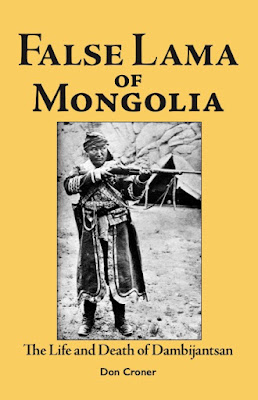
For more on Dambijantsan see False Lama of Mongolia: The Life and Death of Dambijantsan. 


Saturday, February 9, 2008

Mongolia | Baga Nuur | Tsagaan Sar

Wandered out to the town of Baga Nuur to see Zevgee and his family for Tsagaan Sar, the Mongolian New Year. This used to be a fairly tedious trip, but now that the road is paved the whole way it takes only an hour and forty-five minutes to get there. This is the first winter Zevgee has lived in Baga Nuur. Before he lived at his winter camp about forty miles up the Kherlen River valley. This winter he has left the care of his livestock to one of his son-in-laws and has retired to a comfortable log cabin in Baga Nuur.

Zevgee, Mojik, and Zevgee’s wife Tumen-Olzii

Traditional plate of boov, or ceremonial cakes

Sheep back and tail

Zevgee and Mojik

Mojik and Tumen-Olzii

Friday, February 8, 2008

Mongolia | Ulaan Baatar | New Year | Tsagaan Sar

Today is the first day of Tsagaan Sar, the Mongolian New Year. (See Tsagaan Sar 2005 and Tsagaan Sar 2007) Welcome to the The Earth Mouse Year, which is the 22nd year of the 17th Rabjung, according to the Kalachakra Calendar. As you may know, Aniruddha, the 21st Kalkin King, is now reigning in Shambhala.

Monday, January 28, 2008

Mongolia | Ulaan Baatar | Scriptorium

Welcome to the Scriptorium!
One corner of my hovel in the howling wilderness of Zaisan Tolgoi is devoted to my Scriptorium. New Additions to the Scriptorium are made on a monthly and sometimes weekly basis.
One section of my Scriptorium
Just this week there have been four new additions, three fiction and one non-fiction. The first fiction title is Michael Chabon's Gentleman of the Road. I had read Chabon’s first novel The Mysteries of Pittsburgh, which was interesting only because I myself had once lived in Pittsburgh, in the Shadyside District where much of the action takes place, but I had not read anything by him since. But Gentlemen of the Road takes place in 10th-century Khazaria, the Jewish kingdom which then existed on the Steppes Along the Volga River north of the Caspian Sea, and who could resist a setting like that? Later, in the seventeenth century, several tribes of the Oirat, or Western Mongols, including the Torguts and Dörböts, would migrate to this same area north of the Caspian Sea and become known as the Kalymks. The infamous Ja Lama was a Dörbot Kalmyk from this area. The main characters in Chabon’s book are two swindlers and con men, a Jew from Regensburg, in what is now Germany, and a gigantic black Abyssinian from Africa—the title’s Gentlemen of the Road—who get caught up in a scheme to place a Khazar prince on the Khazarian throne. But then it turns out that the Khazar prince is actually a princess! The Gentlemen of the Road should have been tipped off to this when the prince/princess refused to urinate in their presence. Like many con men they could not believe they were being conned. Who could resist a story like this?


Ever since reading The Miniaturist, a tale about a miniature painter in the Indian court of Jalaluddin Muhammad Akbar (جلال الدین محمد اکبر), also known as Akbar the Great (1542 –1605), a distant descendant of Chingis Khan, I have been a big fan of Kunal Basu.

Thus I could hardly resist his book The Opium Clerk, a tale about a Indian clerk working for the East India Company in the late 1800s. Lots of interesting details about the production of opium in India, and some of the action takes place in Canton, where the East India Company unloaded a lot of their opium. On a contemporary note some might say it’s payback time for the Opium Wars, which opened up China to foreign opium, resulting in the addiction of tens of millions of Chinese. Like, who now owns a sizable chunk of Merrill, Lynch and Citibank?

I am also a big fan of Yasmina Khadra, already having read his The Swallows of Kabul, plus The Attack and The Sirens of Baghdad. Yes, I said “his” books, since despite his female pen name the author is a man. Yasmina Khadra (Arabic:ياسمينة خضراء) is the pen name of the Algerian author Mohammed Moulessehoul (born January 10, 1955). Moulessehoul, who was an officer in the Algerian army when he first starting writing, adopted a woman's pseudonym to avoid military censorship. He revealed his true identity in 2001 and now lives in exile in France. So I sprung for one more of his books, In the Name of God, a story about how villagers in Algeria got caught up in fanatical Islamic fundamentalism. Just reading this one—review to follow.

The one non-fiction title added to the Scriptorium this week was The Turks in World History. I stopped by the Silk Road Restaurant the other day and was paging through this book while I had a cup of coffee. On page 12 was an illustration entitled “Nomadic Camp Scene.” The original was done in the fifteenth or sixteenth century somewhere between Herat and Tabriz in what is now Iran. Glancing up from the book I was startled to see a copy of this exact same painting on the wall in front of me. This is just one of the numerous Silk Road-themed reproductions on display at the Silk Road Restaurant. There are also reproductions of the Uighur Princes and Uighur Princesses from the Bezeklik Caves, near Turpan in Xinjiang, China. By the way, the originals of these paintings are now in the Indian Art Museum in Dalhem, on the outskirts of Berlin, Germany. Then on page 42 there is a photo of the Tonyukuk Monuments near Nalaikh, not far from Ulaan Baatar. All and all, this looks to be quite an interesting book. There does seem to be one glaring omission: there is no mention of the Turk Gunj.

Tuesday, January 15, 2008

Mongolia | Gov-Altai Aimag | Tsogt

On the way back from Eej Khairkhan Uul we stopped at the village of Tsogt, high on the wind-swept plateau between the basin of the Gobi Desert to the south and the Biger Depression to the north. The village itself is at an elevation of over 7500 feet. Once an important way-station on the Uliastai–Shar Kuls–Gongpochuan–Suzhou Caravan Route, it also figured prominently in the life of Dambijantsan. He recruited several disciples here and two of his wives. The wives’ names were Myadag and Nyamaa. Myadag reportedly was responsible for making Dambijantsan’s boots and Nyamaa his deels. Myadag and Nyamaa both returned to Tsogt after Dambijantsan was killed. Nyamaa apparently lived until at least the 1960s. Nyamaa claimed that she made Dambijantsan a deel of yellow silk which opened on the left instead of the right. She could not explain why she did this. According to local legend this was the deel Dambijantsan was killed in.

There was also a man named Saaral Jamsran who lived in Tsogt. One day in late 1922 a local official, apparently at that time a Bolshevik commissar, called him in and introduced him to three men who asked if he knew the way to Gongpochuan in Gansu Province. He said he did, and they said “Good, now you are our guide. You must take us there.” He asked why they wanted to go to Gongpochuan. “It’s none of your affair. Just serve as our guide,” one of the men said. Saaral Jamsran agreed. Unbeknownst to him the three men had been sent to assassinate Dambijantsan. One day before they reached Gongpochuan he asked again what they were going to do there. This time one of the man explained that they were just on a hunting trip, hoping to bag some wild sheep or ibex. Saaral Jamsran offered to tell their fortune by reading the patterns on a scorched shoulder blade of a sheep. He did so and then said, “Well, I can see your hunting trip is going to be very successful and that you will find your prey.” The next day they arrived at Gongpochuan. After the assassins killed Dambijantsan, it was, according to local legend, Saaral Jamsran who killed his famous white dog. Saaral Jamsran lived in Tsogt and died in 1960.

While in Tsogt I was able to met with eighty-two year oid Sodnompil and his seventy-four year-old wife Tsiideleg. Tsiideleg says that while at Gongpochuan Dambijantsan sent a message to the head of Tsogt village asking that he send him a “pretty young woman” and “a pretty boy.” She was unable to explain why Dambijantsan wanted a “a pretty boy.” The official was afraid of Dambijantsan and did in fact send him a woman named Otgon and a twenty year-old youth—perhaps pretty but not a boy—named Lavig to Gongpochuan. After Dambijantsan was assassinated they both returned to Tsogt. She also said that her father saw Dambijantsan’s head when it was brought by his assassins from Gongpochuan. One day, she says, he was out looking after his herds when he saw a small caravan of sixteen camels led by two men approaching Tsogt. He rode over to chat with the caravan men. They said they had just come from Gongpochuan and that Dambijantsan had been killed. As proof of this statement they showed him Dambijantsan’s bloody head. Tsiideleg’s father said it was “a horrible thing,” and he quickly rode away without asking anymore questions.
Sodnompil and Tsiideleg
Sodnompil was able to add some information about Lama Ravdan at Eej Khairkhan Uul. He says his father once gave Ravdan a horse. Everyday Lama Ravdan would take this horse and water it at a small rivulet known as Tsoojiin (“Lock”) Gol, on the south side of Eej Khairkhan He also says Lama Ravdan was well-known for producing rain. He says there was a herdsman on the west side of Eej Khairkhan Uul who also farmed some small fields. There was a drought one summer and his crops were dying. Lama Ravdan came and offered to make it rain. He sat down and began various meditations. Although there was a perfectly clear sky a dark cloud soon appeared from beyond Eej Khairkhan Uul and then drifted above the farmer’s fields. Soon it rained and then the cloud disappeared. Lama Ravdan, Sodnompil claimed, became very well known after this incident.

Tsogt was also the site of a monastery known as Tsogtiin Tsogchin Chas. It was destroyed in the late 1930s. The ruins were once surrounded by numerous gers. Then people started noticing lights hovering over the ruins at night and hearing strange noises. This continued for several years. Finally the people got spooked and began moving their gers to the other side of town. Today there are no gers anywhere around the ruins of the monastery.
Just visible foundations of the temples at Tsogt. The area around the temples is now completely deserted.