Tuesday, February 2, 2010

Mongolia | Life of Ja Lama | Chapter 4 | Early Life

Who was Dambijantsan?

A Buddhist monk; a freedom fighter for Mongolian independence; the descendant of Amursanaa (1723–1757), the Western Mongol who led the last great uprising against the Qing Dynasty of China; the incarnation of Mahakala, the Buddhist god of war; bandit, torturer, murderer, or evil incarnate? During his lifetime no one was sure who he really was, and even today the controversy about his life continues.

Born in what is now the Republic of Kalmykia, part of the Russian Federation, Dambijantsen traveled throughout Tibet, India, and China before arriving in Mongolia in 1890 where he tossed gold coins to bystanders and announced to one and all that he had come to free Mongolia from the yoke of the Qing Dynasty of China. After disappearing almost twenty years he returned to lead the attack on Khovd City, the last Chinese outpost in Mongolia. Honored by the Eighth Bogd Gegeen, the theocratic leader of Mongolia, for his efforts in achieving Mongolian independence, he went on to establish his own mini-state in western Mongolia, which he hoped to use as a base for establishing a Mongol-led Buddhist khanate in Inner Asia. His dictatorial nature and unbridled sadism soon came to the fore and he was finally arrested and imprisoned in Russia. After the Russian Revolution he returned to Mongolia, gathered new followers around him, and established a stronghold at the nexus of old caravan routes in Gansu Province, China. He robbed caravans, grew opium, and once again dreamed of creating a new Mongolian khanate in Inner Asia. Finally the new Bolshevik government in Mongolia, fearful of his rising power, issued orders for his assassination. Dambijantsan died in 1922, but in Mongolia legends persist to this day that his spirit still rides on the wind of the Gobi and continues to haunt his former lairs.
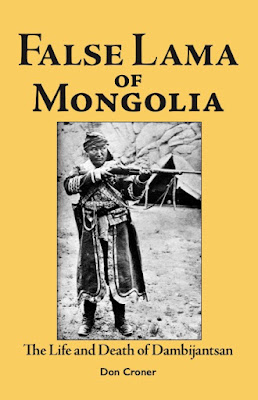

For more on Dambijantsan see False Lama of Mongolia: The Life and Death of Dambijantsan. 


Monday, February 1, 2010

Mongolia | Ulaan Baatar | Lam Rim Temple

Wandered up to Lam Rim Monastery, on Zanabazar Street just below Gandan Monastery in Ulaan Baatar. I have gone here many times over the years but I never really knew the story behind the founding of this monastery. The other day I dropped to see Bayantsagaan, the director of the monastery, and by chance his daughter Erdenetsetseg was there. She lived in Malaysia for several years and speaks near perfect English, so with her help I was able to get some background information.
Erdenetsetseg
Lam Rim Monastery
Bayantsagaan
Lam Rim Monastery was founded in 1990 by Erdenetsetseg’s father S. Bayantsagaan. Originally from Khovd Aimag in western Mongolia, Bayantsagaan studied the Lam Rim Teaching and Buddhist philosophy at the Mongolian Academy of Sciences and the Zanabazar Institute in Ulaan Baatar. He has a Geshé degree from the Zanabazar Institute and is fluent in Tibetan. In the early 1990s he played an active role the democratic movement in Mongolia and for much of the 1990s he worked as the director of the Mongolian Believers Association. During this period about seventy monasteries and temples were activated under his leadership. He has also initiated and strengthened communications between Mongolia and Tibet and in recent years has organized visits of the Dalai Lama to Mongolia.

Lam Rim Monastery was founded to promote the Lam Rim Teaching of Tsongkhapa (Mongolian=Bogd Zonkhov), who in the fifteen-century founded the Gelug Sect in Tibet.
Bogd Zhonkov
Bogd Zhonkov is author of one of the primary Lam Rim texts, The Great Treatise on the Stages of the Path of Enlightenment. Bayantsagaan would like to emphasize that the Lam Rim, or Graduated Path, is not just for monks, but for all practitioners who wish to proceed on the path to Enlightenment. The three main Protectors of the monastery are Gombo, Namsrai, and Choijoo, three deities who have promised to protect Bogd Zonkhov’s teaching wherever it may be.
Interior of Lam Rim Temple
Ninety-six year old monk, the oldest at Lam Rim Monastery
Lama Gombo, a mere stripling at ninety-five years old
New Generation of monks at Lam Rim
Monks giving blessings
Lam Rim Monastery also specializes in the Kalachakra (Mongolian = Duinkhor) Teaching believed to have come from the Kingdom of Shambhala. Kalachakra ceremonies are performed here on the 10th and 25th day of the Lunar Month. One of the goals of the monastery is to prepare people for the eventually arrival of the 25th Kalkin King of Shambhala under whose reign Buddhism will flourish throughout the entire world.
Kingdom of Shambhala depicted on Thangka at Lam Rim Temple
One of the Thirty-Two Kings of Shambhala on display at Lam Rim Temple
Get your Free Lam Rim Temple Brochure Here.

Saturday, January 30, 2010

Mongolia | Zaisan Tolgoi | Wolf Moon

The Wolf Moon of Mid-Winter will be Supersized Tonight:
The 2010 Wolf Moon will appear 30 percent brighter and 14 percent larger than any other full moon this year, because our cosmic neighbor will actually be closer to Earth than usual. The moon will be at its closest perigee—the nearest it gets to our planet during its egg-shaped orbit—for 2010 at 4:04 a.m. ET Saturday, reaching a distance of 221,577 miles (356,593 kilometers) from Earth.
 
Wolf Moon Tonight! Beware of Earthquakes!
And as if that were not enough Mars will be Right Next to the Wolf Moon:
Look into the eastern sky about 7 p.m. Friday or 8 p.m. Saturday and you may ask, “What’s that bright, red star next to the full moon?” That’s no star, it’s the planet Mars, and it happens to be a mere 61.7 million miles from Earth, according to Jon U. Bell, director of the Hallstrom Planetarium at Indian River State College in Fort Pierce.  “That’s actually pretty close for Mars,” Bell said.
 Photo Courtesy of Sky&Telescope
I will be observing the Wolf Moon from Zaisan Tolgoi.
 
Zaisan Tolgoi. If you hear someone howling at the Moon it will probably be me.

Friday, January 29, 2010

Mongolia | Zavkhan Aimag | Vansemberuu Song

Here is a transliteration and translation of the Vansemberuu song by widely acclaimed translator, meditation teacher, and man-about-town Batbold.
Batbold
Torgo shig zoolon delbeetei
Togos udmiin Vansemberuu tsetsegiig
Uchirch haraad monhron gesen
Uridiin ug unen bolovuuu

Tegvel bi ter saikhan Vansemberuu tsetsgiig
Tertee uuliin oroid baival eejiigee
Bi uureed
Enehen nasandaa ochih bailaa

Tegvel bi ter saikhan Vansemberuu tsetsgiig
Tertee uuliin oroid baival eejiigee
Bi uureed
Enehen nasandaa ochih bailaa

Tuulvul bie chatsuu
Toolbol nas chatsuu
Hosoor urgadag Vansemberuu
Uud hoimriin zaitai urgajee

Ilbiin yum shig hosgui saikhan
Iher botgo shig horvood hongor
Seruun khangai hos tsetseg
Setgel bahdam goyomsog urgajee

Uranhan ter turuund ni hureed uzvel
Unaganii uruul shig zoolhon bailaa
Hurenhen ter dund ni hureed uzvel
Huugiin mini zulai shig zoolhon bailaa

Ilbiin yum shig hosgui saikhan
Iher botgo shig horvood hongor
Seruun khangai hos tsetseg
Setgel bahdam goyomsog urgajee

Tegvel bi ter saikhan Vansemberuu tsetsgiig
Tertee uuliin oroid baival eejiigee
Bi uureed
Enehen nasandaa ochih bailaa
Rough English Translation:
With petals tender like a silk
Of peafowl lineage, Vansemberuu
If stumbled upon, it gives eternity
Are the ancient words true

If so, if this beautiful flower called Vansemberuu
Lives on the faraway mountain, I'd
Carry my old mother on my back to it
In this lifetime

If so, if this beautiful flower called Vansemberuu
Lives on the faraway mountain, I'd
Carry my old mother on my back to it
In this lifetime

If measured, equal heights
If counted, ages same
Grows paired, Vansemberuu
With a distance of a ger's length

Unparalleled beauty like magic
Endearing like twin camel babies
The pair of cool Khangai
Are enrapturingly grown

(Voice)
I touched the fine corolla
Felt soft like a foal's lip
I stroked the inner side
Felt soft like my son's forehead

Unparalleled beauty like magic
Endearing like twin camel babies
The pair of cool Khangai
Are enrapturingly grown

If so, if this beautiful flower called Vansemberuu
Lives on the faraway mountain, I'd
Carry my old mother on my back to it
In this my life time

Thursday, January 28, 2010

Mongolia | Life and Death of the Ja Lama | Chapter 9

Who was Dambijantsan?

A Buddhist monk; a freedom fighter for Mongolian independence; the descendant of Amursanaa (1723–1757), the Western Mongol who led the last great uprising against the Qing Dynasty of China; the incarnation of Mahakala, the Buddhist god of war; bandit, torturer, murderer, or evil incarnate? During his lifetime no one was sure who he really was, and even today the controversy about his life continues.

Born in what is now the Republic of Kalmykia, part of the Russian Federation, Dambijantsen traveled throughout Tibet, India, and China before arriving in Mongolia in 1890 where he tossed gold coins to bystanders and announced to one and all that he had come to free Mongolia from the yoke of the Qing Dynasty of China. After disappearing almost twenty years he returned to lead the attack on Khovd City, the last Chinese outpost in Mongolia. Honored by the Eighth Bogd Gegeen, the theocratic leader of Mongolia, for his efforts in achieving Mongolian independence, he went on to establish his own mini-state in western Mongolia, which he hoped to use as a base for establishing a Mongol-led Buddhist khanate in Inner Asia. His dictatorial nature and unbridled sadism soon came to the fore and he was finally arrested and imprisoned in Russia. After the Russian Revolution he returned to Mongolia, gathered new followers around him, and established a stronghold at the nexus of old caravan routes in Gansu Province, China. He robbed caravans, grew opium, and once again dreamed of creating a new Mongolian khanate in Inner Asia. Finally the new Bolshevik government in Mongolia, fearful of his rising power, issued orders for his assassination. Dambijantsan died in 1922, but in Mongolia legends persist to this day that his spirit still rides on the wind of the Gobi and continues to haunt his former lairs.


For more on Dambijantsan see False Lama of Mongolia: The Life and Death of Dambijantsan. 


Mongolia | Zavkhan Aimag | Vansemberuu

During a trip to Otgon Tenger Uul in Zavkhan Aimag I encountered the legendary plant known as Vansemberuu. The lore about this plant seems almost endless, and I am still in the process of collecting information.
Vansemberuu
Vansemberuu

World | iPad

Of all the names that Apple had reportedly secured--Apple Tablet, iTablet, Magic Slate, iSlate--I think it's safe to say that no one truly believed that Apple would name their newest product the iPad. Especially women.
The one-liners came fast and furious:
"So will the 64GB one be called the Maxi-Pad?"
"I'm holding out for the iRag.”


"Will the next version have wings?"
But infatuation trumps Feminine Hygiene.  See I Love the iPad.

Wednesday, January 27, 2010

Mongolia | Fifth Nine-Nine | Tavisan Budaa Khöldökhgui

The Fifth of the Nine-Nines—nine periods of nine days each, each period marked by some description of winter weather—begins today. This is Tavisan Budaa Khöldökhgui, the time when “Cooked Rice Cannot Be Frozen.” I must admit I really don’t understand the definition of this period. It seems to me that cooked rice would be frozen at any temperature below freezing, and we can certainly expect colder temperatures than that during the last week of January and beginning of February. Anyhow, the Fourth of the Nine-Nines was supposed to be coldest of the Nine-Nines, and the rest of the country is still reeling from the cold snap:  Extreme Weather Threatens Mongolians with Hunger and Poverty. Over one million head of livestock have reportedly died. Even wildlife has been affected: Mongolian Antelope Invasion Causes Alarm in Russia. True, it was up to 14ºF / Minus 10ºC yesterday afternoon, but Tsagaan Sar is coming up on the 14th of February and we often have really frigid weather for that. So there may be little if any relief in store for the countryside any time soon. I wish I could get out and see for myself what is happening, but unfortunately I am unable to travel at the moment. Maybe I will have some updates from the countryside around Tsagaan Sar.

Tuesday, January 26, 2010

Mongolia | Life of Zanabazar | Second Trip to Tibet

Most traditional accounts do not mention Zanabazar’s trip to Inner Mongolia to met the Dalai Lama in early 1655. Skipping over this episode, they relate instead  that in the summer of 1655 Zanabazar decided to make another trip to Tibet: “. . . I should like to accomplish my pious desire of again making obeisance to the Dalai Lama,” Zanabazar announced, “and especially to the Holy Panchen Vajradhara Lama [Panchen Lama] and hear the initiations and empowerments and so on which I meditated on before.” In preparation for the journey he decided to go into meditation for several months at his newly established retreat of Tövkhon near Erdene Zuu. In the autumn of 1655 he left for Tibet. See Zanabazar’s Second Trip to Tibet.

Also see:


See also Kindle Version


Saturday, January 23, 2010

Mongolia | Ja Lama

Who was Dambijantsan?

A Buddhist monk; a freedom fighter for Mongolian independence; the descendant of Amursanaa (1723–1757), the Western Mongol who led the last great uprising against the Qing Dynasty of China; the incarnation of Mahakala, the Buddhist god of war; bandit, torturer, murderer, or evil incarnate? During his lifetime no one was sure who he really was, and even today the controversy about his life continues.

Born in what is now the Republic of Kalmykia, part of the Russian Federation, Dambijantsen traveled throughout Tibet, India, and China before arriving in Mongolia in 1890 where he tossed gold coins to bystanders and announced to one and all that he had come to free Mongolia from the yoke of the Qing Dynasty of China. After disappearing almost twenty years he returned to lead the attack on Khovd City, the last Chinese outpost in Mongolia. Honored by the Eighth Bogd Gegeen, the theocratic leader of Mongolia, for his efforts in achieving Mongolian independence, he went on to establish his own mini-state in western Mongolia, which he hoped to use as a base for establishing a Mongol-led Buddhist khanate in Inner Asia. His dictatorial nature and unbridled sadism soon came to the fore and he was finally arrested and imprisoned in Russia. After the Russian Revolution he returned to Mongolia, gathered new followers around him, and established a stronghold at the nexus of old caravan routes in Gansu Province, China. He robbed caravans, grew opium, and once again dreamed of creating a new Mongolian khanate in Inner Asia. Finally the new Bolshevik government in Mongolia, fearful of his rising power, issued orders for his assassination. Dambijantsan died in 1922, but in Mongolia legends persist to this day that his spirit still rides on the wind of the Gobi and continues to haunt his former lairs.


For more on Dambijantsan see False Lama of Mongolia: The Life and Death of Dambijantsan.