Sunday, May 17, 2009

Russia | Kalmykia | Elista | Golden Temple | 17 Nalanda Panditas

The next morning I wander back to the Golden Temple by myself. As mentioned before, it is the biggest Buddhist temple in Europe. The site had been blessed by the Dalai Lama during his visit to Kalmykia in November of 2004. Amazingly, the immense structure was built in nine months, from April to December 2005, and it was officially opened on December 27, 2005. On March 11, 2006, the Dalai Lama gave the temple its official name, Burkhan Bakshin Altan Süm (Golden Abode of the Buddha Shakyamuni). The elaborate paintings on the interior walls, the Telo Rinpoche had told me during our first meeting, had been finished just two weeks before my visit. Tibetan artists from India had been brought in to do the job. I must admit this the most modern and well-appointed Buddhist temple I have ever seen. It might well be the largest I have seen too. The only temple comparable in size is the immense main temple at Samye, the first monastery founded in Tibet, back in 770s.


Burkhan Bakshin Altan Süm

Burkhan Bakshin Altan Süm

Burkhan Bakshin Altan Süm

Burkhan Bakshin Altan Süm

Burkhan Bakshin Altan Süm

Burkhan Bakshin Altan Süm
First I do a circumambulation of the temple. The path around the temple is lined with pavilions housing slightly larger than life-sized statues of the Seventeen Panditas of Nalanda. See more on the Seventeen Panditas and Nalanda. Also see Prayer to the Seventeen Panditas.

Saturday, May 16, 2009

Russia | Kalmykia | Elista | Dambijantsan

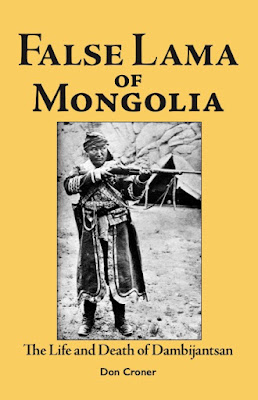
Who was Dambijantsan?

A Buddhist monk; a freedom fighter for Mongolian independence; the descendant of Amursanaa (1723–1757), the Western Mongol who led the last great uprising against the Qing Dynasty of China; the incarnation of Mahakala, the Buddhist god of war; bandit, torturer, murderer, or evil incarnate? During his lifetime no one was sure who he really was, and even today the controversy about his life continues.

Born in what is now the Republic of Kalmykia, part of the Russian Federation, Dambijantsen traveled throughout Tibet, India, and China before arriving in Mongolia in 1890 where he tossed gold coins to bystanders and announced to one and all that he had come to free Mongolia from the yoke of the Qing Dynasty of China. After disappearing almost twenty years he returned to lead the attack on Khovd City, the last Chinese outpost in Mongolia. Honored by the Eighth Bogd Gegeen, the theocratic leader of Mongolia, for his efforts in achieving Mongolian independence, he went on to establish his own mini-state in western Mongolia, which he hoped to use as a base for establishing a Mongol-led Buddhist khanate in Inner Asia. His dictatorial nature and unbridled sadism soon came to the fore and he was finally arrested and imprisoned in Russia. After the Russian Revolution he returned to Mongolia, gathered new followers around him, and established a stronghold at the nexus of old caravan routes in Gansu Province, China. He robbed caravans, grew opium, and once again dreamed of creating a new Mongolian khanate in Inner Asia. Finally the new Bolshevik government in Mongolia, fearful of his rising power, issued orders for his assassination. Dambijantsan died in 1922, but in Mongolia legends persist to this day that his spirit still rides on the wind of the Gobi and continues to haunt his former lairs.


For more on Dambijantsan see False Lama of Mongolia: The Life and Death of Dambijantsan. 


Thursday, May 14, 2009

Russia | Kalmykia | Elista | Telo Tulku Rinpoche

The next morning I have breakfast in the hotel restaurant, which is plush with carpets and still more blonde-wooded furniture. The house breakfast is frugal however; an small omelet, some paper-thin slices of cold cuts and cheese and bread, plus an expresso cup of instant coffee. At the table next to me are four Russian businessman in suits. They order a liter and a half bottle of vodka and consume it with their breakfast. Some things in Mother Russia never change.

The night before Andzha had given me a Russian SIMMs Card for my cell phone and now he calls me. Telo Rinpoche had been in India but he had just arrived yesterday with his teacher, the head of Drepung Gomang Monastery in southern India. At noon there will be a greeting ceremony for the Drepung Tripa, the official title of the lama from India, at the big Altan Süm (Golden Temple), the Rinpoche’ headquarters here in Elista, and the Rinpoche will have a few minutes to speak to me in his office beforehand. Also the monastery’s guest apartment is now ready to be occupied and Andzha will take me there before we go to the Golden Temple.

The apartment is in Microrayon #2, about a mile from the Golden Temple. The building is a Khrushchev-era construction exactly like apartment buildings in Ulaan Baatar from the same era. The builders could have used the same blueprints. Even the doors are the same. I have lived in several of these kinds of apartment buildings in UB so I immediately feel right at home. There’s no furniture but there are a a couple of mattresses propped against one wall. I put one of these on the floor and cover it with a carpet, not a handmade silk carpet like the one I sleep on in Ulaan Baatar but a machine-made woolen carpet from Turkey, but, hey, one can’t have all the comforts of home while traveling. In a corner is a pile of blankets and pillows. The kitchen has a gas stove but there is no hot water.

From here we proceed directly to the Golden Temple. This imposing structure is the largest Buddhist temple in Europe. It was completed only in 2005.

Golden Temple

Andzha drives in the private entrance at the back of the monastery and after taking off our shoes in the first floor entry hall take an elevator to the fourth floor where the Telo Rinpoche has his residence and office. From the elevator we step into a large room which at first glance seems to contain an enormous Buddhist-oriented craps table. But no, it is in fact an immense conference table, seating twenty-four, with a mandala embedded in the middle of it.

Conference Table with Mandala in the middle

Closer view of Mandala. The bottom side of the Mandala is visible in the ceiling of the Main Hall of the Temple.
I have a sudden vision of the 25th King of Shambhala sitting here with his staff, including General Hanuman, the Final Incarnation of the Bogd Gegeen, directing the final battle against the barbarian unbelievers. Andzha adds that the main temple hall is directly below this room, and that the bottom side of the mandala, painted with the same design, can be seen in the ceiling of the hall. All the prayers offered in the main temple ascend through the mandala and concentrate themselves here in this conference room.

The Telo Tulku Rinpoche’s luxurious office, appointed like that of a now disgraced CEO of a Too-Big-to-Fail bank in the USA, is off to one side of this awe-inspiring conference room. The redolence odor of rancid butter, mutton fat, and juniper incense common to monasteries in Mongolia, some of which have not felt a broom since before the fall of the Qing Dynasty, is noticeably absent here.

Telo Tulku Rinpoche

The Telo Rinpoche, the latest in a line of incarnations going back to Mangala, one of the original disciples of the Buddha and including Tilopa, one the 84 Mahasiddis of India, and the last Diluv Khutagt of Mongolia, whose book I have mentioned, greets me warmly. He must meet the Drepung Tripa shortly but he says that afterward he will give me a guided tour of the temple. In the meantime what can he do for me? I tell him that I would like to talk to historians who might know something about Dambijantsan, who was born here in Kalmykia and whose life I am researching, and who like the Rinpoche himself is considered to be, in some circles at least, an incarnation of one the 84 Mahasiddis of India, in Dambijantsans case the mahasiddi known as Güwari. The Rinpoche summons his secretary and instructs her to call one of the local research instittutes and track down any scholars who can shed some light on the up until now shadowy existence of Dambijantsan here in Kalmykia.

Then we take the elevator down to the first floor of the temple and proceed out into the immense main hall. Telo Rinpoche goes out to front gate to meet the Drepung Tripa and I remain behind. A couple hundred people have assembled to greet Drepung Tripa, and many are buying khadags (prayer scarves) from a small shop out front to present to him. Finally a procession of monks lead by Telo Rinpoche proceeds from the front gate to the entrance of the main hall of the temple. The Drepung Tripa, who appears to be in his sixties, comes last, bestowing his blessings on all those who approach him.

Telo Tulku Rinpoche (left) leading the procession into the Temple

The Drepung Tripa blessing people outside the Temple

He is the head of Drepung Gomang Monastery in southern India, which was founded by Tibetans who fled Tibet after the Chinese invasion of 1959 and named after Drepung Monastery in Tibet. Gomang was one of the several colleges at Drepung in Lhasa and the one at which most Mongolians monks who studied in Lhasa attended. Zanabazar, the first Bogd Gegeen of Mongolia, stayed at Gomang during his visits to Mongolia.

Ruins of Gomang College at Drepung in Lhasa

Many other famous Mongolian lamas studied here, including Agvan Dorzhiev, the Buryat who eventually became a tutor to the 13th Dalai and who Accompanied the Dalai Lama to Mongolia in 1904 when the latter fled Tibet after the invasion of the Younghusband Expedition.

Agvan Dorzhiev

Dambijantsan also reportedly attended Gomang College at Drepung in Lhasa. It was here that he allegedly killed his monastic roommate after a quarrel, an act which of course ended his monastic career and put him on the path which would eventually lead him to Mongolia. As George Roerich, in his book Trails to Inmost Asia, notes, “It seems the murder was the crucial point of his life for from then on begins his life as an errant warrior monk, full of wonderful adventures, messianic prophecies, and cruel deeds.”

The Drepung Tripa

The Drepung Tripa mounts the throne in the main hall of the temple and a chanting ceremony begins. After he is served a ceremonial offering of tea and rice people line up to again receive his blessing, after which everyone receives a small portion of rice (Drepung, I might add here, means “Rice Heap”). This greeting ceremony concluded the Drepung Tripa proceeds to the Telo Rinpoche’s office on the fourth floor. The Rinpoche asks me to come with along. At this office he is greeted by a camera crew from a Russian television station. It seems they want an interview with him. “I wanted to give you a tour of the temple,” he said, “But now I must talk to these people. But the monks are going to give the Drepung Tripa a complete tour of the temple, so just tag along with them and you will see everything.” The Drepung Tripa and his group go up to the fifth floor and I follow. The public is normally not allowed above the fourth floor, since the fifth floor contains a huge suite reserved solely for the Dalai Lama should he ever visit Kalmykia again. He has not visited since the temple has been built but there are high hopes he will soon.

At the entrance to the Dalai Lama’s suite on the fifth floor a guard stops me, the only person not in monks’ robes, and says, “Sorry, the public is not allowed up here.” Like a groupie who says, ”I’m with the band,” I said, “I am with the Drepung Tripa.” The guard said, “Oh, excuse me, I am so sorry!” Putting his hand together he bowed and said, “Please, please, go in!”

Sitting Room of the Dalai Lama’s Suite

The suite is immense, with magnificent carpets and sumptuous sofas and chairs. Should the Dalai Lama feel homesick, on one wall there is a painting of the Potala, his former home in Lhasa. I have toured the Dalai Lama’s living quarters in the Potala several times and oddly enough they are preserved just the way he left them, although apparently not in anticipation of his return.

Painting of the Potala in the Dalai Lama’s Suite

On the facing wall is a painting of the Golden Temple. To one side of the sitting room is the Dalai Lama’s bedroom, complete with double bed. Instead of a chocolate, there is a prayer scarf on the pillow.

Dalai Lama’s bed: there’s no chocolate on pillow but there is a prayer scarf

Just off the bedroom is a small study and meditation niche with a mat on the floor and low table. Off to the other side of the sitting room are conference rooms and rooms for the Dalai Lama’s attendants.

Dalai Lama’s Meditation and Study Niche

The sixth floor, which is actually a walkway around the cupola at the top of the temple is also normally closed to the public but of course we get to go up for a look. From here we get a good view at the very modest city of Elista, which ends abruptly less than half a mile away, beyond which treeless steppe stretches off to the horizon. It is windy even here, and even bit cool, but the Drepung Tripa lingers, seeming to enjoy the view from all four sides of the cupola.

View of Elista from the cupola of the Temple

Another view from the cupola

The Drepung Tripa enjoying the view from the cupola

From here we descend back down to the first floor for a tour of the monastery’s Scriptorium, which in additional to a large collection of regular books and Tibetan-language sutras has high speed internet free for the public. The Drepung Tripa asks to see several Tibetan language sutras and lingers over them for awhile.

Drepung Tripa perusing tome in the Scriptorium

I cannot help noticing a display case contaiing a collection of books about the Oirat Zaya Pandita (1599–1622), whose path I keep crossing in the most unexpected places.

Namkhaijantsan (1599–1662), The Oirat Zaya Pandita

He is the inventor of the so-called Tod Bichig Script, a variation of the traditional vertical Mongolian script. While researching the dialects of western Mongolia he stayed at Tögrög Monastery in the small town of Mankhan, on the Dund Tsenger River in what is now Khovd Aimag. Dambijantsan’s camp, where in 1912 he assembled his troops for the assault on the Manchu Fortress in Khovd City, was located on the Dund Tsenger Gol not far from Mankhan. The Zaya Pandita also accompanying the little six-old prince Galdan to Lhasa in 1649 when the latter went there to become a monk. Galdan, who later renounced his vows as a monk and became the khan of the Zungarians, or Western Mongols, would launch a disastrous war against the Eastern Mongols, led by Zanabazar, the first Bogd Gegeen. Seeking protection from Galdan, Zanabazar in 1691 accepted the suzerainzy of the Qing Dynasty in China, making Mongolia a province of China and leading to the subjugation of the Eastern Mongols by the Manchus for 220 years. To free Mongolia from China became the overriding goal of the first part of Dambijantsan’s life.

From the Scriptorium we moved on to the very finely appointed museum of the monastery. Among the plethora of displays here, too numerous to detail, was another exhibit about the Zaya Pandita and also one about Agvan Dorzhiev, the enigmatic Buryat, mentioned before, who did much to revitalize Buddhism in Kalmykia at the beginning of the twentieth century. As mentioned, Dorzhiev reportedly studied with Dambijantsan at Drepung Monastery in Lhasa. Next to the Museum we peek into the lusciously appointed Conference and Film Viewing Hall.

Conference Hall

The Drepung Tripa then retired to his quarters. Andzha and I went to the monastery’s canteen for a late lunch of hearty beef and barley soup (Andzha, despite his years as a monk in India, is not a vegetarian). While we were eating he got a call from Telo Rinpoche, who said that a meeting had been set up for me tomorrow at the Kalmykian Institute of Humanistic Research. Apparently the panditas there know something about Dambijantsan.

Wednesday, May 13, 2009

Russia | Kalmykia | Elista

Back in 2002 I attended the Kalachakra Initiation given by the Dalai Lama in the Austrian City of Graz, hitherto known mainly as the birthplace of numerous distinguished personages, including Archduke Franz Ferdinand II, whose assassination in 1914 touched off World War 1; Baron Ungern-Sternberg, the psychopathic warlord who in 1921 had briefly reigned in Ulaan Baatar as the uncrowned King of Mongolia; Heinrich “Seven Years in Tibet” Harrer; and Arnold “The Terminator” Swartzenegger. Over 10,000 Buddhists of various degrees of persuasion had descended on the this small Catholic-dominated town in the south of Austria to take the initiation, including a contingent of a hundred or so people from the Republic of Kalmykia, part of the Russian Federation. These Kalmyks were descendents of Western, or Oirat, Mongols, who in the early seventeenth century had migrated from what is now western Mongolia and the Chinese province of Xinjiang to the Caspian Steppe straddling the Volga River north of the Caspian Sea where they become the only Mongols to nomadize in the continent of Europe. They had brought Tibetan Buddhism with them from their homeland and after being stomped out during the Stalin-era repressions in Russia the religion was now enjoying a resurgence.

The Kalmyks in Graz were certainly enthusiastic, and they quickly drew attention to themselves for their total disregard for queuing, assigned seating, and other attempts to impose order by the autocratically minded organizers of the initiation. I was able to strike up conservation with several of these Kalmyks in my rudimentary Russian and went out to eat with them a few times. On the last day of the initiation three of them, one a woman in her fifties, approached me and asked a favor. It seems that they had overspent their allowances and not did not have enough money for the bus fares back to Kalmykia. Would it be possibly to lend them a few hundred Euros? Since they were clearly in distress, and in keeping with the theme of compassion being stressed in the Kalachakra teachings, I loaned them the money they needed. “When I come to Kalmykia you can pay me back,” I told them. “No problem,” they said, “we will be waiting for you.” At the time I had absolutely no plans to travel to Kalmykia but then again one never knows.

For six years I can’t say I gave the Kalmyks or the money I had loaned to them another thought. Then in the Fall of 2008 and Winter of 2009 the world-wide financial crisis struck and I myself, even in far-off Mongolia, began to feel the consequences. In addition to the world-wide systemic problems in the economy, the Mongolian tögrög took a stomach-churning fall against the dollar, wiping out any income and then some from tögrög-based accounts in Mongolia. In these troubled times my thoughts naturally turned to the money I had loaned to the Kalmyks back in 2002. Unfortunately, I did not remember the names of the people I lent the money to, nor had I found out where in Kalmykia they lived. Added to that it was quite hard for Americans to get Russian visas in Ulaan Baatar, and travel to Kalmykia, while apparently possible, was described in all available sources as problematic.

At this juncture I got a call from Ulaan Baatar-based translator, author (Fourteen Dalai Lamas: A Sacred Legacy of Reincarnation, among Many Other Titles), Dharma practitioner, tour guide, and Irrepressible Gadabout Glenn Mullin. It seemed that the Telo Tulku Rinpoche, the current incarnation of the Diluv Khutagt, one of the most prominent lamas in pre-revolutionary Mongolia, was in town and he had invited Glenn to a luncheon he was hosting. Glenn was allowed to bring one guest and wondered whether I would like to accompany him.

At the time I was living in semi-occultation in Zaisan Tolgoi, a out-lying district of Ulaan Baatar right beneath the shadow of Bogd Khan Uul, the enormous massif which overlooks the city on the south. I had no idea the Telo Tulku Rinpoche was in town, nor that he was accompanying a delegation of Kalmykian officials meeting with the President of Mongolia. I had long been aware of his previous incarnation, the Diluv Khutagt, however. The Diluv Khutagt had left Mongolia in the early 1930s to escape the repression of Buddhism and the arrest of monks which at that time was just starting to pick up steam. After various peregrinations, including a stint in Lhasa as an advisor to the 13th Dalai Lama, he migrated to America, eventually finding a home among the community of Kalmyk immigrants who after World War II had settled in New Jersey. Here he had penned two books, his Political Memoirs, and his Autobiography. These had been translated into English by Mongolist Owen Lattimore and published together in one volume in 1982. In the mid-1980s I had stumbled upon a copy of this book in the Library of Congress in Washington, and after unsuccessful attempts to buy the book returned to the library and made a zerox copy. This copy I carried with me for the next two decades and indeed I still have it. Intrigued by the life of Diluv Khutagt, in 1998 I had traveled to Gov-Altai Aimag in western Mongolia to visit the ruins of his former monastery, Narobanchin Khiid, which had been destroyed by the communists. I cannot say, however, that I was then aware that his current incarnation had been recognized, and that he was dividing his time between the United State, India, and Kalymkia.

Then in the summer of 2008 I made a pilgrimage to Otgon Tenger, one of the four sacred mountains in Mongolia which by law the President of Mongolia must visit and make an offering to at least once every four years years. I hired horses and in six days did a complete circumnavigation, or khora, in Tibetan, of the perennially snow-capped 12,811-foot peak. We visited the main ovoo of the mountain where the Diluv Khutagt had himself come to perform ceremonies in honor of Otgon Tenger, according to his autobiography, and camped that night nearby. The next morning we rode on in what was at first drizzling rain and what soon turned into a downpour. By noon it was still pouring and there was absolutely no chance of getting a fire going from dried dung—there was no firewood in the area—so we stopped at a ger inhabited a man his wife in their seventies and asked if we could make soup and tea on their stove. They readily agreed and we quickly took shelter from the rain and began preparing lunch. For an half hour or so the old couple had almost nothing to say. Then I asked if they knew about the Diluv Khutagt, who had been born in what is now Zavkhan Aimag, in which Otgon Tenger is also located. Yes, they knew about the Diluv Khutagt, even about how he had migrated to the United States. Then they mentioned that in 1991 the current incarnation of the Diluv Khutagt, the Telo Tulku Rinpoche, had made a pilgrimage to Otgon Tenger and that they had met him. Looking back, I think this is the first time I heard about Telo Tulku Rinpoche.

Now Glenn Mullin and I were going to met him in the Indian Restaurant in the Imperial Puma Hotel just off Sukhbaatar Square. The luncheon was scheduled for 1:00 but the Rinpoche was delayed first by with some lamas at Gandan Monastery then by some government panjandrums. He finally arrived at three o’clock with his sizable entourage and we all retired to one of the restaurant’s private dining rooms. The entire Indian staff of the restaurant appeared briefly to get a glimpse of the famous incarnation who had once lived and studied in India.

Speaking impressive Hindi, he quickly ordered a bevy of Indian dishes and then settled back in his chair. The first thing that struck me about the Rinpoche was his very informal manner and his pure American accent. He had been born in Philadelphia of Kalmyk immigrants and at the age of seven had gone to India to study and had eventually began a monk. While in India he was recognized by the Dalai Lama as the current incarnation of the Diluv Khutagt. He eventually gave up his vows as a monk and got married, but nevertheless he was finally recognized as the head of the Buddhist Faith in Kalymkia. He was currently in Mongolia to discuss the restoration of Narobanchin Khiid and meet with the organizers of a committee which has been set up in Mongolia to represent his interests here.

I had made another copy of Diluv Khutugt’s book from my Library of Congress copy and now presented it to the Rinpoche. He admitted that while he had glanced through the book in libraries he had never read the whole thing. I pointed out the chapter in the Diluv’s autobiography about the Notorious Ja Lama Dambijantsan, who had been born in Kalmykia and about whom I was currently doing research. Somewhat surprisingly, the Rinpoche had heard of him; in fact; he is a Dörböt, the same Kalmyk tribe to which Damijantsan belonged.

To my right was sitting a man who now introduced himself as Khongor Elbikov. His business card revealed that he was the Vice-Chairman of the Parliament of the Republic of Kalmykia. I was a bit embarrassed that I had up until now ignored this rather important personage. “I heard you mention Dambijantsan,” he said. “How do you know about him?”

I replied that I had been doing research about Dambijantsan on-and-off for several years. Were people—besides himself obviously—in Kalmykia still aware of Dambijantsan? I wondered. He said that he believed someone at one of the research institutes in Elista, the capital of Kalmykia, had done some research about Dambijantsan. I should come to Kalmykia and do some research myself, he said. I replied that I would love to, but that it was bit difficult to get a Russian visa in Ulaan Baatar. I had already been turned down three times before. “I will give you an official invitation from the Kalmykian Khural [Parliament],” he said. I don’t see how they can refuse to give you an invitation when you have an official invitation.” The Telo Tulku Rinpoche, who had apparently overheard this conversation, chimed in, “Yes, you must come visit Kalmykia We will sent you an invitation. Don’t worry about it.” Well, I thought, here is my chance to visit Kalmykia and get my money back. And as a bonus, I can delve further into the life of Dambijantsan.

In due course I received the invitation signed by an official in the Kalmykian Parliament. At the Russian Embassy the attaché studied it long and hard. It was clear he did not want to give me a visa but to refuse to honor an official invitation might have repercussions for himself. With obvious disgust, he finallty threw my application and passport into a bin on his desk and barked, “Come back in five days for your visa. Pay $170 now.” Pressing my luck, I asked, “Can I go to St. Petersburg also on this visa?” “No!” he snapped. “Your invitation specifies travel to Moscow-Volgograd-Elista on official business. You must stick to your itinerary. If you want to go to St. Petersburg you must apply for a tourist visa.”

The Aeroflot flight from Ulaan Baatar to Moscow leaves at 7:35 a.m. I hadn’t flown on Aeroflot in years, and was a bit taken by the spiffy new Airbus A320-200 they use on this flight. I flew Aeroflot back in the glory years of the late 1980s when Russian businessmen put down their tray tables the moment they sat down and got out liter bottles of vodka. A flight attendant would come through and tell everyone to put up their tray tables for take-off but of course no one paid the slightest attention to her. Now Aeroflot was just like any other airline. They did not even serve alcohol on the flight. The plane was not more than one-fourth full. I could remember when there was a waiting list of a month for the Mongolia Airlines flight to Moscow. Apparently the economic meltdown was affecting air travel.

Six and hour half hours later we were in Moscow. I was in the front of the plane and was one of the first to reach passport control. Only two windows were open and there was no one in line. A woman gave my visa a cursory glance and stamped it. Wandering out into the airport lobby I was surprised to find the place almost deserted. There was literally no more than a dozen travelers wandering around the shabby run-down premises. This was the airport of the capital of a country which once was and now again aspires to be a world power. The contrast between this and Beijing’s huge and spectacular new world-class airport is nothing less than staggering. And even Ulaan Baatar’s airport was a beehive of activity compared to this deserted place. I had read on the internet that the world financial crisis had curtailed air travel; now I was seeing the effects first-hand.

I had to transfer from the International Terminal to Domestic Terminal #2. For the four mile or so trip cab drivers wanted $60. Luckily I had lots of time, so I took the bus. The domestic terminal was small, maybe the size of the airport in a small city in the American mid-west, and even more shabbier than the international airport. The restaurants did not look appetizing. I did check out the book kiosks. There were big stacks of a book entitled Kak Perezhit Krisis (How to Survive the Crisis) with a big pile of 100 dollar bills going up in flames on the cover.

There are direct flights to Elista from Moscow three days a week, but they are on some small regional airline which does not sell tickets outside of Russia. Not wishing to waste time, in Ulaan Baatar I had bought a ticket on the one hour and forty minute Aeroflot flight to Volgograd, one hundred and eighty miles north of Elista, the capital of Kalmykia. Telo Tulku Rinpoche had said he would send a car up from Elista to Volgograd to pick me up. In addtion, the road from Volgograd to Elista goes right through the old Malo-Dörböt district where Damibjantsan was allegedly born, so I would get a chance to see this region at first-hand.

I was met at the airport by a young Kalmyk man holding a printed sign with my name on it. In all my travels in this world I have walked out into the reception hall of airports hundreds of times and seen people holding signs with the names of expected arrivals but this is the first time I ever saw anyone holding up my name. “My God,” I thought, “I have finally arrived!” I was a real traveler, with someone actually waiting for me, and not just some nameless badarchin wandering alone down the endless corridors of time and space.

This guy lead me outside to a spanking-new Toyota Corolla driven by a big hulking Kalmykian who looked like a Mongolian wrestler. Neither spoke English, and I was forced to resort to my rusty Russian. Neither seemed to understand a word of my forays into Mongolian. They did not even recognize my Mongolian for “What’s your name,” although the driver did finally recognize ner, the word for name. The Kalmykian version of the of the Mongolian language, I would quickly discover, is quite different from the Khalkh dialect spoken in Mongolia. Anyhow, speaking Russian I soon determined that the guy who had met me was named Genan and the driver’s name was Savr. Although I directed my Russian to Genan, it turned out it was the Savr who understood me best, and he often repeated what I had said for the benefit of Genan. I finally discovered that Genan was student of Buddhist philosophy and Tibetan language at the State University of Kalmykia. The Telo Rinpoche had asked him to come along with the driver to met me.

Volgograd is of course the former Stalingrad, where on the vast plains surrounding the city the Soviet Red Army had cornered the Germany army during World War II and dealt it a defeat from which Nazi Gerrmany never recovered. The name of the city has been changed but no one has been allowed to forgot what happened here. Billboards in the old—and now newly popular—Socialist Realism style proclaim the upcoming celebration of the anniversary of the Soviet victory. One large billboard announces: ”Volgograd: City of Heroes.” Apparently we missed the city center but the environs extend for miles. It took a good hour to drive through the suburbs and small villages surrounding the city. At the outskirts we stop for gas and bottled water. As we leave the gas station we pass by a dozen or so blonde-haired and heavily made-up mini-skirted tarts lined up along side the road, clearly soliciting business. “Russian girls,” mutters the driver in disgust, one of his few forays into English.

Beyond the villages lay vast cultivated fields, the horizon disappearing beyond the curvature of the earth. The road is straight, flat, and in reasonably good condition, and the lead-footed driver soon has the Corolla barreling along at ninety miles an hour. Almost imperceptibly the cultivated fields start grading into mixed farm lands and pasture until finally the countryside turns to unbroken steppe. Perhaps not by accident, the border of Kalmykia is near where the steppe take over completely. Somewhere on these monotonously flat steppes, broken only the on occasional pond or small like ringed with tall reeds, Dambijantsan was supposedly born. Apparently there are no speed limits in Kalmykia since going over ninety miles an hour we blew past several police cars without consequence.

We arrive in Elista, the capital of Kalmykia, about three hours after leaving Volgograd. The city is located in a depression in the otherwise level steppe. Its population is said to be just over 100,000. My first impression is of surprisingly clean, tidy, tree lined streets backed by modest two and three story apartment houses. Telo Tulku Rinpoche’s monastery has a guest apartment but at the moment it is unavailable, so I am taken to small three-story hotel on quiet side street lined with trees and lilac bushes in full bloom. Here a young maroon-robed monk meets us as we step into the lobby. He greets me warmly and I think I must have met him before, but I cannot remember where. When meeting people I am often overcome by the strong sensation that I already know them, even when this is clearly impossible. In this case there is an explanation; he was with Telo Tulku Rinpoche at the luncheon in Ulaan Baatar. I had not spoken to him but I must have noticed him. His name is Andzha.

The hotel, called the White Lotus (the symbol of Kalmykia), is decidedly up-scale, newly refurbished with sleek Scandinavian furniture, all blonde wood and chrome, very clean, and possessing awesome water pressure, although I must admit the same quality hotel in China would cost a half or one-third of this one and would almost invariably have internet connections and certainly a hot water kettle, neither of which this place has. And the restaurant serves only breakfast. Andzha offers to take Genan and me to dinner at a café nearby named Tsagaan Sar: “White Month” in Mongolian, one of the first touches of Mongolia I have seen here. What is called manti on the menu turns out to be the beloved Mongolian buuz—steamed meat dumplings. “Kalmyk tea” turns out to be the equally beloved suutai tsai—milk tea. By the time we finished dinner it was nine o’clock local time, one in the morning UB time; since I had already been up twenty-two hours I decided to wait until the next day before launching my quest for the people who owe me the money.

Sunday, May 3, 2009

Mongolia | Ulaan Baatar | Kalachakra Temple | Mandala

Wandered by Gandan Monastery and visited the Kalachakra Temple, where monks are creating a Kalachakra Mandala in preparation for the Kalachakra Ceremony beginning on May 7 and continuing through May 29. The mandala itself, made from sand of various colors, takes six days or so to create. It is based on the three dimensional Kalachakra Mandala found in Kalapa, the capital of the Kingdom of Shambhala, which is itself based on the Dhanyakataka Stupa, where according to tradition the Buddha taught the Kalachakra Tantra to Suchandra, the first of the 32 Kings of Shambhala. There is much else of interest in the temple, increasing representations of the 722 Kalachakara Deities.

Monks fashioning the Kalachakra Mandala

Monk working on the Kalachakra Mandala

Monk working on the Kalachakra Mandala

Colored sand used to fashion the Mandala

Monk working on the Kalachakra Mandala

Monk working on the Kalachakra Mandala

Detail of the Kalachakra Mandala

A painted version of a finished Kalachakra Mandala

Friday, May 1, 2009

Mongolia | Taiwan Tea | Bao Zhong Oolong

I am thrilled to report that the Spring Crop of Bao Zhong Oolong Tea from Taiwan is now available! My shipment of the first picking of the year arrived two days ago and after sampling it I am ready to announce that the 2009 Spring Crop is equal to if not better than the 2008 crop, which as most of you probably know was a bumper year for Bao Zhong.

Bao Zhong tea is a very Lightly Oxidized Oolong Tea, right on the cusp between green tea and oolong tea. Many people who try it think that it is indeed a green tea, although it is slightly oxidized, making it an oolong tea. In any case, with the arrival of the new crop of Bao Zhong can the First Appearance of a Wild Flower here in Zaisan Tolgoi be far behind? These are exciting times we are living in!

Very lightly oxidized Bao Zhong tea leaves

Brewed Bao Zhong. Savor the gorgeous greenish-yellow color.

Monday, April 27, 2009

China | Xinjiang | Dragon Fighter

Rebiya Kadeer

There is a new book out about Rebiya Kadeer, from Urumqi, in Xinjiang Province, who was once reputed to be the richest women in China and was later arrested and thrown into prison on what was widely considered to be trumped-up charges. (Among other suspicious activities, she once met with evil Microsoft potentate Bill “666” Gates.) See Dragon Fighter: One Woman's Epic Struggle for Peace with China.

Despite being persona non grata in China her name is still displayed on the front of one of the department stores she owned in Urumqi (in Uighur Arabic Script). Interestingly, the Uighurs originated in Mongolia—the ruins of their Old Capital City can still be seen in Arkhangai Aimag, north of Kharkhorin. And of course, the Mongolian Vertical Script is based on the old Uighur Vertical Script . . .

Saturday, April 25, 2009

Mongolia | Life & Death of the False Lama #18

Who was Dambijantsan?

A Buddhist monk; a freedom fighter for Mongolian independence; the descendant of Amursanaa (1723–1757), the Western Mongol who led the last great uprising against the Qing Dynasty of China; the incarnation of Mahakala, the Buddhist god of war; bandit, torturer, murderer, or evil incarnate? During his lifetime no one was sure who he really was, and even today the controversy about his life continues.

Born in what is now the Republic of Kalmykia, part of the Russian Federation, Dambijantsen traveled throughout Tibet, India, and China before arriving in Mongolia in 1890 where he tossed gold coins to bystanders and announced to one and all that he had come to free Mongolia from the yoke of the Qing Dynasty of China. After disappearing almost twenty years he returned to lead the attack on Khovd City, the last Chinese outpost in Mongolia. Honored by the Eighth Bogd Gegeen, the theocratic leader of Mongolia, for his efforts in achieving Mongolian independence, he went on to establish his own mini-state in western Mongolia, which he hoped to use as a base for establishing a Mongol-led Buddhist khanate in Inner Asia. His dictatorial nature and unbridled sadism soon came to the fore and he was finally arrested and imprisoned in Russia. After the Russian Revolution he returned to Mongolia, gathered new followers around him, and established a stronghold at the nexus of old caravan routes in Gansu Province, China. He robbed caravans, grew opium, and once again dreamed of creating a new Mongolian khanate in Inner Asia. Finally the new Bolshevik government in Mongolia, fearful of his rising power, issued orders for his assassination. Dambijantsan died in 1922, but in Mongolia legends persist to this day that his spirit still rides on the wind of the Gobi and continues to haunt his former lairs.


For more on Dambijantsan see False Lama of Mongolia: The Life and Death of Dambijantsan.