Friday, February 13, 2009

China | Beijing | Confucius Temple and Amarsanaa

After my visit to the Silk Street Market I scampered on out to the huge Tibeto-Mongolian Yonghegong Monastery. First I wanted to get my prayer beads restrung—the string on mine had become dangerously frazzled—at the Tibetan Thangka shop just down the street from the entrance of Yonghegong, but I soon discovered that since my last visit the Tibetan Thangka shop had been turned into a Tibetan restaurant and bar. They tried to lure me in for a plate of Momos and a pot of butter tea, but I resisted, since I had more pressing business. I moved on down the street to one of the many shops selling religious paraphernalia and bought a supply of Nanmu incense, made from the wood of the Nanmu Tree. Supposedly Nanmu incense was introduced into China by Lobsang Palden Yeshe, the 6th Panchen Lama of Tibet, who gave some as a gift to the Qing Emperor Qianlong on the occasion of the latter’s seventieth birthday in 1778. (The 6th Panchen Lama, it might be parenthetically noted, also wrote a famous Guidebook to Shambhala.) Unfortunately, while in Beijing being feted by Qianlong the Panchen Lama contracted smallpox and transmigrated. Rumors that he was purposely exposed to smallpox in order to elimimate him have never been confirmed. (Qianlong’s father, Yongzheng, was likewise accused of offing Zanabazar, the First Bogd Gegeen of Mongolia, at the Yellow Temple in Beijing.) In any case, Nanmu quickly became the Emperor’s favorite incense. It has the unusual quality of smelling much stronger on rainy days, and is said to clear the nose and sharpen one’s thoughts. It also drives away mosquitoes.

I had intended to pop into Yonghegong Monastery to see if the Shambhala Thangka which is supposedly in storage here had been put out on display since the last time I visited, when it was no where to be seen, but the sight of the dozen or more big tourist buses out front and the hundreds if not thousands of people milling around the entrance quickly discouraged me. It was a balmy 58º F and a lot of Chinese in addition to the usual hordes of Western and Japanese tourists were out on excursions. I had already visited the place a half dozen times or more and saw no need for braving the crowds yet again.

Instead I mosied down a side street to the Confucius Temple. Visiting here was my real reason for coming to Beijing, Tea and carpets aside. Compared with the hubbubish atmosphere prevailing at Yonghegong the Confucius Temple grounds were an oasis of calm and tranquility. Only a handful of elderly Chinese were tottering around the temple grounds, which cover 22,000 square meters or almost 5.5 acres.

Confucius (circa 551-479 BC).

Tranquil grounds of the Confucius Temple

Tranquil grounds of the Confucius Temple

Tranquil grounds of the Confucius Temple

Cypress trees at the Confucius Temple

The Confucian Temple was built during the Mongol Yuan dynasty in China by order of the Yuan Emperor Chengzong, grandson of Khubilai Khan.

Mongol Emperor Chengzong (1265-1307, r. 1294–1307)

Construction began in 1302 and was finished in 1306. It was intended as place where the emperors could go to make offerings to Confucius. The Mongols were of course not Confucianists, but they no doubt felt they had to ingratiate themselves with the Confucian-dominated Chinese bureaucracy if they wanted to successfully rule China.

Confucius was perhaps most famous for his many aphorisms. Some examples:
Before you embark on a journey of revenge, dig two graves.

Everything has its beauty but not everyone sees it.

Forget injuries, never forget kindnesses.

He who will not economize will have to agonize.

I hear and I forget. I see and I remember. I do and I understand.

Ignorance is the night of the mind, but a night without moon and star.

It does not matter how slowly you go so long as you do not stop.

Men's natures are alike, it is their habits that carry them far apart.

Girl who flies airplane upside down has crack up.

Our greatest glory is not in never falling, but in getting up every time we do.

Respect yourself and others will respect you.

Study the past if you would define the future.
Entrance to the main part of the temple complex

Chu Jian Cypress

Most of the cypress trees in the temple compound were planted during the Yuan Dynasty, in the fourteenth century. Many of them are named and have elaborate histories. During the Ming Dynasty, which replaced the Yuan, a wicked minister by the name of Yan Song came here to offer sacrifices. When he passed this cypress tree a high wind sprang up and a branch, driven by the wind, lifted up his black gauze hat (worn by Ming officials as a sign of rank) and exposed his face. Later the tree was said to have the ability to distinguish wicked courtiers from loyal ones. It eventually became known as the Chu Jian Cypress.

Another cypress dating back to the Yuan Dynasty

An Incense Burner. I would love to have one of these for my hovel.

The main reason I came to Beijing and to the Confucius Temple, however, was to see the monument erected by Qing Emperor Qianlong to commemorate the defeat of the Zungarians in 1755. This last great uprising of the Western or Zungarian Mongols was led by Amarsanaa. One hundred and thirty-three years after the the death of Amarsanaa, the notorious Avenger Lama Dambijantsan would claim be his descendant and/or reincarnation and embark on a campaign to overthrow Manchu rule of Mongolia.

Plaque marking the stele erected by Qianlong

Pavilion housing Qianlong’s stele commemorating the defeat of Amarsanaa and the Zungars

Qianlong’s stele commemorating the defeat of Amarsanaa and the Zungars

Turtle on which Qianlong’s stele is mounted

Although the Zungarians were defeated in 1755 the Hui, or Chinese Moslems, of Xinjiang fought against the Qing until they were finally subdued—for the time being—in 1759. From this time on Xinjiang, Now the Westernmost Province of China, was part of the Qing empire.

Pavilion housing a stele commemorating the subjugation of the Huis in 1759.

Thursday, February 12, 2009

China | Beijing | Silk Street Market | Carpets

From Maliandao Tea Street I scarpered over to the notorious Silk Street Market. This is a landmark in Beijing; it used to be an open air market but has now been moved into a large department store-style building. There are reportedly over 1700 shops in the complex and on an average weekday some 20,000 shoppers flood the place, with from 50,000 to 60,000 a day on weekends. The place is infamous for counterfeit brand-name goods and the world’s most aggressive sales people. The management of the complex has provided these helpful English Language guidelines for sales staff in the stores:


I really was not in the market for anything today but I have been coming here for years so I like to chat with the people in the shops where I have bought things before. Despite seeing tens of thousands of customers a week they always greet you like a long-lost friend. First I went to the fabric and tailor shop where I usually have my clothes made (it is impossible to buy my sizes off the shelf in China; difficult anywhere actually). It was nine o’clock on a Sunday morning and the boss of the place, a women in her fifties, was not there. When I asked one of the clerks about her she said, “She’s sleeping; when you are rich you get to sleep in.” I said I wasn’t buying anything, but had come to check out any new fabrics they had in stock. I spent an enjoyable hour lovingly caressing and fondling the heart-stoppingly elegant raw silks, luscious cashmeres, lovely satins, mind-bogglingly magnificent brocades, delectably soft cottons, and sumptuous linens, all the while chatting with the charming to say nothing of knowledgeable staff.

Delectable Fabrics and Lovely Staff

If this isn’t a sight to make your heart palpitate you better check to see if you have not already assumed room temperature.
The gracious Big Boss at the Fabrics Shop, absent on my latest visit.

From the fabric shop—actually one of probably a hundred fabric shops in the complex, a true fabric fondler’s Paradise—I mosied on over to one of the carpet shops I have frequented in the past. Here, as at the fabric shop, the boss—a Mr. Wen—was sleeping in but the eye-dazzling Ms. Chen was on the scene. I have bought carpets here before and Ms. Chen was of course thrilled to the core to see me again.

Here is a rug which I bought at this shop on an earlier visit to Beijing and which now adorns the pounded-earth floor of my hovel in Zaisan Tolgoi.
I told her I was just looking today, but she was more than happy to show me some of the new items they had in stock.

A breath-takingly gorgeous 8oo knot per-square-inch antique silk rug selling for 7500 yuan ($1098)
Another view of same luxuriously opulent carpet

Same magnificent carpet and the equally tantalizing Ms. Chen

Another mouth-wateringly luscious 600 knot per-square-inch antique (dating from the 1920s) silk carpet, this one selling for 2900 yuan ($425)
I did not buy any carpets today but promised the enchanting Ms. Chen I would be back to see her again soon.

Wednesday, February 11, 2009

China | Beijing | Maliandao Tea Street

Since I had completely run out of the puerh tea I had no choice but to wander on down to Beijing and replenish my stores. Loose puerh tea is available at the State Department Store in Ulaan Baatar, but it is hardly the quality I am accustomed to drinking. As I mentioned earlier there had been a devastating collapse of the Puerh Tea Trade in China so I thought it might be a good time to stock up on Puerh in Beijing at fire sale prices. I took a cab from the airport (Mongolian Airlines still flies to the old Terminal #2 so I still have not seen the huge new terminal yet) straight down to Wangfujing Street and checked into a fleabag hotel just a half block from the Foreign Languages Bookstore, one of my usual haunts in the Big Dumpling.

Before checking out the books, however, I headed for the Maliandao Tea Street in southwest part of the city. There are over 1000 tea stores in this area but I always return to the shop of Ms. Na, who has an especially good selection of black and Puerh teas. “Long time no see!” she announced when I walked in the door. When I first met Ms. Na three years ago she spoke no English at all, but now she had obviously learned some colloquialisms. We were also able to conduct a rudimentary conversation on the subject of tea. Hoping to set the tone for the upcoming bargaining I said, “Puerh prices have gone down, yes?” She readily agreed, then suggested we sample her shop’s finest Puerh. This was sixteen year old tea from one of the most famous Puerh producers in Yunnan Province. Six months ago this puerh was selling for 10,000 yuan ($1,463) a kilo. Now the price was 2000 yuan ($292) a kilo.

Loose Puerh — $292 a kilo after Tea Crash

It was certainly delectable, with a wonderfully clear orangish-amber color, a breath-takingly bracing fragrance, and a flavor to bring tears of joy to the eyes of even the most jaded tea taster. But it was a bit out of my price range. I was more interested in the $20 to $30 a kilo Puerhs. Fortunately Ms. Na also had a good selection of these. The slow sampling process began, and two hours later I had bought an assortment of both cake and loose puerhs of differing ages, two kilos of Yunnan Gold black tea (two different grades), a kilo of Qi Mun (Keemun) black tea, and a half kilo of Tie Kwan Yin (Iron Goddess of Mercy) Oolong. That, I thought, should be enough tea to last for the winter months.


The unfailingly gracious and charming Ms.
Na showing off a cake of seven-year old Puerh
Some nice cakes of Puerh

See more on the Maliandao Tea Market.

Monday, February 9, 2009

Tibet | Kailash | Shambhala | Kalki

With websites on three different subjects plus this blog I get a lot of email from readers. The other day I got an email from a guy in India. I won't use his name or give his email address unless he gives permission. He said that he had stumbled across my website The Legend of Shambhala and that he needed to talk to me immediately about something connected with Shambhala. He even gave me his telephone number in India and asked me to call him. I did not call him but I sent him an email asking what it was he wanted to discuss. I got this reply (the message is completely unedited, but I think its sense come through):
sir,
thanx for ur reply. im highly obliged. i had visions of lake mansarover at mt.kailash in tibet.a day before writin to u i was jus havin these talks bout last avtar of lord vishnu, acc to hindu mythology, hes the preserver. i hav neseen the pics or nythn regardin lake mansarover, i jus had visions of dat place. so wen i startd lookin for excerpts bout kalki(last avtar or reincarnation) on net, i came to kno dat he'll b born in a brahmin family at a place called shambhla n wen i startd surfin the net for shambhala, i came across ur articles n stuff. n lookin deeper into d matter i came to kno its believed or as it is acc the legend, dat shambhala is somewher around mt. kialash, lake mansarover, which is coincidentally a very sacred place acc to hinduism. n seein its pic on a website, i got shocked as it was d visions dat i had in a dream. i don kno how to deal with it but its lik i should b der, i don how to comprehend dis. pls help. also all d things writtn in purans, vedas....etc,,,i.e, hindu mythology books are true, well vr gettin proofs of all d stories told in dem on d exact locations mentioned in dos holy books. regards.

Lake Manasarovar
As I understand it he was having dreams about Lake Manasarovar near Mount Kailash in western Tibet. He had never been to Lake Manasarovar but photos he saw on the internet were similar to the scenes he had envisioned in his dreams. He seems to believe that nearby Mount Kailash is somehow connected with Shambhala, or that is indeed the actual location of Shambhala. He also implies that Kalki, the last Avatar, will be born in Shambhala. He says he has trouble comprehending all this and would like some comments.

I have been at a loss as to what to reply to this guy. Does anyone else have any idea what his dreams may signify?

There is indeed a Hindu version of the Shambhala mythologem, in addition to the Tibetan and Theosophical versions. In any case, Mount Kailash is generally not thought to be the actual location of Shambhala. Most sources place it somewhere to the north of Kailash.

I visited Mount Kailash in 2002, the Year of the Horse, and did a circumambulation, which took three days. Anyone who does the khora in the auspicious Year of the Horse gets credit for doing 12 circumambulations so I can say I have done it twelve times.

Mount Kailash

Pilgrims at the base of Mount Kailash

More Pilgrims at the base of Mount Kailash

Monks performing ceremony at the base of Mount Kailash

Painting “Path to Kailash” by Nicholas Roerich

Saturday, February 7, 2009

Mongolia | Kalmykia | Kalmyks | Dambijantsan

Who was Dambijantsan?

A Buddhist monk; a freedom fighter for Mongolian independence; the descendant of Amursanaa (1723–1757), the Western Mongol who led the last great uprising against the Qing Dynasty of China; the incarnation of Mahakala, the Buddhist god of war; bandit, torturer, murderer, or evil incarnate? During his lifetime no one was sure who he really was, and even today the controversy about his life continues.

Born in what is now the Republic of Kalmykia, part of the Russian Federation, Dambijantsen traveled throughout Tibet, India, and China before arriving in Mongolia in 1890 where he tossed gold coins to bystanders and announced to one and all that he had come to free Mongolia from the yoke of the Qing Dynasty of China. After disappearing almost twenty years he returned to lead the attack on Khovd City, the last Chinese outpost in Mongolia. Honored by the Eighth Bogd Gegeen, the theocratic leader of Mongolia, for his efforts in achieving Mongolian independence, he went on to establish his own mini-state in western Mongolia, which he hoped to use as a base for establishing a Mongol-led Buddhist khanate in Inner Asia. His dictatorial nature and unbridled sadism soon came to the fore and he was finally arrested and imprisoned in Russia. After the Russian Revolution he returned to Mongolia, gathered new followers around him, and established a stronghold at the nexus of old caravan routes in Gansu Province, China. He robbed caravans, grew opium, and once again dreamed of creating a new Mongolian khanate in Inner Asia. Finally the new Bolshevik government in Mongolia, fearful of his rising power, issued orders for his assassination. Dambijantsan died in 1922, but in Mongolia legends persist to this day that his spirit still rides on the wind of the Gobi and continues to haunt his former lairs.


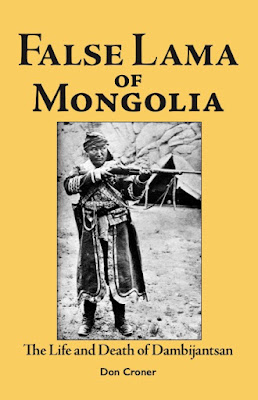
For more on Dambijantsan see False Lama of Mongolia: The Life and Death of Dambijantsan. 


Friday, February 6, 2009

Mongolia | Current Diluv Khutagt #2

For more on the current Diluv Khutagt, a.k.a. Telo Tulku Rinpoche, see Trials of Telo Rinpoche:
Telo Rinpoche, a.k.a. Eddie Ombadykow, is a 21-year-old [in 1994] American whose favourite band is The Smashing Pumpkins. He is also a Buddhist monk who was brought up in a Tibetan monastery in India and recognized by His Holiness the Dalai Lama as a high reincarnate lama. Now, he finds himself in his ancestral homeland, Kalmykia, a remote Buddhist republic in southern Russia, where he is revered by the people as their spiritual leader and charged with the responsibility of reviving Buddhism. The Trials of Telo Rinpoche is the poignant story of his efforts to come to terms with his own unusual destiny while struggling to fulfill the expectations thrust upon him by his family and by the people of Kalmykia who see him as their Messiah.
Current Diluv Khutagt with 14th Dalai Lama

Current Diluv Khutagt with some Rockers in Kalmykia

Thursday, February 5, 2009

Mongolia | The Current Diluv Khutagt

Popped by the Puma Imperial Hotel just off Sükhebaatar Square to see the current incarnation of the Diluv Khutagt. He and his entourage eventually appeared and we retired to a private dining room of the Delhi Darbar Indian Restaurant in the first floor of the hotel to have lunch and chew the fat.

Previous Diluv Khutagt (1884–1965)

The previous incarnation of the Diluv Khutagt was the head of Narobanchin Monastery on the border between Zavkhan and Gov-Altai Aimags.

Ruins of Narobanchin Khiid

He certainly had a distinguished pedigree. According to tradition the first incarnation of his line had been a disciple of the Buddha himself. A later incarnation in Tibet had been the famous Milarepa (c.1052–1135), author of the classic Hundred Thousand Songs of Milarepa.


Still more incarnations turned up on the Ordos Desert in what is now China. The previous Diluv Khutagt was the third incarnation to be born in Mongolia and one of the fourteen incarnations in Mongolia officially recognized the Qing Dynasty. He eventually fell afoul of the new communist government and fled to China. After a stint in Tibet as adviser to the Dalai Lama he emigrated to the United States, where in ended up in New Jersey, of all places. In collaboration with Mongolist Owen Lattimore he then wrote his “Political Memoirs” and “Autobiography,” both of which were combined in one volume entitled The Diluv Khutagt: Memoirs and Autobiography of a Mongol Buddhist Reincarnation in Religion and Revolution. Back in the 1980s I had made a zerox of the copy of this book in the Library of Congress in Washington (the Diluv’s original handwritten manucript of the book is also in the Archives of the Library of Congress).

Both sections of the book contain information about the Avenger Lama Dambijantsan, but the “Autobiography” has an entire chapter devoted to him—the only individual to merit such attention. The Diluv was six years old when he first met Dambijantsan, would encounter him many times in later life, and was eventually involved in the plot to assassinate him. Of the few Mongolians who left written accounts of Dambijantsan the Diluv Khutagt probably knew him best. For more information see Ferdinand Ossendowski Meets the Tushegoun Lama.

This is one of the rarest of all English-language books about Mongolia. It was the only one of Lattimore’s books which could not be located for the Recent Lattimore Conference here in the Big Buuz. Bizarrely, Professor Bira, who was one of the prime movers of the conference, had a copy in his personal library but being temporarily in his absent-minded professor mode had forgotten all about it. Later he remembered and told Glenn Mullin and through the latter’s good offices I was able to borrow the copy. So when Glenn and I finally met up with the current Diluv Khutagt we were able to show him an original copy of the book about his previous incarnation and provide him with a zerox copy. He had of course heard of the book and had apparently glanced through a copy in a library somewhere but never had an opportunity to read the whole thing.

Current Diluv Khutagt

The current Diluv was born in Philadephia, PA in 1972. He was the child of Kalmyk Immigrants who had settled in the United States after World War II. He is a Dörböt, a sub-division of the Kalmyks, and incidentally the same tribe to which Dambijantsan belonged. As a boy he became a monk and studied in a monastery in South India from the age of seven to twenty-one. Eventually he was recognized as the reincarnation of the Diluv Khutagt by the 14th Dalai Lama himself. As I understand it he then decided that he could accomplish more outside of a monastic environment and is now no longer an ordained monk. He himself referred to the years he spent in a monastery as “the years of confusion.” He is now the head of Buddhism in Kalmykia, where he lives full-time, although he remains an American citizen. He is currently becoming more and more involved in promoting Buddhism in Mongolia and the main reason for his visit now is to discuss upcoming projects.

One idea which has been moted is the restoration of the Diluv Khutagt’s former monastery, Narobanchin Khiid. The current Diluv stated rather forcefully that if the plan was simply to restore and open another monastery in Mongolia then he was not in favor. In his opinion there are already enough monasteries and temples in Mongolia. Instead he favors restoring perhaps one temple and then building facilities for orphans and the elderly who have no other place to live.

As for more immediate projects, he wants to bring some Tsam Dancers from a monastery in India for a tour of Mongolia; organize for this summer a music festival featuring Buddhist-oriented performers, promote the study of traditional Mongolian medicine and especially how it can be integrated with modern medical practices; and organize a conference, hopefully to be held this year, in the theme of Buddhism and its relationship to modern scientific theory. This latter subject is of course a Hot Topic in the United States and other Western countries and the Diluv would like to attract some of the leading lights in the field here to Mongolia. Glenn Mullin, who knows many of the main players in this scene, graciously offered his assistance in luring them to Mongolia.

Sitting to my right at the lunch was Khongor Badmaevich, the Vice-Chairman of the People’s Parliament of the Republic of Kalmykia. He is a Torgut, one of the other ethnic groups which make up the Kalmyk people. Somewhat to my surprize he seemed quite familiar with the life of Dambijantsan. He claims that several scholars have recently done work on the life of the Ja Lama. He even asked if I was a disciple of the Ja Lama! I said no, I am approaching his life strictly from an historical point-of-view.

Finally S. Tsendendamba, the Religious Policy Advisor to the President of Mongolia, made a cameo appearance, offered the Diluv Khutagt a khadak, promised all possible asssistance, etc. The Diluv Khutagt said to him, “As you know, I was recognized by the Dalai Lama as the current incarnation of the Diluv Khutagt. With this position comes a lot of responsibility. If I do not fulfill my duty to further Buddhism in Mongolia then I will gladly cut off my head and offer it to you!” Hopefully this will not be necessary.

Out in the lobby Glenn Mullin and I were cornered by a journalist from Kalmykia who was accompanying the Diluv’s party. He quickly zeroed in on the subject of Dambijantsan and questioned me quite closely on the subject for half an hour or so. It never ceases to amaze me how interested people are in the Ja Lama. The source of this fascination is the real mystery about Dambijantsan.

Wednesday, February 4, 2009

Tuesday, February 3, 2009

Mongolia | Heart of Asia | Felt

Get a free sample chapter of Heart of Asia by Nicholas Roerich!

Nicholas Roerich

Heart of Asia

Also see a video clip of A Couple of Mongolian Artists Who Create Masterpieces with Colored Felt by Ulaan Baatar-based Badarchin, Gazarchin, translator, author, auteur, International Gadabout and Bon Vivant Glenn Mullin.