Saturday, November 8, 2008

Mongolia | Life & Death of the False Lama #5

I wrote earlier about the Rise of the Oirats and the factors leading to the great migration westward of the people who would become known as Kalmyks. The Torguts and Dörböt, the tribe to which Dambijantan belonged, were the two main components of the Kalmyks.

The Torgut who lived in the upper Irtysh River in what is now Xinjiang Province of China were particularly susceptible to pressure from the Altan Khan centered just to the north in what are now the Mongolian aimags of Khovd and Bayan-Ölgii. Hearing of rich pasture land to the west the Torgut chieftain Kho-Urlük had sent out scouts west to search for new grazing lands as early as 1608. Starting in the summer of 1615 some 15,000 Torgut starting moving westward toward the steppes south of the Siberian towns of Tara, Tiumen, and Tobolsk. In the early 1630s the Torgut, along with a contingent of Dörböt and a smattering of dissatisfied Choros and Khoshut, moved still farther westward to the Rich Steppes North of the Caspian Sea, described by historian of the Kalmyks Michael Khodarkovsky as “pastoral El Dorado, glorified in songs and epics of many nomadic people.” The Torgut alone who migrated may have numbered over 200,000. These new arrivals quickly overcame the disorganized nomads already inhabiting the area and by the beginning of the 1640s occupied the entire Caspian Steppe from the Emba River in the east to the Terek River in the west, including the rich basin of the lower Volga River, the biggest tributary of the Caspian Sea.

These are the people who became known as Kalmyks, a word about which there is some dispute. It would appear that the word Kalmyk was used to describe Oirats as far back as the fourteenth century by Arab geographer abn Alvardi. This was of course long before the migration to the West of the people now known as Kalmyks. Some popular and even scholarly literature continues to refer to the Western Mongols, or Oirats, who did not migrate to the West as Kalmyks. I adapt here the usage proposed by Khodarkovksy and “reserve the name Kalmyk only for the group of Oirats who came from Jungaria to roam the Caspian steppes in the early seventeenth century.”

For the next hundred years or so the Kalmyks nomadized on the steppe north of the Caspian Sea while gradually acceding to the overall authority of the Russian government. In 1724 they officially accepted Russian suzerainty. By the 1740s, however, relations between the nomads and the Russian empire began to deteriorate. One of the main bones of contention was the continuing encroachment of Russian colonists into the Kalmyk pasture lands. Cossacks from the Don River began emigrating to the lower Volga, followed by Russian and Ukrainian settlers. They built towns, established industries, and began plowing up the traditional Kalmyk pasture lands. By the mid-1740s some 10,000 Kalmyk families no longer had enough livestock to support themselves. Many were forced to take work with commercial fishing operations and other Russian-owned industries. Between the years 1764 to 1768 alone more than one hundred new settlements of Russian and Ukrainian colonists were established on the lower Volga. The Kalmyks who attempted to maintain their nomadic lifestyle were shoved off onto arid, inhospitable desert-steppe far from the major rivers.

Another contentious issue was the forced recruitment of Kalmyk cavalrymen into various Russian military campaigns. When they had first arrived on the Caspian steppe the Kalmyks were more than wiling to help the Russians in campaigns against other nomads who were competing with them for pasture lands and from whom they could expect considerable booty, the traditional motivation for steppe warfare. As the Kalmyks became more and more impoverished they were less and less eager to fight those with whom they had no real beef and from whom no immediate treasure would be forthcoming. The matter came to a head when the Russo-Ottoman War broke out in 1768 and empress Catherine II tried to impress 20,000 Kalmyk cavalrymen to fight the Ottoman Empire and its minions. The Kalmyks could only provide 10,000 men and after disputes with the Russian army commanders many of these deserted.

Then there was the dispute over religion. The Kalmyks had continued to practice the Tibetan form of Buddhism which they had brought with them from Inner Asia. They maintained close ties with Tibet and regularly sent embassies to the Dalai Lama. Kalmyk lamas went to Tibet for training and Kalmyk noblemen and others who could afford it (the roundtrip often took several years) made pilgrimages to Lhasa and other religious sites in Tibet. As their political and economic situation deteriorated, however, the Kalmyks came under more and more pressure to convert to Russian Orthodox Christianity. According to Khodarkovsky:
The Russian government encouraged conversion by all possible feasible means. Those Kalmyks who chose to convert and settle down with the Don Cossacks were put on the military payroll and for the next few years were paid a higher salary than the cossacks. On other occasions, the [converted] Kalmyks were granted tax exemptions for three to five years. The Kalmyk tayishis [noblemen] who chose to convert were rewarded with handsome salaries and could live in towns or settlements especially built for them.
When Donduk-Dashi Khan (r.1741–61) attempted to build a Buddhist temple in Astrakhan, the largest city on the lower Volga, he was told by the Russian government in St. Petersburg that “it was not appropriate to build a temple for idol worshipping in the empire of Her Majesty . . .” Traditional-minded Kalmyks in general were deeply offended by these assaults on their religious beliefs. Some noblemen were so infuriated by what they viewed as subversion of their Buddhism-based society that they went so far as to burn down settlements of Christian converts. Russo-Kalmyk relations were quickly reaching their nadir.

As early as 1747 some Kalymks, intensely disillusioned with life in Russia, had raised the possibility of leaving the country altogether and returning to their original homeland in Inner Asia. The sentiment picked up steam throughout the 1750s and 60s. In 1771, at long last, the Kalmyks had had enough. They decided to return to Inner Asia. Thus began the tragic epic of the Kalmyk Migration, what Khodarkovsky calls “the last known exodus of a nomadic people in the history of Asia.”

In late 1770 the nobleman Tsebek-Dorji had addressed the issue in a speech to the governing council of the Kalmyk Khan:
Look how your rights are being limited in all respects. Russian officials mistreat you and the government wants to make peasants out of you. The banks of the Yayik and Volga are now covered with cossack settlements, and the northern borders of your steppes are inhabited by Germans. In a little while, the Don, Terek, and Kum will also be colonized and you will be pushed to the waterless steppes and the only source of your existence, your herds, will perish. Ubashi’s son has already been ordered give as a hostage, and three hundred from among the noble Kalmyks are to reside in the Russian capital. You can see your situation, and in the future you will have two options—either to carry your burden of slavery, or to leave Russia and thus end your misfortunes. Dalai Lama himself selected two years in which a migration to Jungaria could be undertaken. These two years have arrived. So your present decision will determine your future.
Ubashi Khan and Louzang Jalchin, the head lama of the Kalmyks, agreed that the time had come to act. At this time the majority of the Kalmyks, including most of the Torgut, were on the east side of the Volga. The Dörböt and Khoshut, along a few Torgut, were on the west side. Ubashi Khan himself had moved to the east side of the Volga in the autumn of 1770. The decision to leave Russia had been made, but Ubashi wanted to wait until the Volga was frozen over so the Kalmyks on the west side could cross over and join the exodus. Events forced his hand. Rumors of the planned departure of the Kalymks had leaked out and there was a chance the Russians would take military action to stop them. Then Russian authorities called up 10,000 more Kalmyk cavalryman for service with the Russian army. This was the last straw.

On the morning of January 5 all the Kalmyks on the east side of the Volga—31,000 families, some 150,000 men, women, and children, mounted up and headed eastward to Inner Asia. Various detachments of Cossacks, Russians, and Bashkirs (Moslem tribesmen) were send to halt the escaping Kalmyks and force them to return to the Russian dominions, but they were outnumbered and eventually returned empty-handed. The Kalmyk horde reached the banks of the Emba River, where they camped while awaiting Spring and fresh grass. Yet more detachments of Russian troops were set out after the Kalmyks but they too were rebuffed. The Kalmyks moved on and by early June had reached Lake Balkash in what is now Kazakhstan. Here they encountered their hereditary enemies the Kazakhs, who were thirsting for revenge for earlier Kalmyk attacks against them. Outnumbered and surrounded, the Kalmyks only managed to escape by means of an unexpected night-time breakout and a forced march onward. Most of their sheep herds they had brought with them were lost in the fighting and soon famine set in. By the time they reached the Ili River in what is now Xinjiang Province of China over 100,000 Kalmyks had died from fighting, famine, and lack of water. The survivors, numbering at most 50,000, were greeted by Qing officials and given emergency aid of tents, wheat, rice, sheep, and other commodities.

The Ili River in western Xinjiang

Ili River Valley

The Qing viewed the return of the Kalmyks as a huge propaganda victory, demonstrating to other nomads the advantages of living under Chinese rather than Russian rule. The Qianlong emperor found even greater significant in the return of the Kalmyks. His mother Hsin-mao was celebrating her 80th birthday in 1771 and in her honor Qianlong had commissioned the construction of an enormous temple in the Qing Summer Resort of Jehol (current-day Chengde).

The Putuozongcheng Temple in current-day Chengde

The Putuozongcheng Temple, as it was called, was supposed to be replica of the Potala in Lhasa. Then came news of the return of the Kalmyks, coinciding with the dedication of the temple. Qianlong caused a stele to be erected at the temple with an inscription on it in Chinese, Mongolian, Tibetan, and Manchurian which read in part:
Our vassals over the border all believe in the religion of Sakyamuni. Jehol was the spot where our grandfather the Emperor K’ang-his [the Kangxi Emperor], pacified and appeased them, and there he granted them audiences . . . Now the temple is finished in time for a great national event [Hsin-mao’s birthday] that is to be celebrated by all, in a unique manner . . . In addition to this, the Torgot [Kalmyks, including the Torgut], who have lived in Russia for some time, have returned for religious reasons. The whole of their tribe—which numbers many ten-thousands—arrived just at this time, after wandering about for more than six months. Here is a connection that is mystic.

Qianlong’s stele in front of the Putuozongcheng Temple
Ubashi himself was invited to Jehol and sumptuously wined and dined by Qianlong. He was told he could keep his title of Khan but in fact his people were divided into separate banners and dispersed throughout Xinjiang. They were now under Qing jurisdiction and Ubashi was their ruler in name only. Despite Qianlong’s honeyed words, the Kalmyks quickly discovered that Qing rule was anything but benign. As Khodarkovsky puts it, “The Kalmyks had escaped Russian tentacles only to be ensnared in Chinese ones.” (The immense pile of the Putuozongcheng Temple, which is actually little more than a hollow façade, looms over the city of Chengde to this day; Qianlong’s stele is still prominently displayed out front.)

In the meantime, Russian Empress Catherine II was infuriated that 150,000 of her subjects had managed to escape her domains. She issued ultimatums to the Qing government demanding the return of “these rogues and traitors” but they were ignored.

This great exodus of the Kalmyks inspired Thomas de Quincey (1785-1859), the eccentric English author perhaps better known for his Confessions of an English Opium-Eater to pen an ode entitled Revolt of the Tartars, which begins with an exegesis of the whole episode:
There is no great event in modern history, or, perhaps it may be said more broadly, none in all history, from its earliest records, less generally known, or more striking to the imagination, than the flight eastwards of a principal Tartar nation across the boundless steppes of Asia in the latter half of the last century. The terminus a quo of this flight and the terminus ad quem are equally magnificent—the mightiest of Christian thrones being the one, the mightiest of pagan the other; and the grandeur of these two terminal objects is harmoniously supported by the romantic circumstances of the flight. In the abruptness of its commencement and the fierce velocity of its execution we read an expression of the wild, barbaric character of the agents. In the unity of purpose connecting this myriad of wills, and in the blind but unerring aim at a mark so remote, there is something which recalls to the mind those almighty instincts that propel the migrations of the swallow and the leeming [sic] or the life-withering marches of the locust. Then, again, in the gloomy vengeance of Russia and her vast artillery, which hung upon the rear and the skirts of the fugitive vassals, we are reminded of Miltonic images--such, for instance, as that of the solitary hand pursuing through desert spaces and through ancient chaos a rebellious host, and overtaking with volleying thunders those who believed themselves already within the security of darkness and of distance.
Thomas de Quincey

As we know, Dambijantsan was a member of the Dörböt tribe. The Dörböt, who in the early years of the Kalmyk occupation of the Caspian steppe had roamed the westernmost stretches of the Kalmyk realm, along the River Don, a tributary of the Azov Sea, had in 1743 been moved en masse further east to the steppes bordering the west bank of the Volga River by Donduk Dashi Khan, who had been granted power over them by the Russian government. Residing as they did on the west bank of the Volga, most if not all of the Dörböts remained behind after the great migration of the Kalmyks back to Zungaria in 1771.

In retaliation for the exodus the Russian government on October 19 1771 stripped these remaining Kalmyks of “the last vestige of their political independence” and ordered that they all remain of the west side of the Volga River year-round. Thus it was on the Caspian Steppes on the west bank of the Volga that Dambijantsan was born, perhaps as we have posited, in 1860. As noted, he may have been born into the Sanaev family, but this is by no means certain. From his very earliest age he must have been aware that he was one of the ‘left behind people,” and that the vast majority of his fellow Mongols were off somewhere to the east in Inner Asia. He would spend most of his life trying to reconnect with these people.

Mongolia | Slovakia | Taurid Swarm Year

I mentioned earlier the Taurid Meteor Shower which will be visible in the Heavens from late October to mid-November. I should add that 2008 is a Taurid Swarm Year, which means that this year there is a much greater chance of seeing meteoroids capable of producing Taurid Fireballs. As an indication of just how lucky we are, consider that the last good Taurid Swarm Year was in 1954 and there will not be another one until 2015. On the night of Nov. 5, 2008 there was a Spectacular Fireball sighted from Bratislava, in Slovakia.

Slovakian Fireball at bottom of photo

Thursday, November 6, 2008

Mongolia | Ulaan Baatar | Soyolma and Her Works

Wandered out to the artist Soyolma’s studio. The lovely, gracious, and charming Soyolma is a member of a whole family of renowned artists. Soyolma herself was declared Mongolia’s “Top Female Artist of the Year” in 2007.

Soyolma

One of Soyolma’s works

Another of Soyolma’s works

Detail

Still another of Soyolma’s works

Painting of Narkhajid

According to legend the wife of Hari, the Eighteenth Kalkin King of Shambhala (Khaan Sengeychagya in Mongolian) was an emanation of Narkhajid. Dorjinnaljirma, the consort of Zanabazar, the First Bogd Gegeen of Mongolia, was also believed to be an emanation of Narkhajid.

A different version of Narkhajid

Narkhajid drinking blood from a human skull. My kind of gal!

A White Tara by Soyolma

Some of Soyolma’s works are currently on display at the Union of Mongolian Artists’ Gallery located on the south side of Sükhbaatar Square, in the same building with the Jumbo TV Screen outside. (Just today the Jumbo TV was showing ads for Macbooks; how bizarre is that!) If you are in the neighborhood drop on by. And the Silk Road Restaurant is only a couple of minutes’ walk away! Stop in and chew the fat with Batbold!

Building with the Mongolian Artists’ Gallery

Monday, November 3, 2008

Mongolia | Taurid Meteor Shower

Canvassing various correspondents, I have discovered that most, if not all of you, ignored my advance notice of the Orionid Meteor Shower back on September 21. Now you will get a reprieve. The Taurid Meteor Shower, weak but long-lasting, will be active from late October through mid-November. Actually, "weak" may not be quite the right word. Taurids are indeed few, but some of them are spectacularly bright. So keep an eye out for fireballs. It is always possible that another Chintamani Stone will fall to earth. Unlike many meteor showers, this one can be seen in the evening as well as the morning hours, so sluggards who cannot get up in the wee-hours of the pre-dawn no longer have an excuse.

And if you go out in the evening of November 7 you will be treated to a jaw-droppingly awesome view of the Sagittarius Teapot cradled between Venus and Jupiter. (You may recall that I mentioned the Sagittarius Teapot Earlier) I am giving you advance notice so you can make your viewing plans now. Don’t miss this one!

Graphic courtesy of Sky & Telescope

Sunday, November 2, 2008

Mongolia | Life & Death of the False Lama #3

Who was Dambijantsan?

A Buddhist monk; a freedom fighter for Mongolian independence; the descendant of Amursanaa (1723–1757), the Western Mongol who led the last great uprising against the Qing Dynasty of China; the incarnation of Mahakala, the Buddhist god of war; bandit, torturer, murderer, or evil incarnate? During his lifetime no one was sure who he really was, and even today the controversy about his life continues.

Born in what is now the Republic of Kalmykia, part of the Russian Federation, Dambijantsen traveled throughout Tibet, India, and China before arriving in Mongolia in 1890 where he tossed gold coins to bystanders and announced to one and all that he had come to free Mongolia from the yoke of the Qing Dynasty of China. After disappearing almost twenty years he returned to lead the attack on Khovd City, the last Chinese outpost in Mongolia. Honored by the Eighth Bogd Gegeen, the theocratic leader of Mongolia, for his efforts in achieving Mongolian independence, he went on to establish his own mini-state in western Mongolia, which he hoped to use as a base for establishing a Mongol-led Buddhist khanate in Inner Asia. His dictatorial nature and unbridled sadism soon came to the fore and he was finally arrested and imprisoned in Russia. After the Russian Revolution he returned to Mongolia, gathered new followers around him, and established a stronghold at the nexus of old caravan routes in Gansu Province, China. He robbed caravans, grew opium, and once again dreamed of creating a new Mongolian khanate in Inner Asia. Finally the new Bolshevik government in Mongolia, fearful of his rising power, issued orders for his assassination. Dambijantsan died in 1922, but in Mongolia legends persist to this day that his spirit still rides on the wind of the Gobi and continues to haunt his former lairs.


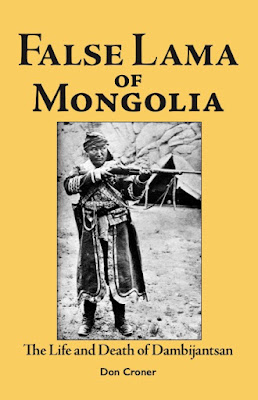
For more on Dambijantsan see False Lama of Mongolia: The Life and Death of Dambijantsan


USA | Alaska | Bears Axed | Feds F#&ked

The news just keeps pouring out of Alaska: Black Bear Fatally Shot Rummaging for Trash Can Treats on Halloween. It's not like the bear did not deserve it. He was a “repeat garbage offender,” according to police. On the bright side, his remains will be donated to one of the city’s soup kitchens. Those lucky Street People! I haven’t had any good bear stew in a long time. Anyhow, this reminds me of the time a bull moose charged into the middle of an Easter Egg hunt in Anchorage and had to be gunned down by State Troopers. Then they called in mental health counselors to deal with the traumatized children. As I recall, the moose carcass was also donated to charity. Being poor in Alaska has its rewards.

But now the bears are fighting back: Eagle River Bear Attacks Moose. Recently convicted in Federal court and now running for reelection, Alaska Senator and felon Ted Stevens is also fighting back. His followers are telling the Feds to go f#&k themselves:

Friday, October 31, 2008

Mongolia | Agharti | Saint-Yves d’Alveidre

Earlier I wrote about the Subterranean Kingdom of Agharti as first described by French occultist Joseph-Alexandre Joseph-Alexandre Saint-Yves d’Alveidre in his 1886 book Mission de l’Inde en Europe (Mission of India in Europe) and elaborated on in Ferdinand Ossendowski’s Beasts, Men and Gods. Amazingly an English language translation of this book has now been published under the title The Kingdom of Agharttha.

The Introduction to the book is by historian of European occultism Joselyn Godwin, author of Aktos: The Polar Myth in Science, Symbolism, and Nazi Survival.


Agharti has been conflated with Shambhala by many commentators. I have will more on the Agharti Mythologem soon.

Sunday, October 26, 2008

Mongolia | Töv Aimag | Günjiin Süm | Temple of the Peaceful Princess

Günjiin Süm

Temple Dedicated to the Manchu Wife of Dondovdorj, Father of the Second Bogd Gegen.

Location: N048°11.009' – E107°33.379', 35.6 miles northeast of Ulaan Baatar as the crow flies and 64 miles by road via the tourist center of Terelj, at the upper end of Khökh Chuluutiin Gol, a small tributary of the Dund Bayangiin Gol, which flows into the Tuul River near Terelj. Accessible only by four-wheel drive vehicle, as several small streams north of Terelj must be crossed. In summer it might be necessary to walk the last mile or so because of the swampy road, but in winter, when the ground it frozen, it is possible to drive the whole way, assuming there is not too much snow.

The 1657 danshig naadam held for Zanabazar at Erdene Zuu after his return from his second trip to Tibet marked the ascension of his influence among his Mongolian followers. As Podzneev points out, “The Gegen’s might in Eastern Khalkha reached its extreme limits at this time; they believed in him and came to him with the most extraordinary requests.” For instance, his nephew Galdandorj, son of the Tüsheet Khan, met with Zanabazar and implored him to cure his wife’s infertility and grant him a son. After numerous such entreaties Zanabazar finally said:
I know that thou wouldst need a son; therefore when I set out in a miraculous manner for Tibet, I visited there the mountain of the hermits, and in a certain cave I found a lama named Arthasiddha, a reincarnation of Vajrapani. I told him that there was one prince among us who needed a son, and asked him for that; he replied to me that when he had completed his meditation he would be ready to be reborn as the son that prince. In proof of his fairness, I demanded that he give me an acknowledgement, and I now present it to thee. This lama died today, and his soul ought to be incarnated in the womb of thy wife.
Galdandorj’s wife did shortly thereafter become pregnant and eventually gave birth to a son who was given the name Dondovdorj.

After Zanabazar recognized Manchu suzerainty in 1691 the Qing emperor awarded Galdandorj the title of Darkhan-Ch’ing-Wang. His son, Dondovdorj, was brought up in Beijing, in the Qing court of Kangxi, and in 1697 the emperor gave him a princess to marry. Some Sources imply that the princess, named Khicheengoui Amarlangoui, was one of Kangxi’s own daughters, while others maintain she was the daughter of one the First Degree Qing princes. In either case, his marriage led to Dondovdorj’s further advancement in the Qing court, and in 1700, after his father’s death, he too was awarded the title of Darkhan-Ch’ing-Wang, in addition to becoming the new Tüsheet Khan. Dondovdorj was, however, a notorious boozer, devil-may-care lady’s man, all-around roisterer, and a poet to boot, and after gregarious affronts to public decorum he was finally forced to relinquish both his position as Tüsheet Khan and his Qing title of Darkhan-Ch’ing-Wang.

Reduced in rank to a second-degree prince, Dondovdorj returned to Mongolia, presumably with his Manchu wife. He eventually distinguished himself on the battlefield and apparently fought against the resurgent Zungarian Mongols who under the leadership of Galdan Bolshigt’s nephew Tzevan-Ravdan had invaded Tibet in 1716.

The Qing emperor Kangxi died in 1722. Zanabazar was in Mongolia at the time of Kangxi’s death. He immediately decided to return to Beijing and pay his respects to Kangxi’s remains, even though he was in his late eighties at the time. Accompanying him was Dondovdorj. The new Qing emperor, Kangxi’s son Yongzheng, forgave Dondovdorj’s previous transgressions and he was again elevated to the title of Darkhan-Ch’ing-Wang. As an additional perk he was given yet another Manchu princess in marriage.

Not long after his arrival in Beijing Zanabazar fell ill. Sensing that his end may have been nearing, his attendants asked him where and under what circumstances he would be reborn. According to tradition, Zanabazar replied, “The second wang [Dondovdorj] should bring into his home a maiden belonging according to birth to the year of the monkey or the chicken.” This was interpreted to mean that Dondovdorj was to find a Mongolian girl born in either the year of the monkey or the chicken and that the second Bogd Gegen would be born to her. Apprized of this prophesy, the emperor Yongzheng gave Dondovdorj permission to immediately return home and seek a new wife. Back in Mongolia Dondovdorj straight away found a nineteen-year old woman named Tsagaan-Dara-Bayartu who had been born in the year of the monkey and just a month after his marriage to the Chinese princess he took her as his third wife.

Zanabazar in himself died in 1723 in Beijing. In 1724, “at daybreak on the first day of the middle of the spring moon in the Wood Dragon year” a son was born to Tsagaan-Dara-Bayartu. In 1728 the boy took his first monastic vows and was given the name Lusandanbidonme. In 1729 he was declared the Second Bogd Gegeen, the seventeenth incarnation of Javzandamba.

Dondovdorj’s second Manchu wife faded into the background and nothing seems to be known of her. To this day, however, numerous folktales exist about the first one, Khicheengoui Amarlangoui, who moved to Mongolia to live with her husband and eventually came to love her adapted country and its people. “The Peaceful Princess,” as she was called, came to consider herself a Mongolian and according to legend she said that when she died she did not her body returned to the land of her ancestors but instead wished to be buried in Mongolia. "I am the wife of a Mongolian man, therefore I am a Mongolian. Bury me in Mongolian soil,” she reportedly said.

Here the ”Peaceful Princess” reenters the historical record. The Qing emperor Yongzheng’s successor, Qianlong, heard about the princess’s wish and in 1740 ordered that a temple be built in Mongolia to hold her remains (one Source claims Dondovdorj himself had the temple built). The so-called Gunjiin Süm consisted of five parts: a tower, the Bogd Entrance, a guard house, the central temple, and the grave of the princess. The complex was heavily damaged in the 1930s, however, and now only remnants of the tower and the Bogd Entrance remain. The temple was gutted but the shell remains and has been restored to a certain extant.
The Temple
The eight-foot high wall around the temple, which encompassed a square about 200 feet long on each side, is still in fairly good shape on three sides.
North side of the walled compound
The princess’s grave, behind the temple, was reportedly looted in the mid-thirties, not, according to local informants, by communist iconoclasts, but by common thieves looking for gold, silver, and other valuables believed to have been buried with her.
Researchers examining the site in 1949 found remains of the princess’s sandalwood coffin and also the body of a man preserved sitting upright in the lotus position. Further examination of the site in 1959 revealed a blouse decorated with pearls, two large loose pearls, and several dolls made of gold and silver. If the site was looted in the 1930s the thieves apparently missed these items. They are now reportedly in the Mongolian State Museum of History in Ulaan Baatar. The fate of the princess’s body remains unclear.

Tuesday, October 21, 2008

Mongolia | Khentii Aimag | Baldan Bereeven Khiid

The monastery of Baldan Bereeven is surrounded by four mountains each said to resemble an animal: a lion on the east; a dragon on the south; a tiger on the west; and a Garuda on the north. Each cardinal point is also guarded by a Protector Deity. We stop first at the small temple to the west of the monastery housing Red Jamsran. The originally temple was demolished during the persecutions of the late 1930s and the Red Jamsram painting damaged or destroyed. The Jamsran rock painting in the temple now is thought by some to be the original but no one is quite sure.

Jamsran Temple

Red Jamsran

At the monastery itself we are met by a watchman who also serves as a guide. According to him the monastery was founded sometime in the last half of the eighteenth century by a lama named Tsevendorj. Most written ephemera says the monastery was founded in 1777 or 1784. The watchman goes on to say, however, that Tsevendorj had studied with Zanabazar, the First Bogd Gegeen of Mongolia, in Tibet. Since Zanabazar made his First Trip to Tibet in 1649 and his Second Trip to Tibet in the mid-1650s, this seems highly unlikely. Anyhow, Tsevendorj was apparently looking for a place to build a monastery and stopped here. Near the base of the Garuda Mountain, just behind the current site of the monastery, lived an old man named Baldan and his wife Tsevelma with their seven goats. When Tsevendorj arrived Tsevelma was making some bereeven (rice boiled in milk). Tsevendorj decided to stay here a few days and in the course of his visit ascertained that this was an auspicious location. He then decided to build a monastery here, naming it Baldan Bereeven, in honor of the herdsman Baldan and his wife’s rice dish. It eventually became one of the three or four biggest and most important monasteries in Mongolia with at one time up to 6000 monks in residence (this according to the guide; other sources say considerably less, maybe 1500).

The main temple of Baldan Bereeven with Garuda Mountain behind

Main Temple

Main Temple with the Lion Mountain behind

The Main Temple. Only the shell remains.

Ruins of another temple

Wish Granting Tree, right, reportedly planted by Lama Naidansüren in the late eighteenth century. People making wishes have left the khadags (blue prayer flags).
Soon three black land cruisers roared up and disgorged fifteen or twenty pilgrims from eastern Khentii Aimag. With them we made the khora around the monastery, the watchman acting as our guide. One of the first stops was a stone statue of White Tara. Next was a large granite tor with the obligatory “Mother’s Womb,” a short tunnel which people crawl through to be symbolically cleansed of their sins. On the top of the tor was a throne-shaped seat which every one was advised to sit in.

White Tara

Pilgrim trying out the throne

The sides of the tor also has numerous indentations shaped like various parts of the body—back, elbow, head, etc. According to legend inserting your own body part into these indentations and massaging yourself against the stone has a beneficial effect on your health.

Enkha massaging her back on the Healing Stone. Enkha: “Wow, am I loving this!’

At the base of the Garuda Mountain are two small temples devoted to Baldan and Tsevelma, who were living here before the monastery was founded.

Temple dedicated to Baldan

On the rock above a complex of small temples, now in ruins, is a Soyombo, the head symbol of the Soyombo Alphabet invented by Zanabazar. This Soyombo was reportedly painted by Lama Dampilranjamba in the late eighteenth century. According to legend Dampilranjamba said, "This Soyombo will remain here long after the rest of the monastery is destroyed and fallen into ruins.” Indeed most of the monastery was destroyed in the late 1930s but the Soyombo painting was not defaced. The small temple below the Soyombo once housed stone statues of Maidar (Maitreya), the Future Buddha; Green Tara, and others. Some of the partially defaced statues have now been put back in the ruins of the temples.

Soyombo Painting

One of the ruined temples

A Green Tara in the one of the ruined temples

After finishing the Khora we stopped in the watchman’s quarters for some tea. A monk there related some more history about the monastery. He claimed that both of the consorts of the Eighth Bogd Gegeen were born here at Baldan Bereveen. The Bogd’s long-time consort Dondogdulam’s ger, claimed this man, was near where we were now camping. Dondogdulam died in 1923.

Dondogdulam

The Bogd Gegeen, then the figure-head king of Mongolia, felt obligated to take another wife-consort who would serve as queen. In the summer of 1923 the Bogd Gegeen’s representatives combed all of Khalkh Mongolia looking for a suitable replacement for the much revered Dondogdulam. The contestants were winnowed down to a group of fifteen young woman aged eighteen to twenty. Two gers were set up along the Khurkh River east of here and an examination of the finalists was held. Finally a nineteen year old girl named Genenpil, the daughter of a herdsmen who lived here at Baldan Bereeven, was chosen to be the Bogd’s new wife. She was taken to Örgöö (Ulaan Baatar) and installed in the Bogd’s palace as his wife. She soon found herself very uncomfortable in her unaccustomedly luxurious surroundings and may not have been too attracted to the Bogd Gegeen, who by then was fifty-three years old, almost totally blind, and legendary for his hard drinking.

A few month after the marriage, in accordance with Mongolian tradition, she made a formal appeal to her husband to end the marriage and be allowed to return home to her parents. The Bogd Gegeen granted this appeal—he really had no choice according to Mongolian custom—and she returned to her father’s ger, but members of the government, concerned about the legitimacy of the Bogd Gegeen’s reign as king and the need for a queen, soon forced her to return. She lived with the Bogd Gegeen until he died in 1924. Genenpil then went back to her family and lived quietly in the countryside. It is not known if she remarried. In 1937 she was arrested during the anti-Buddhist campaign. She had taken no part in the political events since her marriage to the Bogd Gegeen ended with his death in 1924, but her association with him, the chief representative and symbol of the old feudal state, even though it was against her will, was enough to seal her fate. She was executed in 1938.

Mongolia | Khentii Aimag | Khökh Nuur to Baldan Bereeven Khiid

Sometime during the night the incessant winds that had been dogging us since our arrival in Khökh Nuur died down and the sky cleared off completely. By four o'clock in the morning Orion was dominating the sky overhead. Daybreak saw a faultless dome of azure overhead and by the time we had finished breakfast temperatures were up in the 60s F. This was the kind of balmy end-of-summer weather I had been anticipating when I planned this trip. In high spirits we scarpered eastward toward our next destination, Baldan Bereeven Khiid.

This is Chingis Khan Country. From our starting point on the Terelj River, near where Temüjin, the young Chingis Khan, was living when the Merkits kidnapped his wife Börte, to the current day town of Binder, near where Temujin was born (according to one school of thought), farther on out to the east, stretches the territory where many of the events in the early life of the future World Conqueror took place. At a place called Tavan Tolgoi we stop to inspect some slabs of rock which local lore maintains were used by Chingis as pot supports at his fireplace when his ger was located here.

Purported pot supports at a “Chingis Slept Here” site

The stone slabs look surprising like the tomb coverings at the Monument to Kontuyuk, the advisor to the eighth century Khökh Turk Chieftain Kultegin. If they were Turk tomb coverings that of course does not mean Chingis could not have used them later as pot supports. Still later we pass by a place where Temüjin and his bosum buddy and later Arch-Nemesis Jamukha had their final falling out.

By lunch time we had arrived at Övör Elegiin Gol where Zevgee assured us there would be water. Much to Zevgee’s chagrin, however, the river was dry where the trail crossed it. We followed the riverbed downstream perhaps a thousand yards and soon came to a pool of water where the underground stream emerged. The water was fresh, clear, and icy cold. By the pool was a grassy glade surrounded by cottonwood trees and nearby dead brush offered plentiful firewood. The three essentials for a successful lunch—us, tülsh, and süüder (water, firewood, and shade)—thus provided for we unloaded our pack horses and threw out carpets on the grass beneath the largest cottonwood tree. We lounged on our carpets as Zevgee’s son-in-law Badmaa and grandson Bondogo fetched water and built a fire and in no time at all we were sipping delightfully fragrant Oolong tea (Shan Ling Xi from Taiwan, highly recommended). Tumen-Ölzii rolled out dough for fresh noodles and soon we were tucking into bowls of Guriltai Shöl—mutton soup with noodles. I hardly wanted to leave this idyllic spot, but finally we had a last bowl of tea and then packed up our horses and moved on.

By early evening we had reached Baruun Bayan Gol. Here, according to legend, was born Boorch, one of Chingis Khan’s boon companions. (See Paragraphs 90–93, 95, 99, 103, 120, 124–25, 156, 163, 172, 177, 202, 205, 209, 210, 220, 240, 242, 259–60, and 266 of the Secret History of the Mongols [also Kindle Version] for more on Boorch.) Camped on the sward by the river, with plentiful firewood nearby. Yunnan Gold tea followed by boiled sheep ribs and potato and cabbage soup heavily larded with stick-to-the-ribs mutton fat.
Yunnan Gold—the Perfect Complement to boiled sheep ribs and mutton fat

Just after dark breathtakingly luminous Jupiter appeared in the southern sky, just above the Sagittarius Teapot and just below the dimmer Sagittarius Teaspoon. The clear, cloudless sky soon revealed a full panoply of stars overhead: the constellations of Cygnus, Cepheus, and my personal favorite Cassiopeia to the northeast; the ever-glorious Scorpius off to the south; and of course the Seven Gods (Big Dipper) to the west. And then in the early hours toward morning magnificent Orion appeared. All and all a mindbogglingly gorgeous night. The next morning we moved out quickly, hoping to reach Baldan Bereeven Khiid by lunch time.

On the Road to Baldan Bereeven Khiid

We soon passed Khangalyn Nuur, where there is a monument to “Nature.” A sign on the monument implores people to protect the environment.

Monument at Khangalyn Nuur

Then we moved into the wooded foothills and began the climb to 4,698-foot Khangalyn Davaa.

Khangalyn Davaa

View eastward from Khangalyn Davaa. Baldan Bereeven Khiid is at the base of the mountain on the right edge of the photo.
We arrived at Baldan Bereeven just after noon. We were of course anxious to visit the monastery but first we set up camp, built a fire, and had a pot of Tie Kwan Yin Oolong tea. Tie Kwan Yin, the Iron Goddess of Mercy, is, as you probably know, the Chinese version of Avalokitesvara (Tibetan: Chenresig; Mongolian: Janraisag), the Bodhisatta of Companion, and thus a fitting drink in the environs of a monastery. In honor of our arrival Tumen-Ölzii also whipped up a big batch of Tsuivan, a much hallowed mutton and noodle dish which holds a special place of honor in the firmament of Mongolian cuisine.

Zevgee oversees the teapot at our Baldan Beereveen campsite