Tuesday, October 21, 2008

Mongolia | Khentii Aimag | Khökh Nuur to Baldan Bereeven Khiid

Sometime during the night the incessant winds that had been dogging us since our arrival in Khökh Nuur died down and the sky cleared off completely. By four o'clock in the morning Orion was dominating the sky overhead. Daybreak saw a faultless dome of azure overhead and by the time we had finished breakfast temperatures were up in the 60s F. This was the kind of balmy end-of-summer weather I had been anticipating when I planned this trip. In high spirits we scarpered eastward toward our next destination, Baldan Bereeven Khiid.

This is Chingis Khan Country. From our starting point on the Terelj River, near where Temüjin, the young Chingis Khan, was living when the Merkits kidnapped his wife Börte, to the current day town of Binder, near where Temujin was born (according to one school of thought), farther on out to the east, stretches the territory where many of the events in the early life of the future World Conqueror took place. At a place called Tavan Tolgoi we stop to inspect some slabs of rock which local lore maintains were used by Chingis as pot supports at his fireplace when his ger was located here.

Purported pot supports at a “Chingis Slept Here” site

The stone slabs look surprising like the tomb coverings at the Monument to Kontuyuk, the advisor to the eighth century Khökh Turk Chieftain Kultegin. If they were Turk tomb coverings that of course does not mean Chingis could not have used them later as pot supports. Still later we pass by a place where Temüjin and his bosum buddy and later Arch-Nemesis Jamukha had their final falling out.

By lunch time we had arrived at Övör Elegiin Gol where Zevgee assured us there would be water. Much to Zevgee’s chagrin, however, the river was dry where the trail crossed it. We followed the riverbed downstream perhaps a thousand yards and soon came to a pool of water where the underground stream emerged. The water was fresh, clear, and icy cold. By the pool was a grassy glade surrounded by cottonwood trees and nearby dead brush offered plentiful firewood. The three essentials for a successful lunch—us, tülsh, and süüder (water, firewood, and shade)—thus provided for we unloaded our pack horses and threw out carpets on the grass beneath the largest cottonwood tree. We lounged on our carpets as Zevgee’s son-in-law Badmaa and grandson Bondogo fetched water and built a fire and in no time at all we were sipping delightfully fragrant Oolong tea (Shan Ling Xi from Taiwan, highly recommended). Tumen-Ölzii rolled out dough for fresh noodles and soon we were tucking into bowls of Guriltai Shöl—mutton soup with noodles. I hardly wanted to leave this idyllic spot, but finally we had a last bowl of tea and then packed up our horses and moved on.

By early evening we had reached Baruun Bayan Gol. Here, according to legend, was born Boorch, one of Chingis Khan’s boon companions. (See Paragraphs 90–93, 95, 99, 103, 120, 124–25, 156, 163, 172, 177, 202, 205, 209, 210, 220, 240, 242, 259–60, and 266 of the Secret History of the Mongols [also Kindle Version] for more on Boorch.) Camped on the sward by the river, with plentiful firewood nearby. Yunnan Gold tea followed by boiled sheep ribs and potato and cabbage soup heavily larded with stick-to-the-ribs mutton fat.
Yunnan Gold—the Perfect Complement to boiled sheep ribs and mutton fat

Just after dark breathtakingly luminous Jupiter appeared in the southern sky, just above the Sagittarius Teapot and just below the dimmer Sagittarius Teaspoon. The clear, cloudless sky soon revealed a full panoply of stars overhead: the constellations of Cygnus, Cepheus, and my personal favorite Cassiopeia to the northeast; the ever-glorious Scorpius off to the south; and of course the Seven Gods (Big Dipper) to the west. And then in the early hours toward morning magnificent Orion appeared. All and all a mindbogglingly gorgeous night. The next morning we moved out quickly, hoping to reach Baldan Bereeven Khiid by lunch time.

On the Road to Baldan Bereeven Khiid

We soon passed Khangalyn Nuur, where there is a monument to “Nature.” A sign on the monument implores people to protect the environment.

Monument at Khangalyn Nuur

Then we moved into the wooded foothills and began the climb to 4,698-foot Khangalyn Davaa.

Khangalyn Davaa

View eastward from Khangalyn Davaa. Baldan Bereeven Khiid is at the base of the mountain on the right edge of the photo.
We arrived at Baldan Bereeven just after noon. We were of course anxious to visit the monastery but first we set up camp, built a fire, and had a pot of Tie Kwan Yin Oolong tea. Tie Kwan Yin, the Iron Goddess of Mercy, is, as you probably know, the Chinese version of Avalokitesvara (Tibetan: Chenresig; Mongolian: Janraisag), the Bodhisatta of Companion, and thus a fitting drink in the environs of a monastery. In honor of our arrival Tumen-Ölzii also whipped up a big batch of Tsuivan, a much hallowed mutton and noodle dish which holds a special place of honor in the firmament of Mongolian cuisine.

Zevgee oversees the teapot at our Baldan Beereveen campsite

Monday, October 20, 2008

Mongolia | Orionid Meteor Shower

I suspect that many of you, like me, will be up in the wee hours of Tuesday morning, the 21st, to witness the annual Orionid Meteor Shower. If you have not already made your viewing plans you should do so now. The shower will be at its peak between midnight and dawn. In some years—when there is a dark, moonless sky—you can see 20 or more Orionid meteors every hour. Unfortunately, this year a Waning Moon (53.867% illumination at 3:00 a.m. on the 21st) will wash out all but the brightest Orionids. Still, we should be able to spot about ten an hour. I will be watching the meteor shower from the rocky pinnacle behind my lair in Zaisin Tolgoi. This outlook, where I frequently go to view the Heavens, is just to the east of the Khiimoryn Ovoo. As you probably know, it was sky-gazer E. C. Herrick from Connecticut, in the USA, who first documented the Orionid Meteor Shower in 1839, so you might want to include a few kind words for him in your prayers Tuesday morning.

Daytime view from the Pinnacle behind my Lair. The hill in the center is Zaisan Tolgoi, with Ulaan Baatar beyond.

Tuesday, October 14, 2008

Mongolia | Life and Death of the False Lama #2

Who was Dambijantsan?

A Buddhist monk; a freedom fighter for Mongolian independence; the descendant of Amursanaa (1723–1757), the Western Mongol who led the last great uprising against the Qing Dynasty of China; the incarnation of Mahakala, the Buddhist god of war; bandit, torturer, murderer, or evil incarnate? During his lifetime no one was sure who he really was, and even today the controversy about his life continues.

Born in what is now the Republic of Kalmykia, part of the Russian Federation, Dambijantsen traveled throughout Tibet, India, and China before arriving in Mongolia in 1890 where he tossed gold coins to bystanders and announced to one and all that he had come to free Mongolia from the yoke of the Qing Dynasty of China. After disappearing almost twenty years he returned to lead the attack on Khovd City, the last Chinese outpost in Mongolia. Honored by the Eighth Bogd Gegeen, the theocratic leader of Mongolia, for his efforts in achieving Mongolian independence, he went on to establish his own mini-state in western Mongolia, which he hoped to use as a base for establishing a Mongol-led Buddhist khanate in Inner Asia. His dictatorial nature and unbridled sadism soon came to the fore and he was finally arrested and imprisoned in Russia. After the Russian Revolution he returned to Mongolia, gathered new followers around him, and established a stronghold at the nexus of old caravan routes in Gansu Province, China. He robbed caravans, grew opium, and once again dreamed of creating a new Mongolian khanate in Inner Asia. Finally the new Bolshevik government in Mongolia, fearful of his rising power, issued orders for his assassination. Dambijantsan died in 1922, but in Mongolia legends persist to this day that his spirit still rides on the wind of the Gobi and continues to haunt his former lairs.


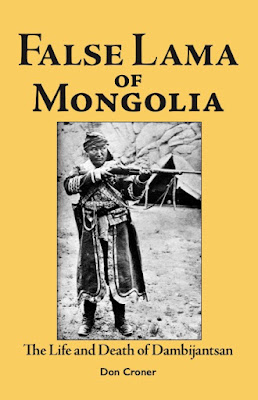
For more on Dambijantsan see False Lama of Mongolia: The Life and Death of Dambijantsan. 


Tuesday, August 19, 2008

Mongolia | Selenge Aimag | Amarbayasgalant Lollapalooza

Popped up to Amarbayasgalant Khiid for the Summer Lollapalooza during which the monastery's protectors, among them Jamsran and Dorje Shugden, were summoned. I had been to Amarbayasgalant Several Times Previously while gathering material for Travels in Northern Mongolia and Guidebook to Locales Connected with the Life of Zanabazar but on each of these trips I had been the only visitor present. Thus I was a bit discombobulated when I encountered several thousand people milling around the monastery and the nearby Naadam grounds. We had planned to camp along the banks of the Even River where I had camped before, but now there were already at least a thousand tents spread out for over a mile along the river bottom. There was even a food court of at least fifty gers and tents serving up khuushur, khorkhog, shorlog, and other delicacies from the pantheon of Mongolian cuisine. Fortunately we soon bumped into Ankha, Owner of the Silk Road Restaurant in Ulaan Baatar, who was spending the summer at Amarbayasgalant teaching the monks how to cook and advising them on the management of the monastery’s new ger camp. All the gers in the camp had been reserved at least a month ago, but he invited us to set up our tents on the grounds. Thus we had access to water and were only about a ten minute walk from the monastery itself.
Visitors streaming towards Amarbayasgalant


Amarbayasgalant Monastery

The Even Valley from one of the ovoos behind the monastery

The Dorje Shugden Temple, located about a mile from Amarbayasgalant

Dorje Shugden, on of the Protectors of Amarbayasgalant

Eight ovoos at the Dorje Shugden Temple, said to
represent the Eight Bogd Gegeens of Mongolia

The justly famous Amarbayasgalant Spring, about a mile from the monastery. As a connoisseur of drinking water I can attest that this is one of the better springs in Mongolia.

Friday, August 8, 2008

China | Xinjiang Province | Urumqi

Urumqi, in Xinjiang Province, China, has long been one of my favorite cities. Thus it is sad to read this news on the first day of Olympics in Beijing:
Xinjiang's capital, Urumqi, appeared to be on high alert today. Security guards were checking bags at the entrances of hotels, department stores and discos in the busy city, where office towers and apartments buildings have been shooting up in recent years. Guards with red arm bands rode on most public buses, watchful for attackers. Small groups of police patrolled the sidewalks of the bustling Muslim quarter, where merchants cooked lamb kebabs and sliced up watermelons at fruit stands.
Downtown Urumqi

Hong Shan (Red Mountain) in downtown Urumqi

Uighur Quarter in Urumqi

The famous Erdaoqiao Market in the Uighur Quarter

Uighur Restaurant

Performers in Uighur Restaurant

Uighur Carpet Store

Sample carpets

Pomegranates

Wednesday, July 30, 2008

Mongolia | Zavkhan Aimag | Otgon Tenger Khora #3

The skies had cleared while we were at Övör Badarkhundaga Nuur, but the moment we left it clouded over and the wind picked up. Soon we were deluged with mixed rain and sleet. The wind blew into our faces, pummeling us with sleet, and finally we could not even make the horses walk into the wind. We ducked behind the Otgon Tenger Ovoo for half an hour to get out of the wind and after it subsided continued on to our campsite on the Övör Bogdyn Gol. There was no chance of getting a fire started so we just retired to our tents with no hot dinner or tea. We rose the next morning to a drizzle and quickly packed up and left, again with no hot meal or tea. We hoped to reach some firewood by noon.

We reached the head of Övör Bogdyn Gol and crossed 9302-foot Turgenii Davaa amidst yet another downpour. On the other side we followed Turgenii Gol downstream to the first two gers we saw and popped into one, where an old man and his wife agreed to let us use their stove to cook lunch and make tea.

For the first twenty minutes the old couple had nothing whatsoever to say. The woman busied herself helping the horsemen cut up mutton and potatoes and the old man sat quietly puffing on his long-stemmed pipe. Then I asked the old man if he had ever heard of the Diluv Khutagt. He kept silent, but his wife piped up that her grandfather was related somehow to the family of the Diluv Khutagt. She know all about his sojourn in America and repeated what we had already heard about the current Diluv’s incarnation and his visit to Otgon Tenger. She maintained he was a Kalmyk, born into the Kalmyk community in New Jersey. I have not been able to confirm this. She also related a lot of other lore which I will deal with in a separate post. Before we left she gave me some artz which she said came from Övör Badarkhundaga Nuur.

From this place, known as Khalteriin Ekh, we crossed 8907-foot Khökh Khamar Davaa (Blue Nose Pass). The rest of the afternoon we crossed a number of low passes separating the drainages of small, unnamed creeks before arriving in early evening at the Khökh Nuur, the bigger of the two lakes on the west side of Otgon Tenger. We had ridden 21.3 miles (34.3 km for you decimal heads) for the day, our longest ride of the trip, and I was exhausted. I had just gotten over a bad bout of pneumonia before coming on this trip, and I was still taking four different plant medicines I had gotten from Ganbaatar, a doctor of traditional Mongolian medicine at Manba Datsan. He had mentioned that they might make me weak, and this certainly seemed to be the case. We stopped at the ger of some friends of our horsemen and after eating a meal cooked on their stove I collapsed in my tent. (I will admit that I did manage to sneak in a few pages of Gurdieff: Making a New World before falling asleep.)
Gers at Khökh Nuur where we spent the night

The next morning—the beginning of our last day on the Khora—the sky was a perfect dome of cobalt blue from horizon to horizon—the first morning without rain we had had on the trip. We had a leisurely breakfast and finally packed up and headed over the ridge to the west of Khökh Nuur. Climbing through a larch forest—the first real forest we had encountered on the trip, we finally arrived at Khoid Dayan Ovoo. From here there are spectacular views of Khökh Nuur and the whole Otgon Tenger massif. Batbayar says this is one of the most sacred spots in Zavkhan Aimag and that many people come here to make offerings. He claims it was used by shamans even before the advent of Buddhism.
Khökh Nuur from Khoid Dayan Ovoo

Khoid Dayan Ovoo

Batbayar prostrating at the Khoid Dayan Ovoo

Otgon Tenger from the Khoid Dayan Ovoo

From the Khoid Dayan Ovoo we continued on to Tsagaan Nuur, where Batbayar lives. We stopped at his ger for lunch and then continued on over a series of glacial moraines to the Children's Camp, where we had started.

Tsagaan Nuur
The total distance of the Khora was 70.9 miles (114.1 km for you unrepentant decimal-heads) measured between twenty-five checkpoints, which we did in five days. We had prostrated to the mountain at the appropriate places, offering khadags (prayer scarves) and burned artz at the main ovoo, and I had repeated the Om Mani Padmi Hum mantra over 10,000 times while we were riding. Hopefully we had paid sufficient respect to the mountain. Whether our actions will have any beneficial effect on this and subsequent incarnations remains to be seen.

Wednesday, July 16, 2008

Mongolia | Khövsgöl Aimag | Darkhad Depression #7

The next day we started down the Khoogin Gol.

Upper Khoogiin Gol

Upper Khoogiin Gol

Upper Khoogiin Gol

Upper Khoogiin Gol

One of our campsites on the Khoogin Gol

Asbestos which Batmönkh found in the mountains. Local people use it for medicine.

Batmönkh

Stone erected by Chingünjav when he was attempting to escape to Russia in the late 1750s.
Wild Onions

Tsagaan Chuluu Ovoo is located on the top of mountain in center

Horse skulls

The Darkhat Depression at the end of our trip

Thursday, June 26, 2008

Mongolia | Khovsgöl Aimag | Darkhad Depression #4

After our late lunch we continue northwest up the valley of the Ikh Cöögt towards 8,550-foot Deed Khets Davaa. The snow-drift lined pass is broad and long, a miniature plateau actually, almost a mile long. Finally we come to an ovoo, seventy feet lower than the highest point of the pass, which overlooks the Buural Gol valley. From here we walk our horses down through a larch forest just over 1300 vertical feet to the banks of the Buural Gol, a major tributary of the Khoogin Gol, whose source is our next desination. The Buural Gol starts about five miles from here, just northwest of Belchir Uul.The Mungaragiin Gol, which we have just come from starts just to the west of Belchir Uul. Another river, the Delger Mörön, starts just south of Belchir Uul and flows southwestward to eventually combine with the Ider to form the Selenge Gol, Lake Baikal’s largest tributary. Thus at the base of Belchir Uul, the nexus of the knot of mountains we are in, begin rivers which flow both into both the Shishigt-Kyzyl-Khem-Yenisei and the Selenge-Angara-Yenisei branches of the Yenisei River System.
Looking up the Buural Gol valley from the western end of Deed Khets Davaa

Beginning the descend into the valley of the Buural Gol

The source of the Buural Gol. Belchir Uul is hidden between the ridges to the left.

It occurs to me that the area we are in might well qualify as the “Heart of Asia.” Now I admit that the epithet “the Heart of Asia” is much overworked. The seed of this chestnut might well be Sir Francis “Guns to Lhasa” Younghusband’s 1896 The Heart of a Continent.” It may have reached its full flowering in Nicholas Roerich’s 1929 Heart of Asia and continues to bloom in titles like The Lost Heart of Asia and The Silk Road: Two Thousand Years in the Heart of Asia and The Heart of Asia: A History of Russian Turkestan and the Central Asian Khanates from the Earliest Times and Through the Heart of Asia: Over the Pamïr to India and Kyrgyz Republic: Heart of Central Asia. If I had the time and inclination I could compile a list of dozens more books and articles which somehow manage to drag in the phrase “the heart of Asia.” Indeed, years ago I had made a silent vow that when writing about this area I would never, under any circumstances, resort to the phrase “the heart of Asia.” But if any place actually deserves the epithet “the heart of Asia”—or at least that part of Asia north of Himalayas—it is this knot of mountains centered around Belchir Uul. On its slopes begin rivers which feed both major branches of the Yenisei River System, the largest north-flowing river in the world and the main artery of northern Asia.

I am still ruminating on this as we head down the Buural Valley. Soon we come upon a hunter’s shelter made a logs where Batmönkh says we will stop for the night. Hunters from Ulaan Uul come here in winter time to hunt deer, he says. He himself has stayed here in his younger days, when he was an avid hunter, but he says that now he now longer hunts. Immediately claiming the shelter for myself I spread out my carpet and sleeping bag inside, then get a fire going up brew and up a much needed pot of Yunnan Black. Actually is it the time of the day for Formosa Oolong, but after the strenuous descent on foot from Deed Khets Davaa I thought something a bit more robust and reinvigorating was called for.

We all sit and drink tea as Nergui prepares dinner. She points out that I neglected to bring a spatula along with my cooking gear. She had been using the dipper as a spatula but it really was not satisfactory for her culinary endeavors. Not to worry, says Batmönkh, he will make a spatula. First he cuts out a foot-long section of a log with his axe, then splits the section in two. From one of the halves he splits off an inch-thick slab. This he roughly shapes with an axe. Then with one of my razor-sharp Xinjiang black steel knives that he has taken a liking to he carefully whittles a very serviceable spatula. Nergui is tickled pink with her new implement, which she quickly utilizes to cook up a big patch of tsuvin, or fried noodles with beef and vegetables.
Batmönkh concentrates on carving a new spatula

Batmönkh’s new spatula
Nergui making gambir—fried flat breads

As we are eating dinner I point out that Nergui has already explained the meaning of her name, then ask Enkha about hers. Her full given name is Enkhjargal, she says. Enkh = “healthy” and jargal = “happy.” So she is “Healthy and Happy.” This is certainly a good name for her, as she radiates good health and always seems to be in a cheerful mood.
Batmönkh and “Healthy and Happy” Enkha in the hunter’s shelter
Nergui emerging from her cocoon after a night of sound sleep

The next morning the peaks at the head of the valley are shrouded in gray clouds and mist and rain seems imminent. Batmönkh says we must hurry as it will probably snow on the pass and it could get real nasty by late afternoon.