Thursday, January 28, 2010

Mongolia | Zavkhan Aimag | Vansemberuu

During a trip to Otgon Tenger Uul in Zavkhan Aimag I encountered the legendary plant known as Vansemberuu. The lore about this plant seems almost endless, and I am still in the process of collecting information.
Vansemberuu
Vansemberuu

World | iPad

Of all the names that Apple had reportedly secured--Apple Tablet, iTablet, Magic Slate, iSlate--I think it's safe to say that no one truly believed that Apple would name their newest product the iPad. Especially women.
The one-liners came fast and furious:
"So will the 64GB one be called the Maxi-Pad?"
"I'm holding out for the iRag.”


"Will the next version have wings?"
But infatuation trumps Feminine Hygiene.  See I Love the iPad.

Wednesday, January 27, 2010

Mongolia | Fifth Nine-Nine | Tavisan Budaa Khöldökhgui

The Fifth of the Nine-Nines—nine periods of nine days each, each period marked by some description of winter weather—begins today. This is Tavisan Budaa Khöldökhgui, the time when “Cooked Rice Cannot Be Frozen.” I must admit I really don’t understand the definition of this period. It seems to me that cooked rice would be frozen at any temperature below freezing, and we can certainly expect colder temperatures than that during the last week of January and beginning of February. Anyhow, the Fourth of the Nine-Nines was supposed to be coldest of the Nine-Nines, and the rest of the country is still reeling from the cold snap:  Extreme Weather Threatens Mongolians with Hunger and Poverty. Over one million head of livestock have reportedly died. Even wildlife has been affected: Mongolian Antelope Invasion Causes Alarm in Russia. True, it was up to 14ºF / Minus 10ºC yesterday afternoon, but Tsagaan Sar is coming up on the 14th of February and we often have really frigid weather for that. So there may be little if any relief in store for the countryside any time soon. I wish I could get out and see for myself what is happening, but unfortunately I am unable to travel at the moment. Maybe I will have some updates from the countryside around Tsagaan Sar.

Tuesday, January 26, 2010

Mongolia | Life of Zanabazar | Second Trip to Tibet

Most traditional accounts do not mention Zanabazar’s trip to Inner Mongolia to met the Dalai Lama in early 1655. Skipping over this episode, they relate instead  that in the summer of 1655 Zanabazar decided to make another trip to Tibet: “. . . I should like to accomplish my pious desire of again making obeisance to the Dalai Lama,” Zanabazar announced, “and especially to the Holy Panchen Vajradhara Lama [Panchen Lama] and hear the initiations and empowerments and so on which I meditated on before.” In preparation for the journey he decided to go into meditation for several months at his newly established retreat of Tövkhon near Erdene Zuu. In the autumn of 1655 he left for Tibet. See Zanabazar’s Second Trip to Tibet.

Also see:


See also Kindle Version


Saturday, January 23, 2010

Mongolia | Ja Lama

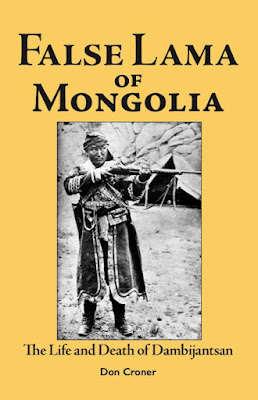
Who was Dambijantsan?

A Buddhist monk; a freedom fighter for Mongolian independence; the descendant of Amursanaa (1723–1757), the Western Mongol who led the last great uprising against the Qing Dynasty of China; the incarnation of Mahakala, the Buddhist god of war; bandit, torturer, murderer, or evil incarnate? During his lifetime no one was sure who he really was, and even today the controversy about his life continues.

Born in what is now the Republic of Kalmykia, part of the Russian Federation, Dambijantsen traveled throughout Tibet, India, and China before arriving in Mongolia in 1890 where he tossed gold coins to bystanders and announced to one and all that he had come to free Mongolia from the yoke of the Qing Dynasty of China. After disappearing almost twenty years he returned to lead the attack on Khovd City, the last Chinese outpost in Mongolia. Honored by the Eighth Bogd Gegeen, the theocratic leader of Mongolia, for his efforts in achieving Mongolian independence, he went on to establish his own mini-state in western Mongolia, which he hoped to use as a base for establishing a Mongol-led Buddhist khanate in Inner Asia. His dictatorial nature and unbridled sadism soon came to the fore and he was finally arrested and imprisoned in Russia. After the Russian Revolution he returned to Mongolia, gathered new followers around him, and established a stronghold at the nexus of old caravan routes in Gansu Province, China. He robbed caravans, grew opium, and once again dreamed of creating a new Mongolian khanate in Inner Asia. Finally the new Bolshevik government in Mongolia, fearful of his rising power, issued orders for his assassination. Dambijantsan died in 1922, but in Mongolia legends persist to this day that his spirit still rides on the wind of the Gobi and continues to haunt his former lairs.


For more on Dambijantsan see False Lama of Mongolia: The Life and Death of Dambijantsan. 


Thursday, January 21, 2010

Mongolia | Life of Dambijantsan

Who was Dambijantsan?

A Buddhist monk; a freedom fighter for Mongolian independence; the descendant of Amursanaa (1723–1757), the Western Mongol who led the last great uprising against the Qing Dynasty of China; the incarnation of Mahakala, the Buddhist god of war; bandit, torturer, murderer, or evil incarnate? During his lifetime no one was sure who he really was, and even today the controversy about his life continues.

Born in what is now the Republic of Kalmykia, part of the Russian Federation, Dambijantsen traveled throughout Tibet, India, and China before arriving in Mongolia in 1890 where he tossed gold coins to bystanders and announced to one and all that he had come to free Mongolia from the yoke of the Qing Dynasty of China. After disappearing almost twenty years he returned to lead the attack on Khovd City, the last Chinese outpost in Mongolia. Honored by the Eighth Bogd Gegeen, the theocratic leader of Mongolia, for his efforts in achieving Mongolian independence, he went on to establish his own mini-state in western Mongolia, which he hoped to use as a base for establishing a Mongol-led Buddhist khanate in Inner Asia. His dictatorial nature and unbridled sadism soon came to the fore and he was finally arrested and imprisoned in Russia. After the Russian Revolution he returned to Mongolia, gathered new followers around him, and established a stronghold at the nexus of old caravan routes in Gansu Province, China. He robbed caravans, grew opium, and once again dreamed of creating a new Mongolian khanate in Inner Asia. Finally the new Bolshevik government in Mongolia, fearful of his rising power, issued orders for his assassination. Dambijantsan died in 1922, but in Mongolia legends persist to this day that his spirit still rides on the wind of the Gobi and continues to haunt his former lairs.


For more on Dambijantsan see False Lama of Mongolia: The Life and Death of Dambijantsan. 


Wednesday, January 20, 2010

Mongolia | Dönön Ükhiin Ever Khöldöne | Killer Winter

The Fourth of the Nine-Nines, known as Dönön Ükhiin Ever Khöldöne—Time When Four Year-Old Cows’ Horns Freeze—began on Monday, January 18. This is supposed to be the coldest of the Nine-Nines, periods of nine days each, each period marked by some description of winter weather. On Monday, however, it was an incredibly balmy 14ºF / Minus 10ºC at three in the afternoon, probably the highest temperature of 2010. This morning things are back to normal:  Minus 33°F / -36 °C at 6:00 a.m.

This is turning out to be a Killer Winter. The UB Post:
Official figures indicate that approximately 90 percent of the country is suffering from zud  conditions, with snowfall reaching between 20-120 centimeters. The average temperature in northern Mongolia has dropped to -35 degrees Celsius, with temperatures in the rest of country ranging between-17 to -22 degrees Celsius. So far, the coldest temperature of -47 degrees was recorded in Uvs Province. As of 16 January 2010, a total of 198 sums in 19 provinces are suffering from severe weather.

According to estimates by the Emergency Management Agency (NEMA), a total of 786,639 heads of livestock have perished, 89 percent of which belong to the ten worst affected provinces. The total loss of livestock is approximately 17 per cent of the estimated 43.6 million heads of livestock in the country. Some five people died during a recent snowstorm.
Xinjiang Province of China, just south of western Mongolia, has also been hammered, According to the NYT:
Closed roads and delayed flights left thousands of travelers stranded Tuesday following blizzards and extreme cold that killed four people and affected 1.6 million others in northwestern China, a government spokesman said. Snowstorms delayed 122 flights in Urumqi, capital of Xinjiang region, on Monday, leaving more than 4,000 passengers stranded, and blocked roads from nine avalanches stranded more than 1,000 passengers in the region, according to a Urumqi government spokesman surnamed Wang. Like many Chinese officials he declined to give his full name. Four people had died because of the bad weather, Wang said Tuesday. He did not give details.Rescue workers were evacuating thousands of rural residents to safer ground at lower altitudes because of the latest storm front, expected to last through Wednesday and plunge temperatures to minus 45 degrees (minus 43 Celsius), Wang said.

In neighboring Mongolia, an official appealed for help from the international community as his country battles the most severe winter it has seen in three decades.
I have several friends in Urumqi but I have not heard from any of them for months, since internet access Remains Cut Off to Xinjiang following the Upheavals there last July. The last I heard all internet cafes were closed and all common email services like hotmail.com were blocked.

Wednesday, January 13, 2010

Mongolia | 3rd of the Nine Nines | Gurvan Ükhrii Ever Khöldönö | Earthquake

The Third of The Nine-Nines began on January 9. Gurvan Ükhrii Ever Khöldönö is the nine-day period of Winter when the horns of three year-old cows freeze. This period is supposed to be colder than the First of the Nine Nines and the Second of the Nine Nines. So far this has not been the case. A couple days ago it was Minus 20ºF / –28ºC at 7:00 a.m. and this morning  Minus 31°F / -35 °C at 7:00 a.m. On January 3rd, during the Second of the Nine Nines, temperatures fell to a marrow-chilling Minus 44ºF / –42ºC. But there is a New Moon in two days, on the 15th, so we can expect colder weather.

On the First Day of the 3rd of the Nine-Nines, January 9, there was  also an earthquake in Mongolia. In Dundgov Aimag the quake measured 5.6 on the Richter Scale. In Ulaan Baatar it measured 3.5. Most people I talked to in Ulaan Baatar itself claimed not to have felt it. In Zaisan Tolgoi I definitely felt it while sitting in my Scriptorium. It was not a sharp jolt-type quake but rather the shaking bowl-full-of-jello variety, lasting six or seven seconds. I was just about to bolt for the door when it finally stopped. A book or two may have wobbled on the shelves.

Earthquakes are not common in Mongolia—at least compared to places like Alaska, for instance, where bars serve a free round after every trembler—but when they do occur they tend to be monsters. The Gobi-Altai Quake, also known as the Ikh Bogd Uul Quake, of December 4, 1957,  was  “one of the world's largest recorded intracontinental earthquakes,”  according to the USGS.

When I visited Ikh Bogd Uul in 1998 I was told by local herdsmen that a day or two prior to the quake marmots which should have been soundly hibernating at that time of the year suddenly emerged from their holes and starting running around in a panic. Then the quake hit.

Ikh Bogd Uul (mountain) in Bayankhongor Aimag. An immense landslide caused by the quake can be seen just right of center. The sheared-off side of the mountain can be seen above the landslide.

Scarp just west of Ikh Bogd Uul created by the 1957 Quake

Saturday, January 9, 2010

Mongolia | Turkey | Zaisan Tolgoi | Istanbul

Here’s a Shocker! Zaisan Tolgoi was not named by the New York Times as one of the  31 Places to Visit in 2010! But Istanbul was! Let’s look at the facts. Zaisan Tolgoi, in addition to being the terminus of bus routes #7, #33, and #12 and hosting a prison,  has a newly opened  restaurant, the Irish Palace (nothing  to do with Ireland; “Irish” is just synonymous with “restaurant” in Mongolia) with its own Coffee Corner and we now have a new mini-shop similar to a 7-11 except that is it only open twelve hours a day! So take that Istanbul, with all your ancient  Mosques and churches, Rococo Hotels, fancy Golden Horns, and whatnot. Don’t get me wrong, I love Istanbul—it is for sure on my list of 10 ten best places on the world—but let’s face it: it is not quite in the same league as Zaisan Tolgoi.

So here is what the ever-increasingly irrelevant and totally out-of-touch New York Times has to say about Istanbul:
19. Istanbul
The reputation of Istanbul’s contemporary art scene has been steadily growing in recent years, with the Web site ArtKnowledgeNews.com recently calling it “one of the most innovative in the world.” That reputation is bound to be burnished even more this year, now that Istanbul has been named the 2010 European Capital of Culture (a designation it shares with Essen, Germany, and Pecs, Hungary). There will be a series of events, gallery shows and stage performances throughout the city to mark the occasion. (A complete list of events can be found at en.istanbul2010.org/index.htm.) But one of the best ways to get a crash course in what Istanbul’s leading artists are up to right now is to spend some time wandering around the Misir Apartments (311/4 Istiklal Cadessi), right on the busy pedestrian thoroughfare that cuts through the trendy Beygolu neighborhood. Inside this elegant, early-20th-century building are some of the city’s most cutting-edge art venues, like Galerist (www.galerist.com.tr) and Gallerie Nev (www.galerinevistanbul.com) Afterward, head to the rooftop terrace and have a drink at 360 Istanbul, a stylish bar and restaurant that offers stunning views of the city’s skyline (360istanbul.com).
I was struck by the last line, because the Last Time I Was in Istanbul  my host Gunj and I did in fact pop by 360 Istanbul for a drink at the rooftop terrace (and when I say we had “a drink” I do not mean this as a euphemism for having twelve or fifteen drinks and then being shown the door by the bouncers; we had one drink each, OK?). In fact, the building is owned by the uncle of one of Gunj’s best friends, with whom we had dinner the night before. Small World! Amazingly enough, the NYT’s description is accurate; the rooftop terrace does indeed offer “stunning views of the city’s skyline.”

But since it mentioned the art scene in Istanbul why did the NYT leave out the Latest Show of Miniatures by Jahongir Ashurov? And why did the NYT fail to point out that George Gurdieff once Lived in An Apartment on Kumbaraci Sokak, not far from 360 Istanbul? Did I mention that the NYT is becoming increasingly irrelevant to say nothing of out-of touch?

Kumbaraci Sokak today
And why, in the name of all that’s Holy, no mention of the Tekke of the Whirling Dervishes, just down the street from 360 Istanbul? The tekke, which is now closed for renovation, has long been Rumored to be a Portal to Shambhala.

The Whirling Dervishes Tekke is supposedly closed for renovation. Or is this just a clever ruse for hiding a Portal to Shambhala?

Thursday, January 7, 2010

Mongolia | Madame Blavatsky | Voice for the 2010s?

Madame Blavatsky is Back in the News:
Fantasist, fabulist, spiritualist, Theosophist and all-round bullshit artist, Madame Blavatsky was as savvy as L. Ron Hubbard and as batty as Anne Heche, circa 2001 . . . The next time you are downward dogging, give a thought to that ballsy broad from the Ukraine. Give her spirit a shout out or two.